Pearson Edexcel · A-Level · Mathematics
Course version: 9MA0 · Version from Mar 2026
Understand and use addition of forces; resultant forces; dynamics for…
Full specification wording
Forces and Newton’s laws: 8.5 Understand and use addition of forces; resultant forces; dynamics for motion in a plane.
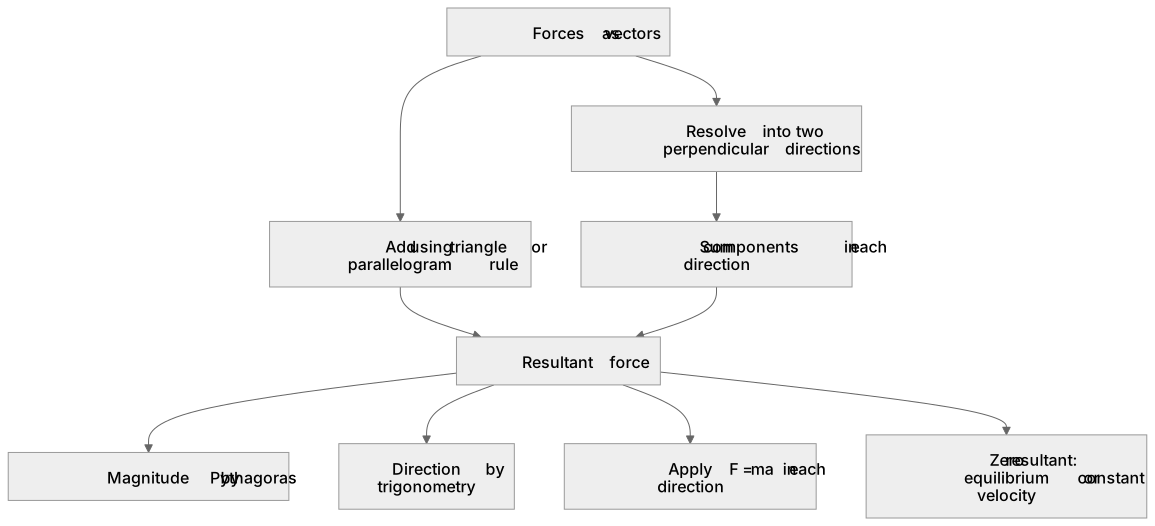
Forces are vectors, so they add by the triangle or parallelogram rule.
Checked against the Pearson Edexcel 9MA0 specification (opens in a new tab) on .
- Point 5 of 6
- 4 key terms
Study notes
From the checked teaching notes for this specification point.
The idea
Forces are vectors, so they add by the triangle or parallelogram rule. The resultant force is the single force that has the same effect as all the original forces combined. For motion in a plane, resolve forces into two perpendicular directions, usually horizontal and vertical or along and perpendicular to the motion. Add components in each direction to find the resultant components, then apply F = ma in each direction. For example, forces of 3 N east and 4 N north give a resultant of 5 N at an angle of arctan(4/3) ≈ 53.1° north of east, since √(3² + 4²) = 5. For a particle of mass 2 kg under this resultant, a = 5 ÷ 2 = 2.5 m s⁻² in the direction of the resultant. When forces balance, the resultant is zero and the particle is in equilibrium or moves with constant velocity. Always state the magnitude and direction of the resultant.
What earns the marks
- Add forces as vectors using components or the triangle/parallelogram rule to find the resultant.
- Resolve forces into two perpendicular directions and sum components to obtain the resultant components.
- Calculate the magnitude of the resultant using Pythagoras and its direction using trigonometry.
- Apply F = ma in each perpendicular direction for motion in a plane.
- Recognise that a zero resultant means equilibrium or constant velocity.
Common mistakes and how to put them right
Adding force magnitudes arithmetically without considering direction.
Put it right by resolving into components or using vector addition.
Forgetting to give the direction of the resultant.
Put it right by calculating the angle relative to a stated axis.
Applying F = ma to individual forces instead of the resultant.
Put it right by finding the resultant first.
Exam tips
- Draw a vector triangle or parallelogram to visualise the addition of forces.
- Show the component sums explicitly before calculating the resultant magnitude and direction.
- State the direction of the resultant clearly, for example as a bearing or angle from a named axis.
Try the lesson
The start of the Forces and Newton’s laws: 8.5 Understand and use addition of forces; resultant forces; dynamics for motion in a plane. lesson, made from checked teaching notes for this specification point.
Have a go first
Two forces of magnitudes 5 N and 12 N act at right angles to each other on a particle. Find the magnitude of the resultant force.
Listen
Forces are vectors, so they add by the triangle or parallelogram rule. The resultant force is the single force that has the same effect as all the original forces combined. For motion in a plane, resolve forces into two perpendicular directions, usually horizontal and vertical or along and perpendicular to the motion. Add components in each direction to find the resultant components, then apply F = ma in each direction. For example, forces of 3 N east and 4 N north give a resultant of 5 N at an angle of arctan(4/3) ≈ 53.1° north of east, since √(3² + 4²) = 5. For a particle of mass 2 kg under this resultant, a = 5 ÷ 2 = 2.5 m s⁻² in the direction of the resultant. When forces balance, the resultant is zero and the particle is in equilibrium or moves with constant velocity. Always state the magnitude and direction of the resultant. A strong answer earns marks for these points. Add forces as vectors using components or the triangle/parallelogram rule to find the resultant. Resolve forces into two perpendicular directions and sum components to obtain the resultant components. Calculate the magnitude of the resultant using Pythagoras and its direction using trigonometry. Apply F = ma in each perpendicular direction for motion in a plane. A common slip: Adding force magnitudes arithmetically without considering direction. Instead, resolving into components or using vector addition. Exam tip: Draw a vector triangle or parallelogram to visualise the addition of forces.
See it
Key words
Say what each word means before you turn the card.
Vector addition of forces
Try answering aloud or in your head before turning the card.
Resultant force
Try answering aloud or in your head before turning the card.
Dynamics in a plane
Try answering aloud or in your head before turning the card.
Equilibrium
Try answering aloud or in your head before turning the card.
See every definition
- Vector addition of forces
- Forces are vectors, so they add by the triangle or parallelogram rule.
- Resultant force
- The single force that has the same effect as all the original forces combined.
- Dynamics in a plane
- Resolving forces into two perpendicular directions, adding components in each direction, then applying F = ma in each direction.
- Equilibrium
- When forces balance, the resultant is zero and the particle is in equilibrium or moves with constant velocity.
Label the diagram
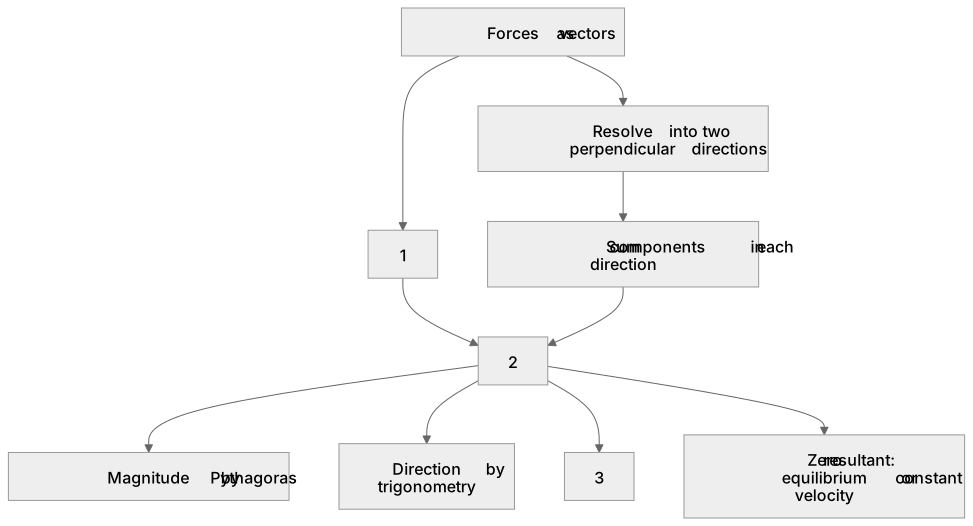
Some boxes have lost their names. Pick the right name for each number.
1Box 1
2Box 2
3Box 3
There is more to this lesson
The full lesson goes on to check your understanding and help you earn the marks. Create a free account to carry on, with your progress saved.
A week of Premium from your first lesson · Then the free plan continues · No card, no charge
Test your understanding of Forces and Newton’s laws: 8.5 Understand and use addition of forces; resultant forces; dynamics for motion in a plane.
Active recall beats re-reading. Take an instant quiz now to test what you’ve learned and lock it into long-term memory.
A week of Premium from your first lesson · Then the free plan continues · No card, no charge