Pearson Edexcel · A-Level · Mathematics
Course version: 9MA0 · Version from Mar 2026
Integration: 8.1 Know and use the Fundamental Theorem of Calculus.
The Fundamental Theorem of Calculus links differentiation and integration as inverse processes.
Checked against the Pearson Edexcel 9MA0 specification (opens in a new tab) on .
- Point 1 of 8
Study notes
From the checked teaching notes for this specification point.
The idea
The Fundamental Theorem of Calculus links differentiation and integration as inverse processes. If F is an antiderivative of f, so F′(x) = f(x), then the definite integral of f from a to b equals F(b) − F(a). This lets you evaluate a definite integral by finding any antiderivative, substituting the upper limit, substituting the lower limit and subtracting. For example, ∫ from 1 to 3 of 2x dx = [x²] from 1 to 3 = 3² − 1² = 9 − 1 = 8. The theorem also shows that differentiating a definite integral with a variable upper limit returns the integrand, so d/dx of ∫ from a to x of f(t) dt = f(x). Use it to connect rates of change with accumulated change.
What earns the marks
- States that differentiation and integration are inverse operations, with F′(x) = f(x) when F is an antiderivative of f.
- Evaluates a definite integral as F(b) − F(a) after finding an antiderivative F.
- Substitutes the upper limit first and the lower limit second, then subtracts in the correct order.
- Applies the theorem to a variable upper limit, recognising that d/dx of ∫ from a to x of f(t) dt = f(x).
- Uses the theorem to interpret a definite integral as the accumulated change in an antiderivative over an interval.
- Handles constants of integration correctly by omitting them in definite evaluation because they cancel in the subtraction.
Common mistakes and how to put them right
Subtracting in the wrong order by doing F(a) − F(b).
Put it right by taking upper limit value minus lower limit value.
Including a constant of integration in a definite integral.
Put it right by omitting it, since it cancels.
Confusing the variable of integration with the limit variable.
Put it right by using a dummy variable such as t inside the integral when the upper limit is x.
Exam tips
- Write the antiderivative in square brackets with the limits attached before substituting.
- Show the substitution of each limit on a separate line so the subtraction order is clear.
- Check by differentiating your antiderivative mentally to confirm it returns the integrand.
Try the lesson
The start of the Integration: 8.1 Know and use the Fundamental Theorem of Calculus. lesson, made from checked teaching notes for this specification point.
Have a go first
Given that F(x) is an antiderivative of the continuous function f(x), write down an expression for the definite integral of f(x) from x = a to x = b in terms of F.
Listen
The Fundamental Theorem of Calculus links differentiation and integration as inverse processes. If F is an antiderivative of f, so F′(x) = f(x), then the definite integral of f from a to b equals F(b) − F(a). This lets you evaluate a definite integral by finding any antiderivative, substituting the upper limit, substituting the lower limit and subtracting. For example, ∫ from 1 to 3 of 2x dx = [x²] from 1 to 3 = 3² − 1² = 9 − 1 = 8. The theorem also shows that differentiating a definite integral with a variable upper limit returns the integrand, so d/dx of ∫ from a to x of f(t) dt = f(x). Use it to connect rates of change with accumulated change. A strong answer earns marks for these points. States that differentiation and integration are inverse operations, with F′(x) = f(x) when F is an antiderivative of f. Evaluates a definite integral as F(b) − F(a) after finding an antiderivative F. Substitutes the upper limit first and the lower limit second, then subtracts in the correct order. Applies the theorem to a variable upper limit, recognising that d/dx of ∫ from a to x of f(t) dt = f(x). A common slip: Subtracting in the wrong order by doing F(a) − F(b). Instead, taking upper limit value minus lower limit value. Exam tip: Write the antiderivative in square brackets with the limits attached before substituting.
See it
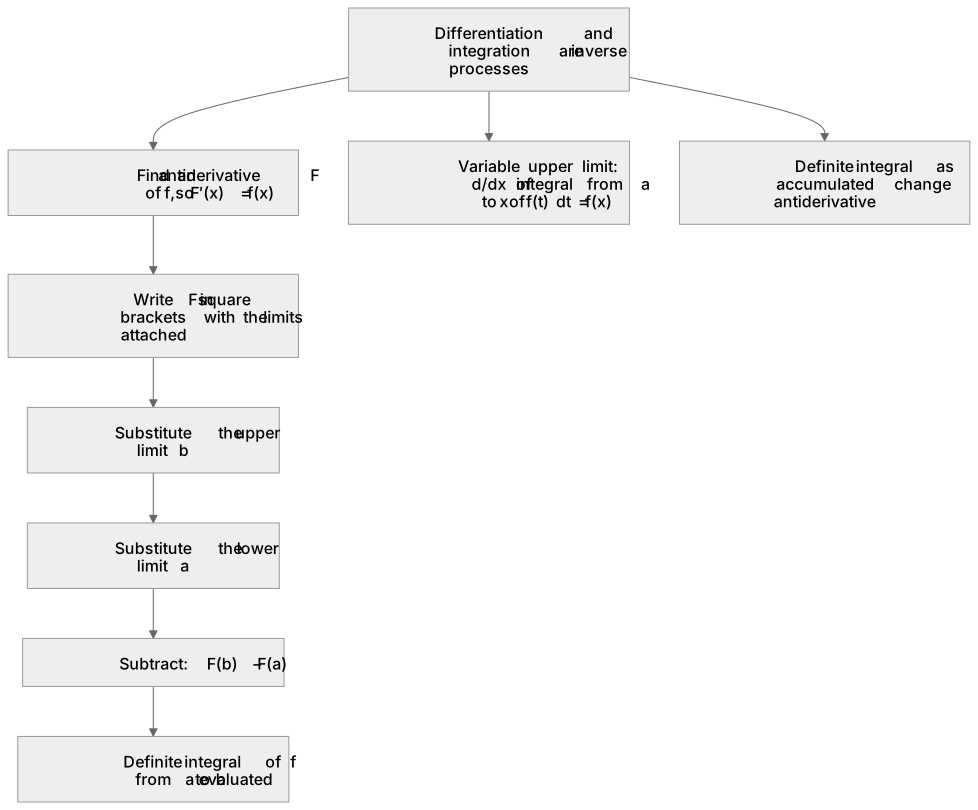
Label the diagram
Some boxes have lost their names. Pick the right name for each number.
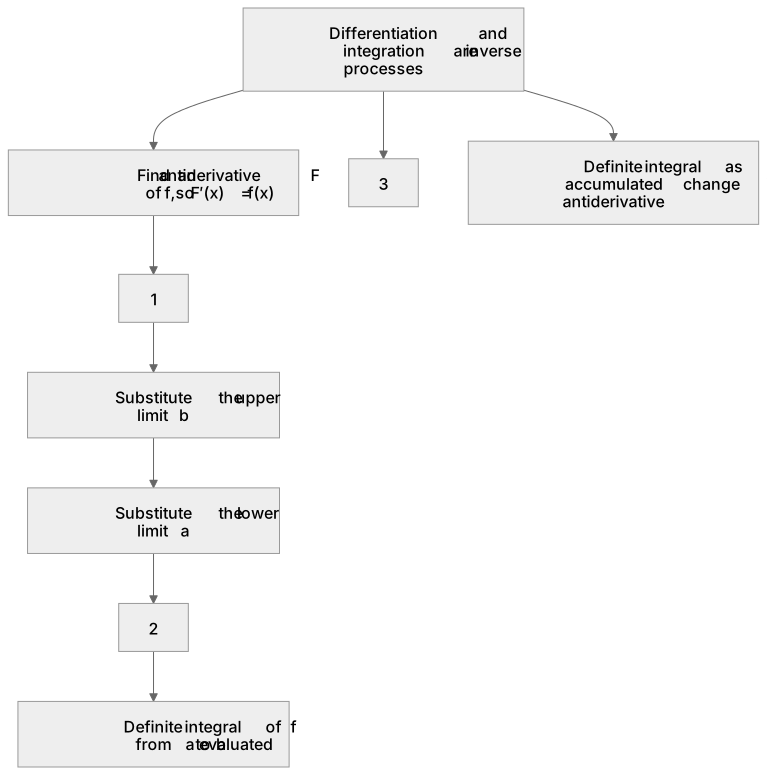
1Box 1
2Box 2
3Box 3
There is more to this lesson
The full lesson goes on to check your understanding and help you earn the marks. Create a free account to carry on, with your progress saved.
A week of Premium from your first lesson · Then the free plan continues · No card, no charge
Test your understanding of Integration: 8.1 Know and use the Fundamental Theorem of Calculus.
Active recall beats re-reading. Take an instant quiz now to test what you’ve learned and lock it into long-term memory.
A week of Premium from your first lesson · Then the free plan continues · No card, no charge