Pearson Edexcel · A-Level · Mathematics
Course version: 9MA0 · Version from Mar 2026
Integrate xⁿ (excluding n = −1) and related sums, differences and constant…
Full specification wording
Integration: 8.2 Integrate xⁿ (excluding n = −1) and related sums, differences and constant multiples. Integrate e^(kx), 1/x, sin kx, cos kx and related sums, differences and constant multiples.
Standard integration reverses standard differentiation.
Checked against the Pearson Edexcel 9MA0 specification (opens in a new tab) on .
- Point 2 of 8
- 3 key terms
Study notes
From the checked teaching notes for this specification point.
The idea
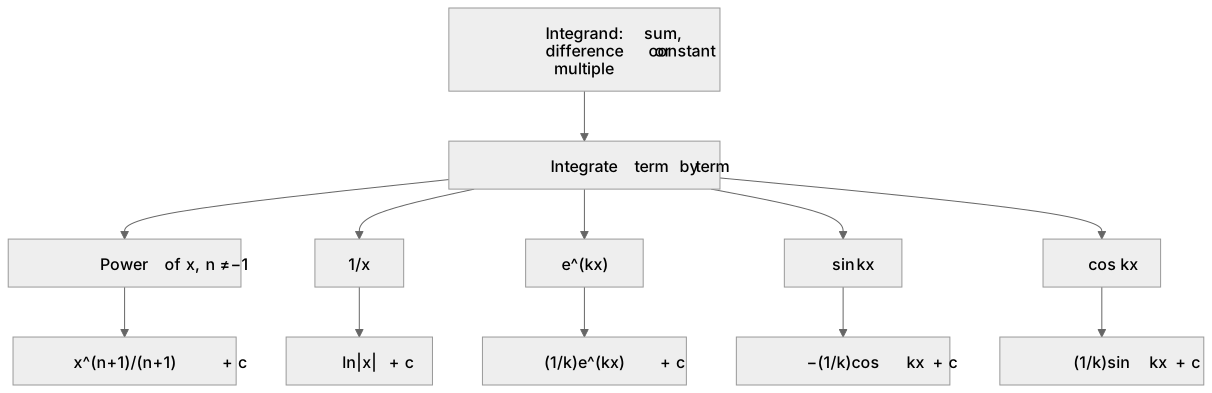
Standard integration reverses standard differentiation. For powers, ∫ xⁿ dx = x^(n+1)/(n+1) + c, valid for all n except n = −1; for example ∫ x³ dx = x⁴/4 + c. The exceptional case is ∫ 1/x dx = ln|x| + c, where the modulus keeps the logarithm defined for negative x. Exponential functions integrate to themselves with a scale factor: ∫ e^(kx) dx = (1/k)e^(kx) + c. Trigonometric functions give ∫ sin kx dx = −(1/k)cos kx + c and ∫ cos kx dx = (1/k)sin kx + c. Sums, differences and constant multiples are integrated term by term, so ∫ (3x² − 2 sin 2x + 5/x) dx = x³ + cos 2x + 5 ln|x| + c.
What earns the marks
- Applies the power rule ∫ xⁿ dx = x^(n+1)/(n+1) + c correctly for positive, negative and fractional n except n = −1.
- Recognises the exceptional case and integrates 1/x as ln|x| + c rather than using the power rule.
- Integrates e^(kx) as (1/k)e^(kx) + c, including the reciprocal scale factor.
- Integrates sin kx as −(1/k)cos kx + c and cos kx as (1/k)sin kx + c with correct signs.
- Integrates sums, differences and constant multiples term by term, carrying the constant of integration c.
- Simplifies coefficients and exponents correctly, for example writing x^(5/2)/(5/2) as (2/5)x^(5/2).
Common mistakes and how to put them right
Applying the power rule to 1/x and obtaining x⁰/0.
Put it right by using ln|x| + c instead.
Forgetting the reciprocal factor when integrating e^(kx) or trigonometric functions.
Put it right by dividing by k.
Omitting the constant of integration in an indefinite integral.
Put it right by adding c to every indefinite result.
Exam tips
- Write each term on its own line before combining, so signs and coefficients are easy to check.
- Differentiate your answer mentally to confirm it returns the original integrand.
- Remember the modulus in ln|x| and the constant c in every indefinite integral.
Try the lesson
The start of the Integration: 8.2 Integrate xⁿ (excluding n = −1) and related sums, differences and constant multiples. Integrate e^(kx), 1/x, sin kx, cos kx and related sums, differences and constant multiples. lesson, made from checked teaching notes for this specification point.
Have a go first
Find the indefinite integral of x⁵ with respect to x.
Listen
Standard integration reverses standard differentiation. For powers, ∫ xⁿ dx = x^(n+1)/(n+1) + c, valid for all n except n = −1; for example ∫ x³ dx = x⁴/4 + c. The exceptional case is ∫ 1/x dx = ln|x| + c, where the modulus keeps the logarithm defined for negative x. Exponential functions integrate to themselves with a scale factor: ∫ e^(kx) dx = (1/k)e^(kx) + c. Trigonometric functions give ∫ sin kx dx = −(1/k)cos kx + c and ∫ cos kx dx = (1/k)sin kx + c. Sums, differences and constant multiples are integrated term by term, so ∫ (3x² − 2 sin 2x + 5/x) dx = x³ + cos 2x + 5 ln|x| + c. A strong answer earns marks for these points. Applies the power rule ∫ xⁿ dx = x^(n+1)/(n+1) + c correctly for positive, negative and fractional n except n = −1. Recognises the exceptional case and integrates 1/x as ln|x| + c rather than using the power rule. Integrates e^(kx) as (1/k)e^(kx) + c, including the reciprocal scale factor. Integrates sin kx as −(1/k)cos kx + c and cos kx as (1/k)sin kx + c with correct signs. A common slip: Applying the power rule to 1/x and obtaining x⁰/0. Instead, using ln|x| + c instead. Exam tip: Write each term on its own line before combining, so signs and coefficients are easy to check.
See it
Key words
Say what each word means before you turn the card.
Standard integrals as inverses of derivatives
Try answering aloud or in your head before turning the card.
The exceptional case of 1/x
Try answering aloud or in your head before turning the card.
Term-by-term integration of sums and differences
Try answering aloud or in your head before turning the card.
See every definition
- Standard integrals as inverses of derivatives
- Standard integration reverses standard differentiation, so powers, exponentials and trigonometric functions integrate back to related standard forms.
- The exceptional case of 1/x
- The power rule is valid for all n except n = −1, where 1/x integrates as ln|x| + c instead.
- Term-by-term integration of sums and differences
- Sums, differences and constant multiples are integrated term by term, carrying the constant of integration c.
Label the diagram
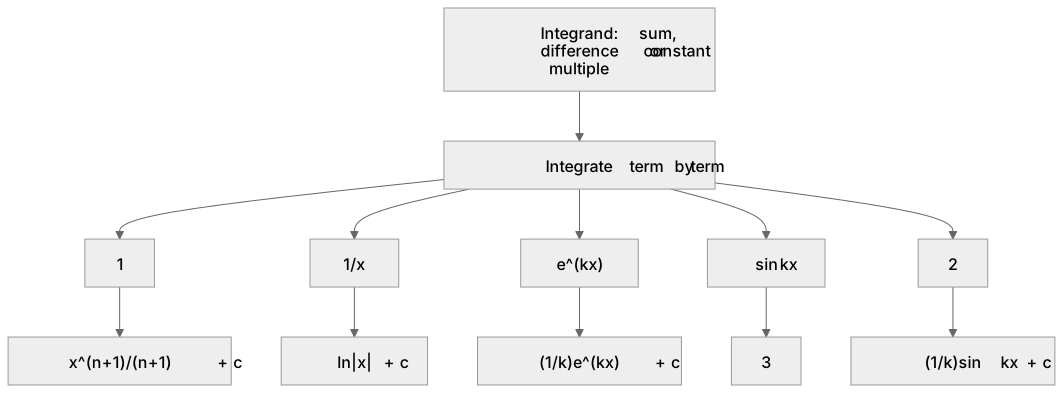
Some boxes have lost their names. Pick the right name for each number.
1Box 1
2Box 2
3Box 3
There is more to this lesson
The full lesson goes on to check your understanding and help you earn the marks. Create a free account to carry on, with your progress saved.
A week of Premium from your first lesson · Then the free plan continues · No card, no charge
Test your understanding of Integration: 8.2 Integrate xⁿ (excluding n = −1) and related sums, differences and constant multiples. Integrate e^(kx), 1/x, sin kx, cos kx and related sums, differences and constant multiples.
Active recall beats re-reading. Take an instant quiz now to test what you’ve learned and lock it into long-term memory.
A week of Premium from your first lesson · Then the free plan continues · No card, no charge