Pearson Edexcel · A-Level · Mathematics
Course version: 9MA0 · Version from Mar 2026
Carry out simple cases of integration by substitution and integration by…
Full specification wording
Integration: 8.5 Carry out simple cases of integration by substitution and integration by parts; understand these methods as the inverse processes of the chain and product rules respectively (Integration by substitution includes finding a suitable substitution and is limited to cases where one substitution will lead to a function which can be integrated; integration by parts includes more than one application of the method but excludes reduction formulae).
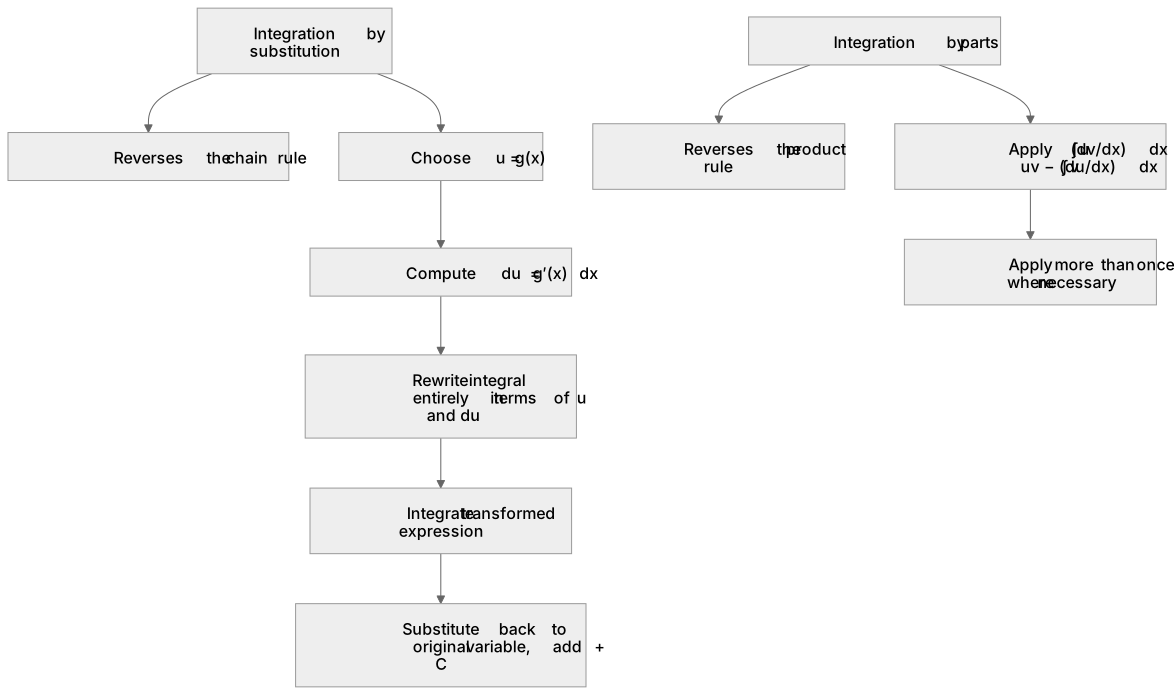
Integration by substitution reverses the chain rule: choose u = g(x), so du = g′(x) dx, and rewrite ∫ f(g(x))g′(x) dx as ∫ f(u) du.
Checked against the Pearson Edexcel 9MA0 specification (opens in a new tab) on .
- Point 5 of 8
- 3 key terms
Study notes
From the checked teaching notes for this specification point.
The idea
Integration by substitution reverses the chain rule: choose u = g(x), so du = g′(x) dx, and rewrite ∫ f(g(x))g′(x) dx as ∫ f(u) du. For example, ∫ 2x cos(x²) dx uses u = x², du = 2x dx, giving ∫ cos u du = sin u + C = sin(x²) + C. Integration by parts reverses the product rule: ∫ u dv = uv − ∫ v du, often written ∫ u (dv/dx) dx = uv − ∫ v (du/dx) dx. For example, ∫ x eˣ dx with u = x and dv = eˣ dx gives x eˣ − ∫ eˣ dx = x eˣ − eˣ + C. Some integrals need more than one application, such as ∫ x² eˣ dx, but reduction formulae are excluded. Substitution is limited to cases where one substitution produces an integrable function.
What earns the marks
- For substitution, selects a suitable u = g(x), computes du = g′(x) dx, and rewrites the integral entirely in terms of u and du.
- For substitution, integrates the transformed expression and substitutes back to the original variable, including the constant of integration for indefinite integrals.
- For definite integrals by substitution, changes the limits to u-values or substitutes back before evaluating at the original limits.
- For integration by parts, applies the formula ∫ u (dv/dx) dx = uv − ∫ v (du/dx) dx, choosing u and dv/dx appropriately.
- For integration by parts, applies the method more than once where necessary, for example for ∫ x² eˣ dx, without using reduction formulae.
- Explains that substitution reverses the chain rule and integration by parts reverses the product rule.
Common mistakes and how to put them right
Forgetting to replace dx with du in a substitution.
Put it right by computing du = g′(x) dx and substituting both the integrand and the differential.
Choosing u and dv/dx poorly in integration by parts, leading to a more complicated integral.
Put it right by choosing u to simplify on differentiation and dv/dx to be integrable.
Omitting the constant of integration for indefinite integrals.
Put it right by adding + C after integrating.
For definite integrals by substitution, failing to change the limits.
Put it right by converting the limits to u-values or by substituting back before evaluating.
Attempting a reduction formula when the specification excludes it.
Put it right by applying integration by parts repeatedly for the required number of steps.
Exam tips
- For substitution, state u and du clearly, then show the integral fully in terms of u before integrating.
- For integration by parts, write down u, dv/dx, du/dx and v in a small table to avoid sign and substitution errors.
- If an integral requires more than one application of integration by parts, show each stage clearly and simplify between stages.
- Check whether a substitution is suitable by confirming that the derivative of the chosen u appears in the integrand, up to a constant factor.
Try the lesson
The start of the Integration: 8.5 Carry out simple cases of integration by substitution and integration by parts; understand these methods as the inverse processes of the chain and product rules respectively (Integration by substitution includes finding a suitable substitution and is limited to cases where one substitution will lead to a function which can be integrated; integration by parts includes more than one application of the method but excludes reduction formulae). lesson, made from checked teaching notes for this specification point.
Have a go first
Using the substitution u = x² + 1, evaluate the integral of 2x(x² + 1)³ with respect to x.
Listen
Integration by substitution reverses the chain rule: choose u = g(x), so du = g′(x) dx, and rewrite ∫ f(g(x))g′(x) dx as ∫ f(u) du. For example, ∫ 2x cos(x²) dx uses u = x², du = 2x dx, giving ∫ cos u du = sin u + C = sin(x²) + C. Integration by parts reverses the product rule: ∫ u dv = uv − ∫ v du, often written ∫ u (dv/dx) dx = uv − ∫ v (du/dx) dx. For example, ∫ x eˣ dx with u = x and dv = eˣ dx gives x eˣ − ∫ eˣ dx = x eˣ − eˣ + C. Some integrals need more than one application, such as ∫ x² eˣ dx, but reduction formulae are excluded. Substitution is limited to cases where one substitution produces an integrable function. A strong answer earns marks for these points. For substitution, selects a suitable u = g(x), computes du = g′(x) dx, and rewrites the integral entirely in terms of u and du. For substitution, integrates the transformed expression and substitutes back to the original variable, including the constant of integration for indefinite integrals. For definite integrals by substitution, changes the limits to u-values or substitutes back before evaluating at the original limits. For integration by parts, applies the formula ∫ u (dv/dx) dx = uv − ∫ v (du/dx) dx, choosing u and dv/dx appropriately. A common slip: Forgetting to replace dx with du in a substitution. Instead, computing du = g′(x) dx and substituting both the integrand and the differential. Exam tip: For substitution, state u and du clearly, then show the integral fully in terms of u before integrating.
See it
Key words
Say what each word means before you turn the card.
Integration by substitution
Try answering aloud or in your head before turning the card.
Integration by parts
Try answering aloud or in your head before turning the card.
Repeated integration by parts
Try answering aloud or in your head before turning the card.
See every definition
- Integration by substitution
- Reverses the chain rule by choosing u = g(x), so du = g′(x) dx, and rewriting the integral in terms of u and du.
- Integration by parts
- Reverses the product rule using ∫ u (dv/dx) dx = uv − ∫ v (du/dx) dx, and may need more than one application.
- Repeated integration by parts
- Applying the method more than once where necessary, for example for ∫ x² eˣ dx, but reduction formulae are excluded.
Label the diagram
Some boxes have lost their names. Pick the right name for each number.
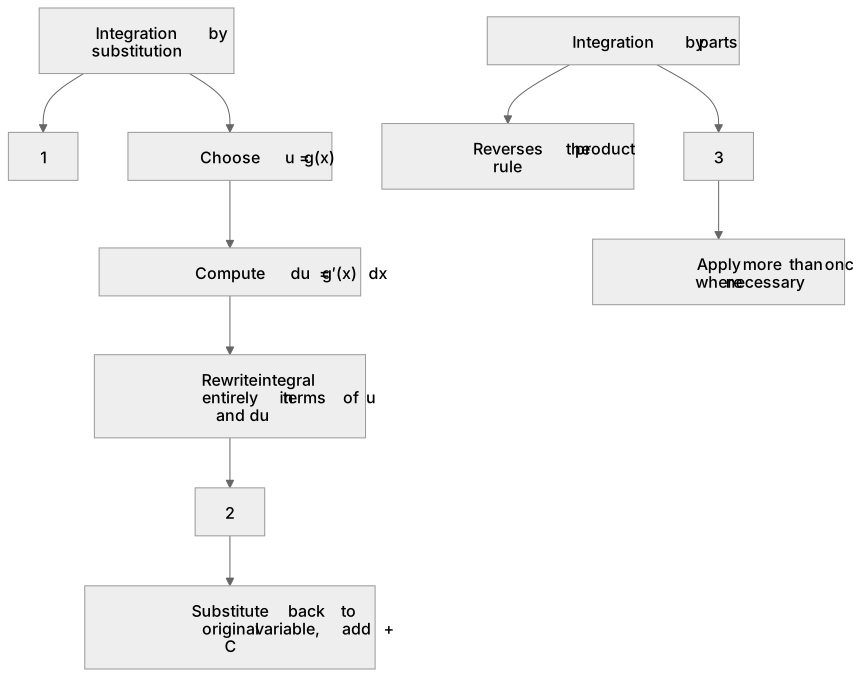
1Box 1
2Box 2
3Box 3
There is more to this lesson
The full lesson goes on to check your understanding and help you earn the marks. Create a free account to carry on, with your progress saved.
A week of Premium from your first lesson · Then the free plan continues · No card, no charge
Test your understanding of Integration: 8.5 Carry out simple cases of integration by substitution and integration by parts; understand these methods as the inverse processes of the chain and product rules respectively (Integration by substitution includes finding a suitable substitution and is limited to cases where one substitution will lead to a function which can be integrated; integration by parts includes more than one application of the method but excludes reduction formulae).
Active recall beats re-reading. Take an instant quiz now to test what you’ve learned and lock it into long-term memory.
A week of Premium from your first lesson · Then the free plan continues · No card, no charge