Pearson Edexcel · A-Level · Mathematics
Course version: 9MA0 · Version from Mar 2026
Integrate using partial fractions that are linear in the denominator.
Full specification wording
Integration: 8.6 Integrate using partial fractions that are linear in the denominator.
Integrating using partial fractions with linear denominators means decomposing a rational function into simpler fractions whose denominators are linear factors, then integrating each term.
Checked against the Pearson Edexcel 9MA0 specification (opens in a new tab) on .
- Point 6 of 8
Study notes
From the checked teaching notes for this specification point.
The idea
Integrating using partial fractions with linear denominators means decomposing a rational function into simpler fractions whose denominators are linear factors, then integrating each term. For example, (3x + 2)/((x + 1)(x + 2)) can be written as A/(x + 1) + B/(x + 2). Multiplying out gives 3x + 2 = A(x + 2) + B(x + 1). Setting x = −1 gives A = −1; setting x = −2 gives B = 4. So the integral is ∫ (−1/(x + 1) + 4/(x + 2)) dx = −ln|x + 1| + 4 ln|x + 2| + C. The method applies when the denominator factors into distinct linear factors; repeated or quadratic factors are not required by this statement. The absolute value is needed because ln is defined only for positive arguments.
What earns the marks
- Factorises the denominator into linear factors and sets up the correct partial fraction form with unknown constants.
- Determines the constants by substituting suitable values of x or by comparing coefficients.
- Integrates each term of the form A/(ax + b) as (A/a) ln|ax + b| + C, including the constant of integration for indefinite integrals.
- Handles definite integrals by evaluating the antiderivative at the limits after finding the partial fractions.
- Uses the absolute value inside the logarithm to keep the argument positive where necessary.
Common mistakes and how to put them right
Omitting the absolute value in ln|ax + b|.
Put it right by writing ln|ax + b| because the logarithm requires a positive argument.
Forgetting to divide by the coefficient of x when integrating A/(ax + b).
Put it right by writing (A/a) ln|ax + b| + C.
Setting up an incorrect partial fraction form for repeated linear factors.
Put it right by using separate terms for each power, such as A/(x + 1) + B/(x + 1)², when the denominator has a repeated factor.
Making sign errors when solving for the constants.
Put it right by substituting values carefully and checking by expanding.
Exam tips
- Always factorise the denominator completely before writing the partial fraction form.
- Use substitution of convenient x-values to find constants quickly, but check by comparing coefficients if unsure.
- For definite integrals, either integrate first and then substitute the limits, or change limits if using a substitution; do not mix the two.
- Write the final answer with ln|ax + b| and include + C for indefinite integrals.
Try the lesson
The start of the Integration: 8.6 Integrate using partial fractions that are linear in the denominator. lesson, made from checked teaching notes for this specification point.
Have a go first
Express 1/((x + 1)(x + 2)) in partial fractions and hence find its integral with respect to x.
Listen
Integrating using partial fractions with linear denominators means decomposing a rational function into simpler fractions whose denominators are linear factors, then integrating each term. For example, (3x + 2)/((x + 1)(x + 2)) can be written as A/(x + 1) + B/(x + 2). Multiplying out gives 3x + 2 = A(x + 2) + B(x + 1). Setting x = −1 gives A = −1; setting x = −2 gives B = 4. So the integral is ∫ (−1/(x + 1) + 4/(x + 2)) dx = −ln|x + 1| + 4 ln|x + 2| + C. The method applies when the denominator factors into distinct linear factors; repeated or quadratic factors are not required by this statement. The absolute value is needed because ln is defined only for positive arguments. A strong answer earns marks for these points. Factorises the denominator into linear factors and sets up the correct partial fraction form with unknown constants. Determines the constants by substituting suitable values of x or by comparing coefficients. Integrates each term of the form A/(ax + b) as (A/a) ln|ax + b| + C, including the constant of integration for indefinite integrals. Handles definite integrals by evaluating the antiderivative at the limits after finding the partial fractions. A common slip: Omitting the absolute value in ln|ax + b|. Instead, writing ln|ax + b| because the logarithm requires a positive argument. Exam tip: Always factorise the denominator completely before writing the partial fraction form.
See it
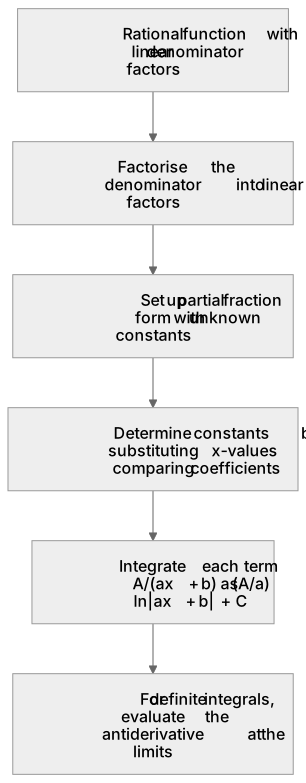
Put it in order
Put these steps in the order they happen.
- 1. Set up partial fraction form with unknown constants
- 2. Factorise the denominator into linear factors
- 3. Rational function with linear denominator factors
- 4. For definite integrals, evaluate the antiderivative at the limits
- 5. Integrate each term A/(ax + b) as (A/a) ln|ax + b| + C
- 6. Determine constants by substituting x-values or comparing coefficients
Label the diagram
Some boxes have lost their names. Pick the right name for each number.
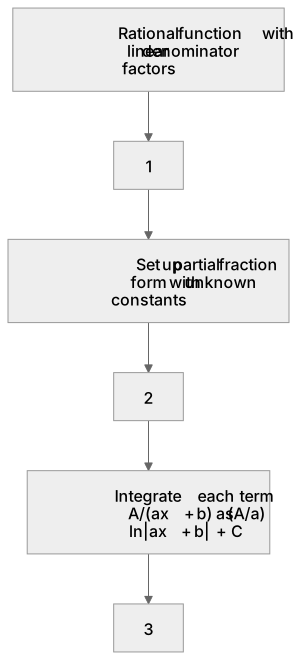
1Box 1
2Box 2
3Box 3
There is more to this lesson
The full lesson goes on to check your understanding and help you earn the marks. Create a free account to carry on, with your progress saved.
A week of Premium from your first lesson · Then the free plan continues · No card, no charge
Test your understanding of Integration: 8.6 Integrate using partial fractions that are linear in the denominator.
Active recall beats re-reading. Take an instant quiz now to test what you’ve learned and lock it into long-term memory.
A week of Premium from your first lesson · Then the free plan continues · No card, no charge