Pearson Edexcel · A-Level · Mathematics
Course version: 9MA0 · Version from Mar 2026
Numerical methods: 9.5 Use numerical methods to solve problems in context.
Numerical methods solve equations and estimate quantities when exact algebra is impractical.
Checked against the Pearson Edexcel 9MA0 specification (opens in a new tab) on .
- Point 5 of 5
- 4 key terms
Study notes
From the checked teaching notes for this specification point.
The idea
Numerical methods solve equations and estimate quantities when exact algebra is impractical. In context, you translate a real situation into a mathematical model, choose a suitable method such as sign-change location, iteration, Newton–Raphson or the trapezium rule, and interpret the output with correct units. For example, a population model P(t) = 200e^(0.3t) − 50t may require solving P(t) = 500; evaluating P at successive integer t values to locate a sign change gives an interval containing the root, and further iteration refines it. You must justify convergence, state accuracy to the required degree, and relate the numerical answer back to the original problem, checking that it is physically sensible.
What earns the marks
- Formulates a contextual problem as an equation, function or integral and selects an appropriate numerical method for the required accuracy.
- Uses sign changes, iteration or Newton–Raphson correctly, showing successive values and demonstrating that the sequence converges to the required root.
- Carries out the trapezium rule or other numerical integration in context, choosing a sensible strip width and interpreting the result with correct units.
- Interprets the numerical solution in the original context, states the accuracy achieved and comments on whether the answer is reasonable.
Common mistakes and how to put them right
Stopping at the first sign change without refining to the required accuracy.
Put it right by continuing the iteration or narrowing the interval until the specified tolerance is met.
Using an iteration that diverges because the starting value is unsuitable.
Put it right by choosing a start near the root or checking that successive values approach a limit.
Giving a numerical answer without units or contextual meaning.
Put it right by restating what the number represents, such as time in years or cost in pounds.
Exam tips
- Show each iteration or evaluation to the required number of decimal places so the examiner can follow the convergence.
- State the interval or tolerance explicitly when locating a root, for example that the root lies between two consecutive values.
- Finish with a sentence interpreting the result in the context of the question, including units and any sensible rounding.
Try the lesson
The start of the Numerical methods: 9.5 Use numerical methods to solve problems in context. lesson, made from checked teaching notes for this specification point.
Have a go first
The temperature T °C of a chemical reaction t minutes after it begins is modelled by T = 20 + 5t - \ln(t+1). The time when the temperature reaches 30 °C is found by solving 5t - \ln(t+1) - 10 = 0. The iterative formula t_{n+1} = 2 + 0.2\ln(t_n+1) is used. Starting with t_0 = 2, find the value of t_2 to four decimal places.
Listen
Numerical methods solve equations and estimate quantities when exact algebra is impractical. In context, you translate a real situation into a mathematical model, choose a suitable method such as sign-change location, iteration, Newton–Raphson or the trapezium rule, and interpret the output with correct units. For example, a population model P(t) = 200e^(0.3t) − 50t may require solving P(t) = 500; evaluating P at successive integer t values to locate a sign change gives an interval containing the root, and further iteration refines it. You must justify convergence, state accuracy to the required degree, and relate the numerical answer back to the original problem, checking that it is physically sensible. A strong answer earns marks for these points. Formulates a contextual problem as an equation, function or integral and selects an appropriate numerical method for the required accuracy. Uses sign changes, iteration or Newton–Raphson correctly, showing successive values and demonstrating that the sequence converges to the required root. Carries out the trapezium rule or other numerical integration in context, choosing a sensible strip width and interpreting the result with correct units. Interprets the numerical solution in the original context, states the accuracy achieved and comments on whether the answer is reasonable. A common slip: Stopping at the first sign change without refining to the required accuracy. Instead, continuing the iteration or narrowing the interval until the specified tolerance is met. Exam tip: Show each iteration or evaluation to the required number of decimal places so the examiner can follow the convergence.
See it
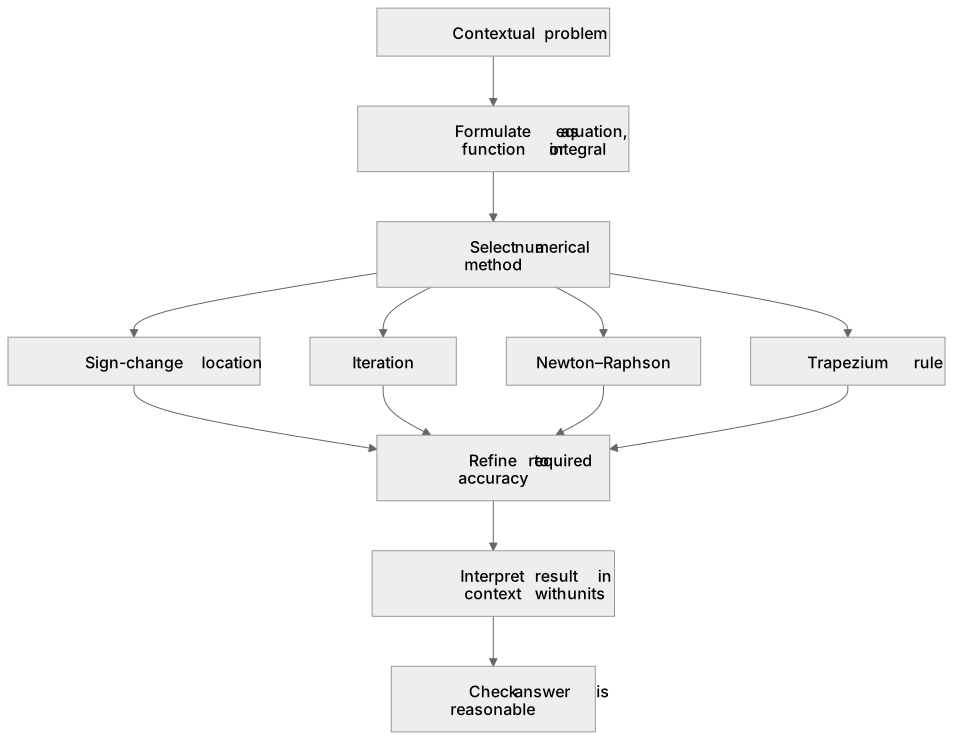
Key words
Say what each word means before you turn the card.
Sign-change location
Try answering aloud or in your head before turning the card.
Iteration
Try answering aloud or in your head before turning the card.
Convergence
Try answering aloud or in your head before turning the card.
Tolerance
Try answering aloud or in your head before turning the card.
See every definition
- Sign-change location
- Evaluating a function at successive values to locate a sign change, giving an interval containing the root.
- Iteration
- A numerical method that refines a solution, showing successive values and demonstrating that the sequence converges to the required root.
- Convergence
- The property that successive values approach a limit, which must be justified and checked by choosing a start near the root.
- Tolerance
- The specified accuracy to which an interval is narrowed or an iteration continued until the required degree is met.
Label the diagram
Some boxes have lost their names. Pick the right name for each number.
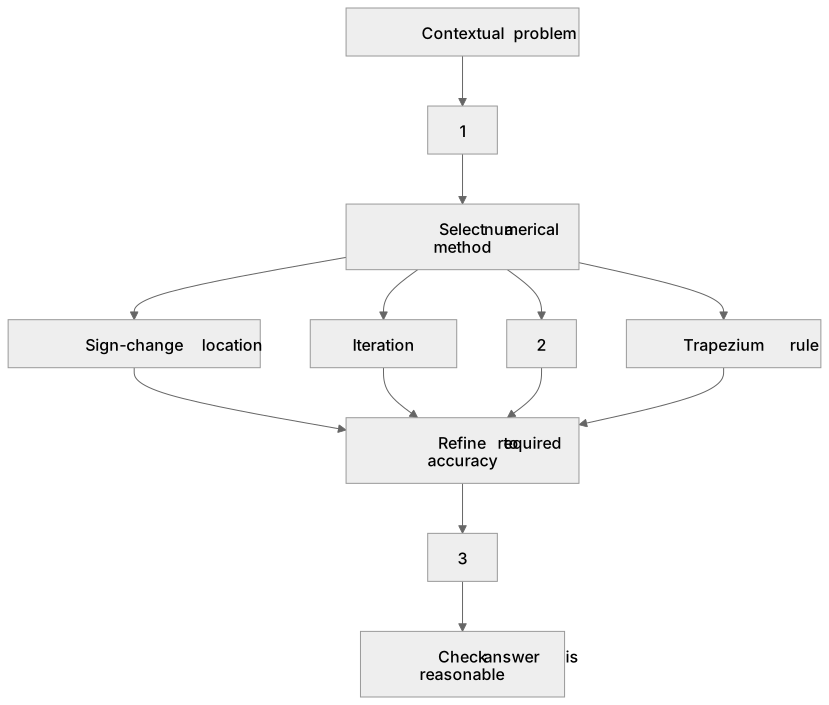
1Box 1
2Box 2
3Box 3
There is more to this lesson
The full lesson goes on to check your understanding and help you earn the marks. Create a free account to carry on, with your progress saved.
A week of Premium from your first lesson · Then the free plan continues · No card, no charge
Test your understanding of Numerical methods: 9.5 Use numerical methods to solve problems in context.
Active recall beats re-reading. Take an instant quiz now to test what you’ve learned and lock it into long-term memory.
A week of Premium from your first lesson · Then the free plan continues · No card, no charge