Pearson Edexcel · A-Level · Mathematics
Course version: 9MA0 · Version from Mar 2026
Mathematical argument, language and proof: Understand and use language and…
Full specification wording
Overarching theme 1: Mathematical argument, language and proof: Understand and use language and symbols associated with set theory, as set out in the content. Apply to solutions of inequalities and probability.
Set theory provides a rigorous framework for defining collections of objects, which is crucial for expressing solutions to inequalities and calculating probabilities.
Checked against the Pearson Edexcel 9MA0 specification (opens in a new tab) on .
- Point 3 of 5
- 3 key terms
Study notes
From the checked teaching notes for this specification point.
The idea
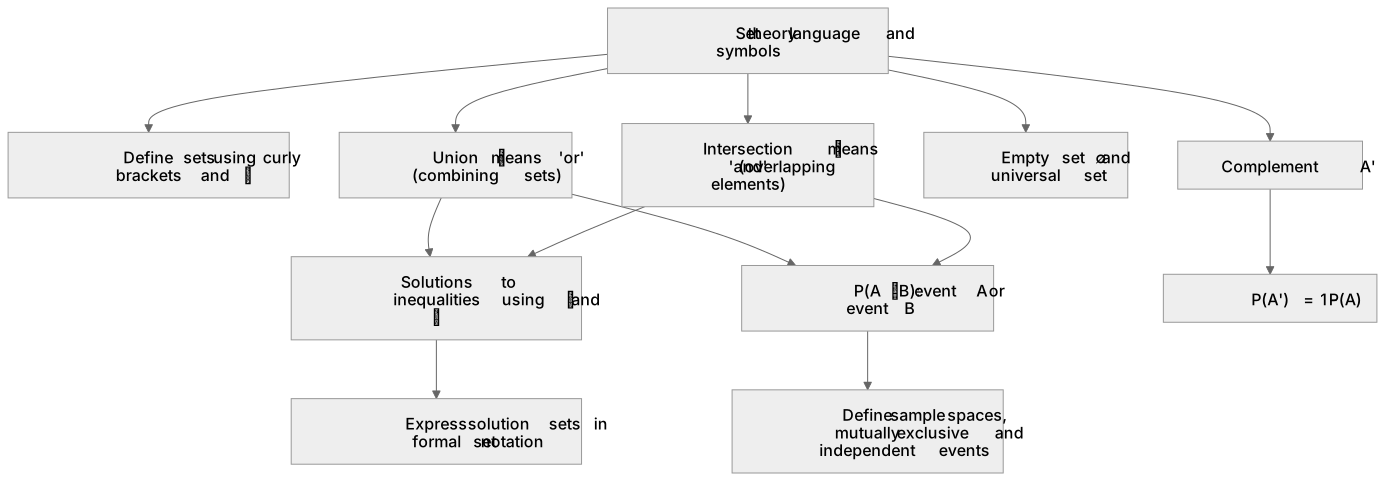
Set theory provides a rigorous framework for defining collections of objects, which is crucial for expressing solutions to inequalities and calculating probabilities. You must understand and use symbols such as ∈ (is an element of), ∪ (union), ∩ (intersection), ∅ (empty set), and the universal set. When solving inequalities, express the solution set using formal notation, for example, {x : x > 2} ∪ {x : x < -1}. In probability, set notation describes events and their relationships; P(A ∪ B) represents the probability of event A or event B occurring, while P(A ∩ B) denotes both occurring. Mastering this language allows you to define sample spaces, mutually exclusive events, and independent events with mathematical precision.
What earns the marks
- Use correct set notation to define sets, including the use of curly brackets and the element symbol (∈).
- Express the solutions to linear and quadratic inequalities using formal set notation, correctly applying union (∪) and intersection (∩) symbols.
- Apply set theory symbols to define events in probability, calculating probabilities for unions and intersections of sets.
- Interpret Venn diagrams using set notation to identify specific regions, such as the complement of a set (A').
Common mistakes and how to put them right
Confusing the union (∪) and intersection (∩) symbols.
Put it right: Union means 'or' (combining sets) and intersection means 'and' (overlapping elements).
Writing inequality solutions incorrectly by combining disjoint sets into a single continuous inequality.
Put it right: Use the union symbol (∪) to join separate solution intervals.
Misinterpreting the complement of a set in probability.
Put it right: P(A') refers to the probability of event A not happening, which is 1 - P(A), rather than an unrelated event.
Exam tips
- When asked for the solution to a quadratic inequality, sketch a quick graph and use set notation with the union symbol for disjoint regions.
- In probability questions, draw a Venn diagram to visualise the sets before calculating P(A ∪ B) or P(A ∩ B).
- Ensure you use curly brackets { } when defining a set of values, as standard parentheses ( ) denote coordinates or open intervals.
Try the lesson
The start of the Overarching theme 1: Mathematical argument, language and proof: Understand and use language and symbols associated with set theory, as set out in the content. Apply to solutions of inequalities and probability. lesson, made from checked teaching notes for this specification point.
Have a go first
The sets A and B are defined by A = {1, 2, 3, 4} and B = {3, 4, 5}. Which set represents A ∩ B?
Listen
Set theory provides a rigorous framework for defining collections of objects, which is crucial for expressing solutions to inequalities and calculating probabilities. You must understand and use symbols such as ∈ (is an element of), ∪ (union), ∩ (intersection), ∅ (empty set), and the universal set. When solving inequalities, express the solution set using formal notation, for example, {x : x > 2} ∪ {x : x < -1}. In probability, set notation describes events and their relationships; P(A ∪ B) represents the probability of event A or event B occurring, while P(A ∩ B) denotes both occurring. Mastering this language allows you to define sample spaces, mutually exclusive events, and independent events with mathematical precision. A strong answer earns marks for these points. Use correct set notation to define sets, including the use of curly brackets and the element symbol (∈). Express the solutions to linear and quadratic inequalities using formal set notation, correctly applying union (∪) and intersection (∩) symbols. Apply set theory symbols to define events in probability, calculating probabilities for unions and intersections of sets. Interpret Venn diagrams using set notation to identify specific regions, such as the complement of a set (A'). Exam tip: When asked for the solution to a quadratic inequality, sketch a quick graph and use set notation with the union symbol for disjoint regions.
See it
Key words
Say what each word means before you turn the card.
Set notation
Try answering aloud or in your head before turning the card.
Union (∪)
Try answering aloud or in your head before turning the card.
Intersection (∩)
Try answering aloud or in your head before turning the card.
See every definition
- Set notation
- Formal language and symbols used to define collections of objects, including curly brackets and the element symbol (∈).
- Union (∪)
- Combining sets, meaning 'or', used to join separate solution intervals and to represent the probability of event A or event B occurring.
- Intersection (∩)
- Overlapping elements, meaning 'and', used to denote both events occurring, as in P(A ∩ B).
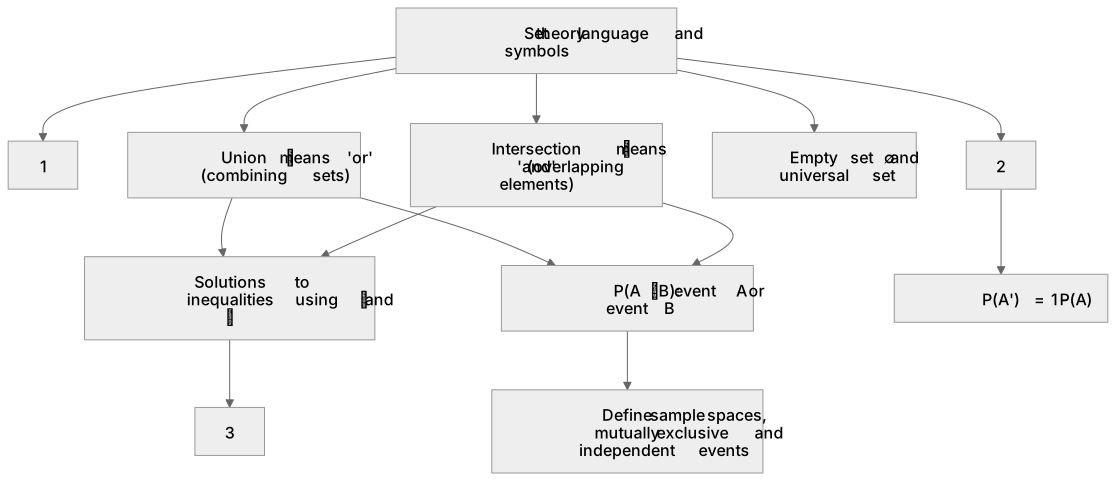
Label the diagram
Some boxes have lost their names. Pick the right name for each number.
1Box 1
2Box 2
3Box 3
There is more to this lesson
The full lesson goes on to check your understanding and help you earn the marks. Create a free account to carry on, with your progress saved.
A week of Premium from your first lesson · Then the free plan continues · No card, no charge
Test your understanding of Overarching theme 1: Mathematical argument, language and proof: Understand and use language and symbols associated with set theory, as set out in the content. Apply to solutions of inequalities and probability.
Active recall beats re-reading. Take an instant quiz now to test what you’ve learned and lock it into long-term memory.
A week of Premium from your first lesson · Then the free plan continues · No card, no charge