Pearson Edexcel · A-Level · Mathematics
Course version: 9MA0 · Version from Mar 2026
Mathematical argument, language and proof: Understand and use mathematical…
Full specification wording
Overarching theme 1: Mathematical argument, language and proof: Understand and use mathematical language and syntax as set out in the content.
Mastering mathematical language and syntax is fundamental for expressing concepts accurately across all areas of the specification.
Checked against the Pearson Edexcel 9MA0 specification (opens in a new tab) on .
- Point 2 of 5
Study notes
From the checked teaching notes for this specification point.
The idea
Mastering mathematical language and syntax is fundamental for expressing concepts accurately across all areas of the specification. This involves understanding the precise definitions of mathematical terms and using correct notation to formulate solutions. For example, when working with calculus, using proper Leibniz notation such as dy/dx for derivatives and the integral sign with respect to a variable (∫ f(x) dx) is essential. Syntax dictates the structural rules of mathematics; an operator must always have operands, and brackets must be used to define the order of operations clearly. By adhering to these conventions, you ensure that your mathematical reasoning is unambiguous, logically sound, and easily interpreted by examiners.
What earns the marks
- Apply correct mathematical syntax, ensuring all operators have appropriate operands and equations are balanced.
- Use standard notation for specific mathematical operations, such as correct derivative and integral notation in calculus.
- Structure mathematical arguments using accepted conventions, including the proper use of brackets to indicate the order of operations.
- Interpret mathematical language accurately to translate worded problems into algebraic or numerical models.
Common mistakes and how to put them right
Writing an operator without an operand, such as leaving a square root symbol empty or writing an equals sign without a right-hand side.
Put it right: Complete the mathematical statement.
Misusing calculus notation, such as writing a derivative without specifying the original function, or omitting the dx in an integral.
Put it right: Include the full notation.
Ignoring the order of operations by omitting necessary brackets, leading to incorrect algebraic manipulation.
Put it right: Use brackets to group terms correctly.
Exam tips
- Read the question carefully to ensure you understand the specific mathematical language being used, such as 'exact value' or 'simplest form'.
- Check your working line by line to ensure that mathematical syntax is maintained, particularly when manipulating complex algebraic fractions.
- Never leave an equals sign hanging at the end of a line; ensure every equation has both a left-hand side and a right-hand side.
Try the lesson
The start of the Overarching theme 1: Mathematical argument, language and proof: Understand and use mathematical language and syntax as set out in the content. lesson, made from checked teaching notes for this specification point.
Have a go first
A student wants to define the set of all real numbers x such that x is strictly greater than 5. Which of the following uses correct mathematical syntax for this set?
Listen
Mastering mathematical language and syntax is fundamental for expressing concepts accurately across all areas of the specification. This involves understanding the precise definitions of mathematical terms and using correct notation to formulate solutions. For example, when working with calculus, using proper Leibniz notation such as dy/dx for derivatives and the integral sign with respect to a variable (∫ f(x) dx) is essential. Syntax dictates the structural rules of mathematics; an operator must always have operands, and brackets must be used to define the order of operations clearly. By adhering to these conventions, you ensure that your mathematical reasoning is unambiguous, logically sound, and easily interpreted by examiners. A strong answer earns marks for these points. Apply correct mathematical syntax, ensuring all operators have appropriate operands and equations are balanced. Use standard notation for specific mathematical operations, such as correct derivative and integral notation in calculus. Structure mathematical arguments using accepted conventions, including the proper use of brackets to indicate the order of operations. Interpret mathematical language accurately to translate worded problems into algebraic or numerical models. Exam tip: Read the question carefully to ensure you understand the specific mathematical language being used, such as 'exact value' or 'simplest form'.
See it
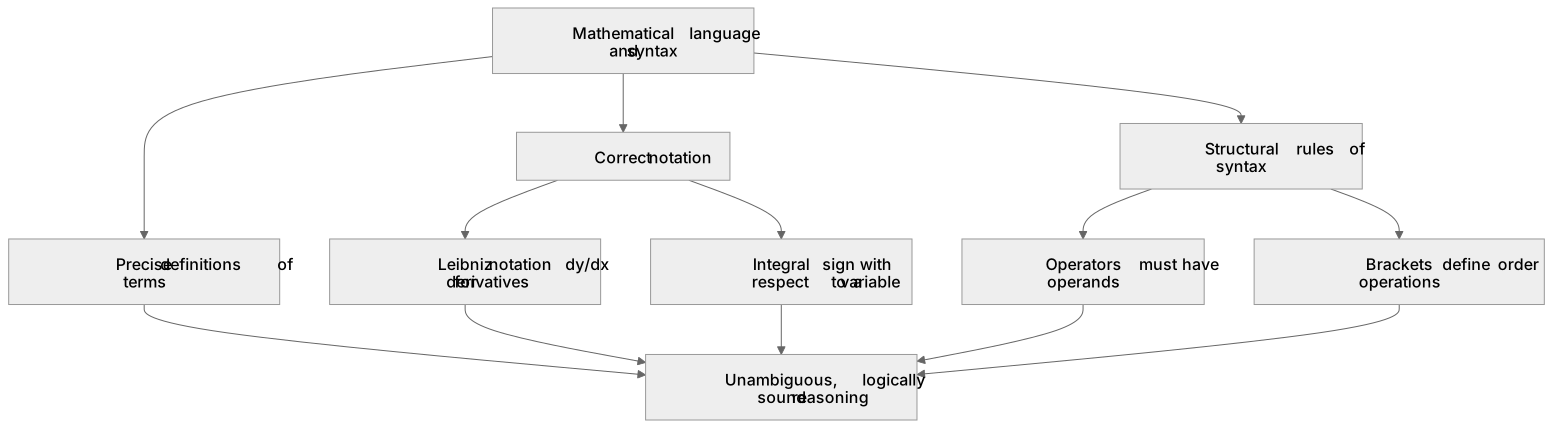
Label the diagram
Some boxes have lost their names. Pick the right name for each number.
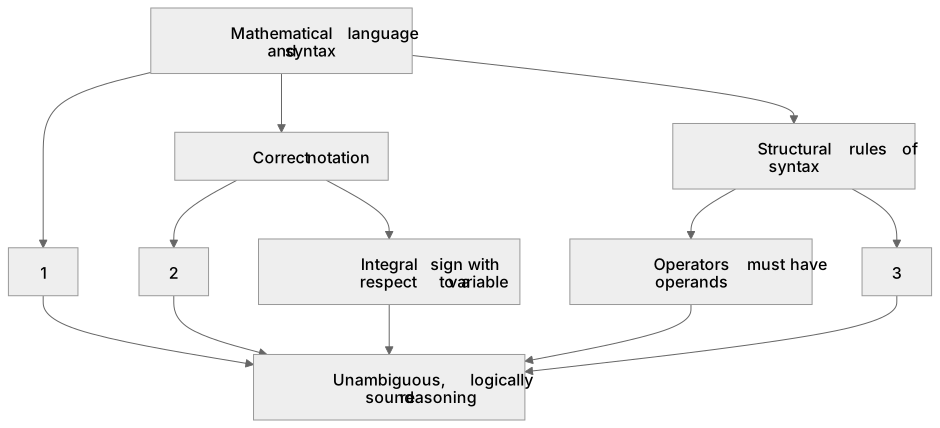
1Box 1
2Box 2
3Box 3
There is more to this lesson
The full lesson goes on to check your understanding and help you earn the marks. Create a free account to carry on, with your progress saved.
A week of Premium from your first lesson · Then the free plan continues · No card, no charge
Test your understanding of Overarching theme 1: Mathematical argument, language and proof: Understand and use mathematical language and syntax as set out in the content.
Active recall beats re-reading. Take an instant quiz now to test what you’ve learned and lock it into long-term memory.
A week of Premium from your first lesson · Then the free plan continues · No card, no charge