Pearson Edexcel · A-Level · Mathematics
Course version: 9MA0 · Version from Mar 2026
Mathematical problem solving: Construct extended arguments to solve…
Full specification wording
Overarching theme 2: Mathematical problem solving: Construct extended arguments to solve problems presented in an unstructured form, including problems in context.
Here the problem does not arrive with a suggested method or a sequence of leading parts.
Checked against the Pearson Edexcel 9MA0 specification (opens in a new tab) on .
- Point 2 of 7
- 4 key terms
Study notes
From the checked teaching notes for this specification point.
The idea
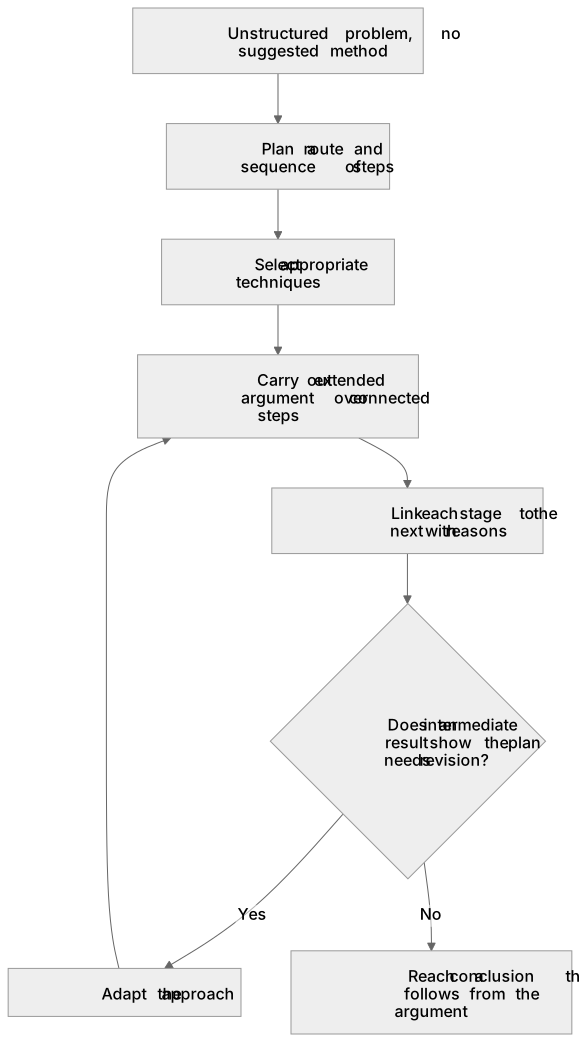
Here the problem does not arrive with a suggested method or a sequence of leading parts. You must plan a route, choose techniques, carry them through over several connected steps and keep the argument coherent from start to finish. An extended argument links each stage to the next with reasons, so a reader can follow why each calculation is legitimate. Contexts may be pure or applied: for instance, finding when a population model P(t) = 500e^{0.02t} reaches 2000 requires forming an equation, taking logarithms, solving for t and interpreting the result in years. You decide the order, monitor progress and adjust if a chosen route stalls, rather than expecting a single remembered procedure to finish the job.
What earns the marks
- Devises a strategy and sequence of steps before committing to detailed calculation.
- Selects appropriate techniques and applies them accurately within the argument.
- Maintains logical continuity so each stage follows from the previous one.
- Handles multi-step working without losing track of the overall goal.
- Adapts the approach when an intermediate result shows the original plan needs revision.
- Reaches a conclusion that follows from the accumulated argument.
Common mistakes and how to put them right
Starting to calculate before deciding on a route, which produces disconnected working.
Put it right by planning the main stages first.
Abandoning a valid method at the first awkward expression instead of simplifying or substituting.
Put it right by pausing to look for an equivalent form.
Losing the thread of a long argument and answering a sub-part only.
Put it right by restating the overall goal at each major stage.
Exam tips
- Sketch a brief plan or list the stages before writing detailed mathematics.
- Show enough reasoning that each step can be followed, even where a calculator does the arithmetic.
- If a route stalls, try an equivalent representation rather than restarting from scratch.
Try the lesson
The start of the Overarching theme 2: Mathematical problem solving: Construct extended arguments to solve problems presented in an unstructured form, including problems in context. lesson, made from checked teaching notes for this specification point.
Have a go first
A farmer plans to enclose a rectangular grazing enclosure. One side of the enclosure will be formed by a straight stone wall, requiring no fencing. The other three sides will be formed by 120 m of wire fencing. What is the maximum possible area of the enclosure, in square metres?
Listen
Here the problem does not arrive with a suggested method or a sequence of leading parts. You must plan a route, choose techniques, carry them through over several connected steps and keep the argument coherent from start to finish. An extended argument links each stage to the next with reasons, so a reader can follow why each calculation is legitimate. Contexts may be pure or applied: for instance, finding when a population model P(t) = 500e^{0.02t} reaches 2000 requires forming an equation, taking logarithms, solving for t and interpreting the result in years. You decide the order, monitor progress and adjust if a chosen route stalls, rather than expecting a single remembered procedure to finish the job. A strong answer earns marks for these points. Devises a strategy and sequence of steps before committing to detailed calculation. Selects appropriate techniques and applies them accurately within the argument. Maintains logical continuity so each stage follows from the previous one. Handles multi-step working without losing track of the overall goal. A common slip: Starting to calculate before deciding on a route, which produces disconnected working. Instead, planning the main stages first. Exam tip: Sketch a brief plan or list the stages before writing detailed mathematics.
See it
Key words
Say what each word means before you turn the card.
Strategic planning
Try answering aloud or in your head before turning the card.
Multi-step reasoning
Try answering aloud or in your head before turning the card.
Technique selection
Try answering aloud or in your head before turning the card.
Adaptive problem solving
Try answering aloud or in your head before turning the card.
See every definition
- Strategic planning
- Devising a strategy and sequence of steps before committing to detailed calculation, so the main stages are planned first.
- Multi-step reasoning
- Carrying working through several connected steps while keeping the argument coherent from start to finish.
- Technique selection
- Choosing appropriate techniques and applying them accurately within the argument.
- Adaptive problem solving
- Adjusting the chosen route when an intermediate result shows the original plan needs revision, rather than expecting a single remembered procedure to finish the job.
Label the diagram
Some boxes have lost their names. Pick the right name for each number.
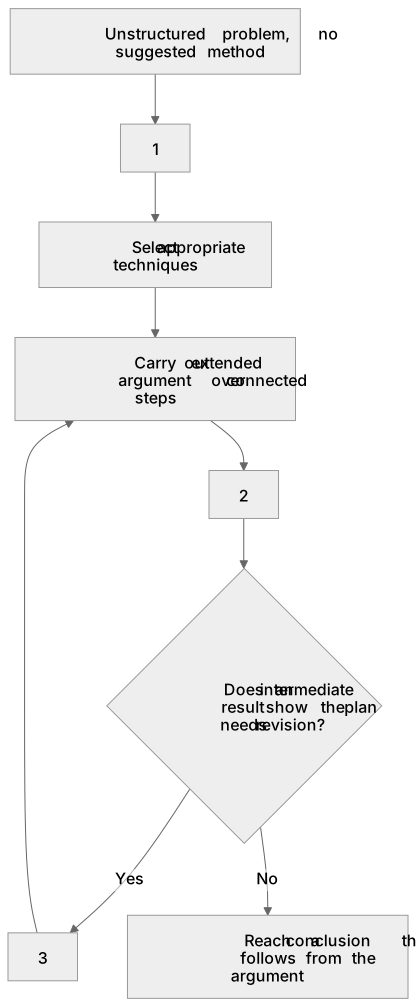
1Box 1
2Box 2
3Box 3
There is more to this lesson
The full lesson goes on to check your understanding and help you earn the marks. Create a free account to carry on, with your progress saved.
A week of Premium from your first lesson · Then the free plan continues · No card, no charge
Test your understanding of Overarching theme 2: Mathematical problem solving: Construct extended arguments to solve problems presented in an unstructured form, including problems in context.
Active recall beats re-reading. Take an instant quiz now to test what you’ve learned and lock it into long-term memory.
A week of Premium from your first lesson · Then the free plan continues · No card, no charge