Pearson Edexcel · A-Level · Mathematics
Course version: 9MA0 · Version from Mar 2026
Mathematical problem solving: Interpret and communicate solutions in the…
Full specification wording
Overarching theme 2: Mathematical problem solving: Interpret and communicate solutions in the context of the original problem.
After solving, you must return to the original situation and explain what the answer means there.
Checked against the Pearson Edexcel 9MA0 specification (opens in a new tab) on .
- Point 3 of 7
- 4 key terms
Study notes
From the checked teaching notes for this specification point.
The idea
After solving, you must return to the original situation and explain what the answer means there. Interpretation involves checking that the mathematical result is meaningful in context: a negative time, a probability above 1 or a non-integer count of people signals that something needs reconsidering. Communication means presenting the result clearly, with correct units, appropriate accuracy and a statement of what it represents. For example, if a model gives t = 4.7 hours until a tank empties, you report approximately 4.7 hours and note that the model applies only while the tank still contains water. You also judge whether assumptions made earlier limit the conclusion, and you express that limitation honestly rather than overstating the result.
What earns the marks
- Translates the mathematical result back into the language of the original situation.
- Attaches correct units and an appropriate degree of accuracy to the answer.
- Checks that the result is feasible and sensible within the context.
- Explains what the answer means, not merely what number was obtained.
- Acknowledges assumptions or limitations that affect the interpretation.
- Presents the conclusion clearly so a non-specialist reader can follow it.
Common mistakes and how to put them right
Giving a bare number with no units or context.
Put it right by stating the quantity and its unit in a sentence.
Reporting excessive accuracy from a model, such as 4.72319 hours.
Put it right by rounding to a sensible level for the context.
Ignoring an impossible result, such as negative length or probability greater than 1.
Put it right by revisiting the model or its domain and commenting on the issue.
Exam tips
- Finish with a sentence that answers the original question in its own terms.
- Include units and round only at the final communication stage.
- Comment briefly on any assumption that could affect how the answer should be used.
Try the lesson
The start of the Overarching theme 2: Mathematical problem solving: Interpret and communicate solutions in the context of the original problem. lesson, made from checked teaching notes for this specification point.
Have a go first
A model predicts that a population P after t years is P = 500 + 40t. What does the number 40 represent in the context of the population?
Listen
After solving, you must return to the original situation and explain what the answer means there. Interpretation involves checking that the mathematical result is meaningful in context: a negative time, a probability above 1 or a non-integer count of people signals that something needs reconsidering. Communication means presenting the result clearly, with correct units, appropriate accuracy and a statement of what it represents. For example, if a model gives t = 4.7 hours until a tank empties, you report approximately 4.7 hours and note that the model applies only while the tank still contains water. You also judge whether assumptions made earlier limit the conclusion, and you express that limitation honestly rather than overstating the result. A strong answer earns marks for these points. Translates the mathematical result back into the language of the original situation. Attaches correct units and an appropriate degree of accuracy to the answer. Checks that the result is feasible and sensible within the context. Explains what the answer means, not merely what number was obtained. A common slip: Giving a bare number with no units or context. Instead, stating the quantity and its unit in a sentence. Exam tip: Finish with a sentence that answers the original question in its own terms.
See it
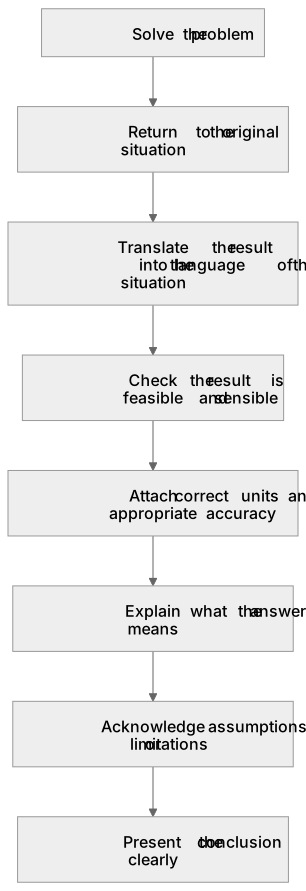
Put it in order
Put these steps in the order they happen.
- 1. Attach correct units and appropriate accuracy
- 2. Present the conclusion clearly
- 3. Explain what the answer means
- 4. Solve the problem
- 5. Return to the original situation
- 6. Acknowledge assumptions or limitations
- 7. Translate the result into the language of the situation
- 8. Check the result is feasible and sensible
Key words
Say what each word means before you turn the card.
Contextual meaning
Try answering aloud or in your head before turning the card.
Units and accuracy
Try answering aloud or in your head before turning the card.
Feasibility checking
Try answering aloud or in your head before turning the card.
Clear communication
Try answering aloud or in your head before turning the card.
See every definition
- Contextual meaning
- Explaining what the answer means in the original situation, not merely what number was obtained.
- Units and accuracy
- Attaching correct units and an appropriate degree of accuracy to the answer when presenting it.
- Feasibility checking
- Checking that the result is feasible and sensible within the context, since a negative time, a probability above 1 or a non-integer count of people signals that something needs reconsidering.
- Clear communication
- Presenting the conclusion clearly, with a statement of what it represents, so a non-specialist reader can follow it.
Label the diagram
Some boxes have lost their names. Pick the right name for each number.
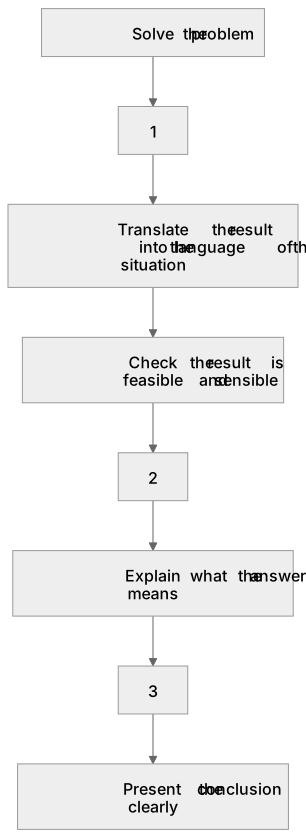
1Box 1
2Box 2
3Box 3
There is more to this lesson
The full lesson goes on to check your understanding and help you earn the marks. Create a free account to carry on, with your progress saved.
A week of Premium from your first lesson · Then the free plan continues · No card, no charge
Test your understanding of Overarching theme 2: Mathematical problem solving: Interpret and communicate solutions in the context of the original problem.
Active recall beats re-reading. Take an instant quiz now to test what you’ve learned and lock it into long-term memory.
A week of Premium from your first lesson · Then the free plan continues · No card, no charge