Pearson Edexcel · A-Level · Mathematics
Course version: 9MA0 · Version from Mar 2026
Mathematical modelling: Translate a situation in context into a…
Full specification wording
Overarching theme 3: Mathematical modelling: Translate a situation in context into a mathematical model, making simplifying assumptions.
Mathematical modelling begins by translating a real context into mathematical form.
Checked against the Pearson Edexcel 9MA0 specification (opens in a new tab) on .
- Point 1 of 5
- 4 key terms
Study notes
From the checked teaching notes for this specification point.
The idea
Mathematical modelling begins by translating a real context into mathematical form. You identify the key variables, choose suitable units, and state simplifying assumptions that make the problem tractable. For example, modelling a falling object: let h be height in metres and t time in seconds; assume no air resistance and constant gravitational acceleration g = 9.8 m s⁻². This gives h = h₀ − ½gt². The assumptions ignore air resistance and the variation of g with height. You must decide which features to include and which to neglect, then express relationships using functions, equations or graphs. The model is a simplification, not the reality, so assumptions must be explicit and justified in context.
What earns the marks
- Identifies the relevant variables and their units from the context, for example time in seconds and height in metres.
- States clear simplifying assumptions, such as ignoring air resistance or treating acceleration as constant.
- Translates the situation into a correct mathematical form, for example an equation, function or graph.
- Justifies why each assumption is reasonable in the given context, linking to the scale or purpose of the model.
- Uses appropriate notation and defines symbols consistently.
Common mistakes and how to put them right
Omitting assumptions entirely: correct by explicitly listing each simplification and explaining its effect.
Using inconsistent or missing units.
Put it right by stating units for every variable and checking dimensional consistency.
Including irrelevant variables that complicate the model.
Put it right by identifying only the factors that materially affect the output.
Exam tips
- Underline the contextual quantities in the question before writing any equations.
- Write assumptions as full sentences that name the factor being ignored and the reason.
- Check that your mathematical expression reduces to a sensible result when extreme values are substituted.
Try the lesson
The start of the Overarching theme 3: Mathematical modelling: Translate a situation in context into a mathematical model, making simplifying assumptions. lesson, made from checked teaching notes for this specification point.
Have a go first
A cylindrical water tank has radius r metres and height h metres. Water flows in at a constant rate of 0.4 cubic metres per minute. Construct a model for the depth d, in metres, of water after t minutes, starting from an empty tank, and state one simplifying assumption needed.
Listen
Mathematical modelling begins by translating a real context into mathematical form. You identify the key variables, choose suitable units, and state simplifying assumptions that make the problem tractable. For example, modelling a falling object: let h be height in metres and t time in seconds; assume no air resistance and constant gravitational acceleration g = 9.8 m s⁻². This gives h = h₀ − ½gt². The assumptions ignore air resistance and the variation of g with height. You must decide which features to include and which to neglect, then express relationships using functions, equations or graphs. The model is a simplification, not the reality, so assumptions must be explicit and justified in context. A strong answer earns marks for these points. Identifies the relevant variables and their units from the context, for example time in seconds and height in metres. States clear simplifying assumptions, such as ignoring air resistance or treating acceleration as constant. Translates the situation into a correct mathematical form, for example an equation, function or graph. Justifies why each assumption is reasonable in the given context, linking to the scale or purpose of the model. A common slip: Using inconsistent or missing units. Instead, stating units for every variable and checking dimensional consistency. Exam tip: Underline the contextual quantities in the question before writing any equations.
See it
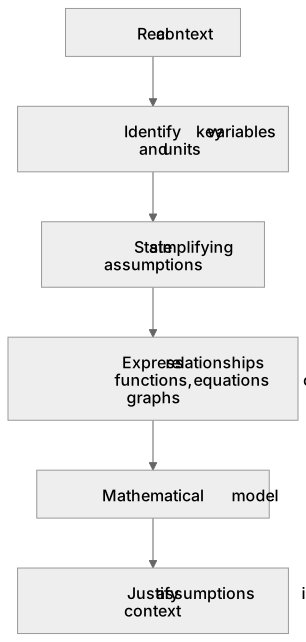
Put it in order
Put these steps in the order they happen.
- 1. State simplifying assumptions
- 2. Identify key variables and units
- 3. Real context
- 4. Justify assumptions in context
- 5. Mathematical model
- 6. Express relationships as functions, equations or graphs
Key words
Say what each word means before you turn the card.
Mathematical model
Try answering aloud or in your head before turning the card.
Simplifying assumptions
Try answering aloud or in your head before turning the card.
Variables and units
Try answering aloud or in your head before turning the card.
Mathematical representation
Try answering aloud or in your head before turning the card.
See every definition
- Mathematical model
- A simplification, not the reality, obtained by translating a situation in context into mathematical form.
- Simplifying assumptions
- Statements that make the problem tractable, which must be explicit and justified in context.
- Variables and units
- The key quantities identified from the context, each given suitable units.
- Mathematical representation
- The expression of relationships using functions, equations or graphs.
Label the diagram
Some boxes have lost their names. Pick the right name for each number.
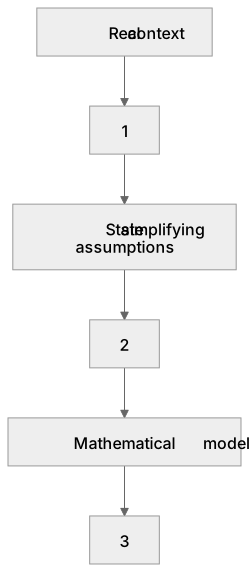
1Box 1
2Box 2
3Box 3
There is more to this lesson
The full lesson goes on to check your understanding and help you earn the marks. Create a free account to carry on, with your progress saved.
A week of Premium from your first lesson · Then the free plan continues · No card, no charge
Test your understanding of Overarching theme 3: Mathematical modelling: Translate a situation in context into a mathematical model, making simplifying assumptions.
Active recall beats re-reading. Take an instant quiz now to test what you’ve learned and lock it into long-term memory.
A week of Premium from your first lesson · Then the free plan continues · No card, no charge