Pearson Edexcel · A-Level · Mathematics
Course version: 9MA0 · Version from Mar 2026
Mathematical modelling: Use a mathematical model with suitable inputs to…
Full specification wording
Overarching theme 3: Mathematical modelling: Use a mathematical model with suitable inputs to engage with and explore situations (for a given model or a model constructed or selected by the student).
Once a model exists, you use it by substituting suitable inputs to explore the situation.
Checked against the Pearson Edexcel 9MA0 specification (opens in a new tab) on .
- Point 2 of 5
- 4 key terms
Study notes
From the checked teaching notes for this specification point.
The idea
Once a model exists, you use it by substituting suitable inputs to explore the situation. This may involve a model given to you or one you have constructed or selected. For example, using the model h = h₀ − ½gt² with h₀ = 20 m and g = 9.8 m s⁻², substitute t = 1 s to find h = 20 − 4.9 = 15.1 m. You choose inputs that are meaningful in context, such as positive times or realistic speeds, and compute outputs accurately. You may vary one input at a time to see how the output changes, or compare several scenarios. The aim is to engage with the situation mathematically, not just to calculate. You should record inputs and outputs clearly, with units, and be prepared to explain what the outputs mean.
What earns the marks
- Selects appropriate input values that are valid within the context and the model's domain.
- Substitutes inputs correctly into the mathematical model, maintaining accuracy.
- Computes outputs accurately, including correct units and significant figures where appropriate.
- Explores the situation by varying inputs or comparing different scenarios.
- Records and presents inputs and outputs clearly, for example in a table or graph.
Common mistakes and how to put them right
Using inputs outside the model's valid range.
Put it right by checking the domain and context before substituting.
Making arithmetic errors when substituting.
Put it right by working step by step and checking with an estimate.
Ignoring units in the output.
Put it right by carrying units through the calculation and stating them in the answer.
Exam tips
- Write down the model equation before substituting any numbers.
- Choose inputs that are easy to compute and clearly relevant to the question.
- Show your substitution step explicitly so the method is visible.
Try the lesson
The start of the Overarching theme 3: Mathematical modelling: Use a mathematical model with suitable inputs to engage with and explore situations (for a given model or a model constructed or selected by the student). lesson, made from checked teaching notes for this specification point.
Have a go first
A model for the temperature T, in degrees Celsius, of a cooling drink after t minutes is T = 20 + 60e^(-0.1t). Use the model to find the temperature after 10 minutes, giving your answer to one decimal place.
Listen
Once a model exists, you use it by substituting suitable inputs to explore the situation. This may involve a model given to you or one you have constructed or selected. For example, using the model h = h₀ − ½gt² with h₀ = 20 m and g = 9.8 m s⁻², substitute t = 1 s to find h = 20 − 4.9 = 15.1 m. You choose inputs that are meaningful in context, such as positive times or realistic speeds, and compute outputs accurately. You may vary one input at a time to see how the output changes, or compare several scenarios. The aim is to engage with the situation mathematically, not just to calculate. You should record inputs and outputs clearly, with units, and be prepared to explain what the outputs mean. A strong answer earns marks for these points. Selects appropriate input values that are valid within the context and the model's domain. Substitutes inputs correctly into the mathematical model, maintaining accuracy. Computes outputs accurately, including correct units and significant figures where appropriate. Explores the situation by varying inputs or comparing different scenarios. A common slip: Using inputs outside the model's valid range. Instead, checking the domain and context before substituting. Exam tip: Write down the model equation before substituting any numbers.
See it
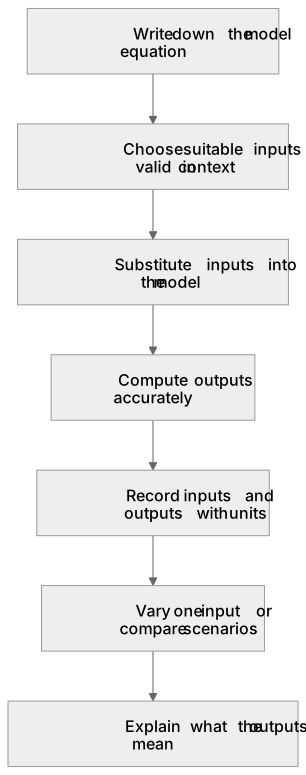
Put it in order
Put these steps in the order they happen.
- 1. Explain what the outputs mean
- 2. Vary one input or compare scenarios
- 3. Substitute inputs into the model
- 4. Record inputs and outputs with units
- 5. Write down the model equation
- 6. Choose suitable inputs valid in context
- 7. Compute outputs accurately
Key words
Say what each word means before you turn the card.
Substitution and computation
Try answering aloud or in your head before turning the card.
Input selection
Try answering aloud or in your head before turning the card.
Exploration of scenarios
Try answering aloud or in your head before turning the card.
Accurate recording
Try answering aloud or in your head before turning the card.
See every definition
- Substitution and computation
- Putting suitable inputs into the model and computing outputs accurately, maintaining accuracy and carrying units through the calculation.
- Input selection
- Choosing inputs that are meaningful in context, such as positive times or realistic speeds, and valid within the model's domain.
- Exploration of scenarios
- Engaging with the situation mathematically by varying one input at a time to see how the output changes, or comparing several scenarios.
- Accurate recording
- Recording inputs and outputs clearly, with units, for example in a table or graph, and being prepared to explain what the outputs mean.
Label the diagram
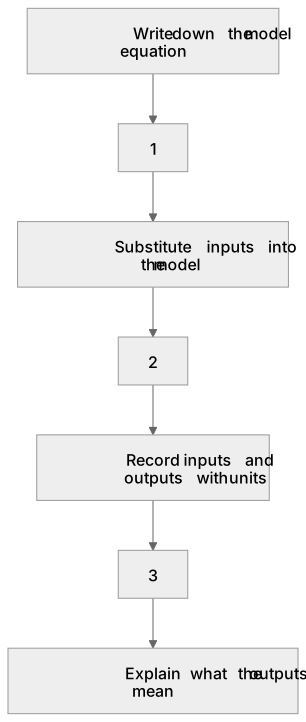
Some boxes have lost their names. Pick the right name for each number.
1Box 1
2Box 2
3Box 3
There is more to this lesson
The full lesson goes on to check your understanding and help you earn the marks. Create a free account to carry on, with your progress saved.
A week of Premium from your first lesson · Then the free plan continues · No card, no charge
Test your understanding of Overarching theme 3: Mathematical modelling: Use a mathematical model with suitable inputs to engage with and explore situations (for a given model or a model constructed or selected by the student).
Active recall beats re-reading. Take an instant quiz now to test what you’ve learned and lock it into long-term memory.
A week of Premium from your first lesson · Then the free plan continues · No card, no charge