Pearson Edexcel · A-Level · Mathematics
Course version: 9MA0 · Version from Mar 2026
Mathematical modelling: Understand and use modelling assumptions.
Full specification wording
Overarching theme 3: Mathematical modelling: Understand and use modelling assumptions.
Modelling assumptions are the simplifications you choose so a real situation becomes tractable mathematics.
Checked against the Pearson Edexcel 9MA0 specification (opens in a new tab) on .
- Point 5 of 5
- 4 key terms
Study notes
From the checked teaching notes for this specification point.
The idea
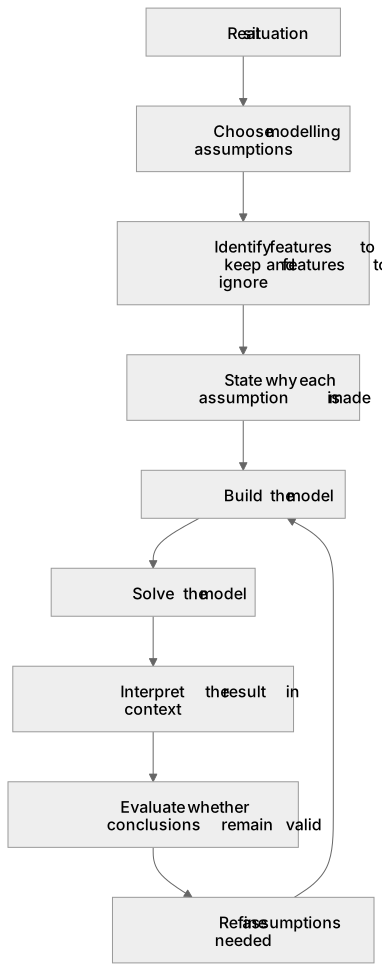
Modelling assumptions are the simplifications you choose so a real situation becomes tractable mathematics. To understand them, identify which features you keep and which you ignore, and state why. To use them, build a model, solve it, then interpret the result in context and refine assumptions if needed. For example, modelling a falling object as a particle with constant acceleration ignores air resistance and rotation; the resulting suvat equations give a first estimate, and you can then add drag for a better model. In mechanics, assumptions such as smooth, light, inextensible, uniform or particle each remove a force or property. In statistics, assuming a fair die or independent trials defines a probability model. Assessment rewards clear statements of assumptions, correct use in calculations, and evaluation of whether conclusions remain valid when assumptions change.
What earns the marks
- State each modelling assumption explicitly, naming the physical or statistical feature that is simplified or ignored.
- Explain how the assumption changes the mathematics, for example removing a force, fixing a probability, or making a variable constant.
- Use the assumption consistently throughout the solution so that equations and conclusions match the stated model.
- Interpret the mathematical result back in the original context and comment on the reasonableness of the assumptions.
- Refine or criticise the model by identifying a limitation and suggesting a more realistic assumption where appropriate.
Common mistakes and how to put them right
Treating an assumption as a fact about the real world rather than a modelling choice.
Put it right by stating it as a simplifying condition of the model.
Applying an assumption only at the start and then using incompatible equations later.
Put it right by checking every stage against the stated assumptions.
Giving a vague assumption such as 'ignore things' without naming what is ignored.
Put it right by specifying the omitted feature, for example air resistance or friction.
Exam tips
- Underline the modelling context in the question and list the assumptions you will use before starting calculations.
- When a question asks you to criticise a model, name a specific limitation and say how it would affect the result, for example air resistance would reduce the predicted speed.
- Keep your final answer in context: include units and a short sentence interpreting what the number means for the original situation.
Try the lesson
The start of the Overarching theme 3: Mathematical modelling: Understand and use modelling assumptions. lesson, made from checked teaching notes for this specification point.
Have a go first
A cyclist is modelled as a particle moving along a straight horizontal road with constant speed. Which assumption is being made about the cyclist's motion?
Listen
Modelling assumptions are the simplifications you choose so a real situation becomes tractable mathematics. To understand them, identify which features you keep and which you ignore, and state why. To use them, build a model, solve it, then interpret the result in context and refine assumptions if needed. For example, modelling a falling object as a particle with constant acceleration ignores air resistance and rotation; the resulting suvat equations give a first estimate, and you can then add drag for a better model. In mechanics, assumptions such as smooth, light, inextensible, uniform or particle each remove a force or property. In statistics, assuming a fair die or independent trials defines a probability model. Assessment rewards clear statements of assumptions, correct use in calculations, and evaluation of whether conclusions remain valid when assumptions change. A strong answer earns marks for these points. State each modelling assumption explicitly, naming the physical or statistical feature that is simplified or ignored. Explain how the assumption changes the mathematics, for example removing a force, fixing a probability, or making a variable constant. Use the assumption consistently throughout the solution so that equations and conclusions match the stated model. Interpret the mathematical result back in the original context and comment on the reasonableness of the assumptions. A common slip: Treating an assumption as a fact about the real world rather than a modelling choice. Instead, stating it as a simplifying condition of the model. Exam tip: Underline the modelling context in the question and list the assumptions you will use before starting calculations.
See it
Key words
Say what each word means before you turn the card.
Modelling assumptions
Try answering aloud or in your head before turning the card.
Interpretation
Try answering aloud or in your head before turning the card.
Refinement
Try answering aloud or in your head before turning the card.
Evaluation
Try answering aloud or in your head before turning the card.
See every definition
- Modelling assumptions
- The simplifications you choose so a real situation becomes tractable mathematics, identifying which features you keep and which you ignore.
- Interpretation
- Reading the mathematical result back in the original context and commenting on the reasonableness of the assumptions.
- Refinement
- Identifying a limitation of a model and suggesting a more realistic assumption where appropriate.
- Evaluation
- Judging whether a model's conclusions remain valid when assumptions change.
Label the diagram
Some boxes have lost their names. Pick the right name for each number.
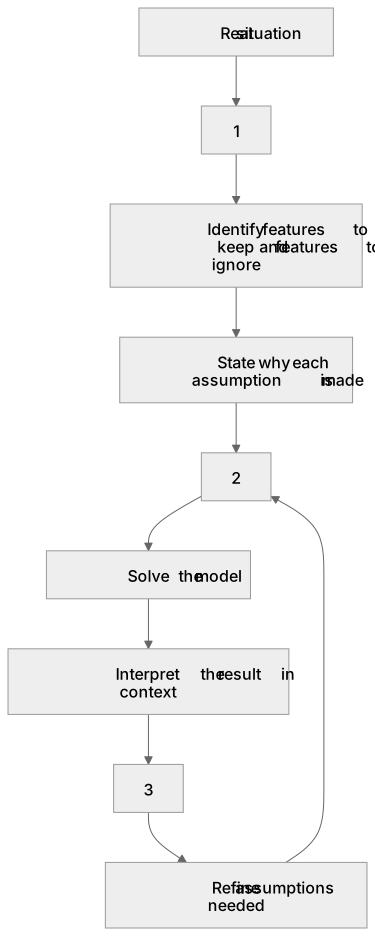
1Box 1
2Box 2
3Box 3
There is more to this lesson
The full lesson goes on to check your understanding and help you earn the marks. Create a free account to carry on, with your progress saved.
A week of Premium from your first lesson · Then the free plan continues · No card, no charge
Test your understanding of Overarching theme 3: Mathematical modelling: Understand and use modelling assumptions.
Active recall beats re-reading. Take an instant quiz now to test what you’ve learned and lock it into long-term memory.
A week of Premium from your first lesson · Then the free plan continues · No card, no charge