Pearson Edexcel · A-Level · Mathematics
Course version: 9MA0 · Version from Mar 2026
Mathematical modelling: Understand that a mathematical model can be…
Full specification wording
Overarching theme 3: Mathematical modelling: Understand that a mathematical model can be refined by considering its outputs and simplifying assumptions; evaluate whether the model is appropriate.
A model is rarely perfect first time.
Checked against the Pearson Edexcel 9MA0 specification (opens in a new tab) on .
- Point 4 of 5
- 4 key terms
Study notes
From the checked teaching notes for this specification point.
The idea
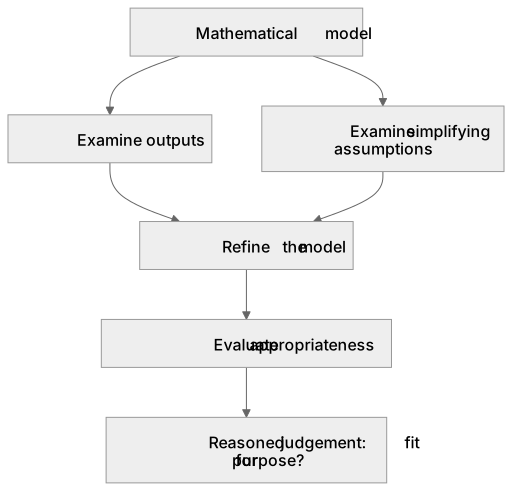
A model is rarely perfect first time. By examining outputs and assumptions, you can refine it. For example, if a falling-object model predicts a height of −5 m at t = 3 s, you might refine by including air resistance or limiting the domain to t ≥ 0. Refinement could mean adding a variable, changing a function, or adjusting assumptions. You then evaluate whether the model is appropriate: does it predict realistically? Are the assumptions justified? Is it fit for purpose? You should discuss strengths and limitations, and suggest specific improvements. Evaluation is not just saying the model is wrong; it is a reasoned judgement about its usefulness in context, supported by evidence from outputs and assumptions.
What earns the marks
- Identifies specific simplifying assumptions that could be refined or removed.
- Uses outputs to justify a refinement, for example noting unrealistic predictions.
- Suggests a concrete refinement, such as adding a term or changing a parameter.
- Evaluates the appropriateness of the model by weighing strengths against limitations.
- Communicates a reasoned judgement about whether the model is fit for its purpose.
Common mistakes and how to put them right
Stating that the model is 'wrong' without suggesting an improvement.
Put it right by proposing a specific refinement and explaining its effect.
Ignoring the role of assumptions in the evaluation.
Put it right by linking each limitation to a stated assumption.
Failing to use outputs as evidence.
Put it right by referring to specific calculated values when justifying refinement.
Exam tips
- Structure your evaluation by listing assumptions, then limitations, then possible refinements.
- Use phrases such as 'the model assumes... but in reality...' to show critical thinking.
- Conclude with a clear judgement about the model's appropriateness for the given context.
Try the lesson
The start of the Overarching theme 3: Mathematical modelling: Understand that a mathematical model can be refined by considering its outputs and simplifying assumptions; evaluate whether the model is appropriate. lesson, made from checked teaching notes for this specification point.
Have a go first
A model for the number of people P attending a village fete is P = 200 + 30d, where d is the number of days after the posters are put up. The model predicts P = 500 after 10 days. State one reason why this model may not be appropriate for very large values of d.
Listen
A model is rarely perfect first time. By examining outputs and assumptions, you can refine it. For example, if a falling-object model predicts a height of −5 m at t = 3 s, you might refine by including air resistance or limiting the domain to t ≥ 0. Refinement could mean adding a variable, changing a function, or adjusting assumptions. You then evaluate whether the model is appropriate: does it predict realistically? Are the assumptions justified? Is it fit for purpose? You should discuss strengths and limitations, and suggest specific improvements. Evaluation is not just saying the model is wrong; it is a reasoned judgement about its usefulness in context, supported by evidence from outputs and assumptions. A strong answer earns marks for these points. Identifies specific simplifying assumptions that could be refined or removed. Uses outputs to justify a refinement, for example noting unrealistic predictions. Suggests a concrete refinement, such as adding a term or changing a parameter. Evaluates the appropriateness of the model by weighing strengths against limitations. A common slip: Stating that the model is 'wrong' without suggesting an improvement. Instead, proposing a specific refinement and explaining its effect. Exam tip: Structure your evaluation by listing assumptions, then limitations, then possible refinements.
See it
Key words
Say what each word means before you turn the card.
Model refinement
Try answering aloud or in your head before turning the card.
Assumption review
Try answering aloud or in your head before turning the card.
Critical evaluation
Try answering aloud or in your head before turning the card.
Fitness for purpose
Try answering aloud or in your head before turning the card.
See every definition
- Model refinement
- Changing a model by adding a variable, changing a function, or adjusting assumptions after considering its outputs and simplifying assumptions.
- Assumption review
- Examining the simplifying assumptions of a model and identifying specific ones that could be refined or removed.
- Critical evaluation
- A reasoned judgement about the usefulness of a model in context, weighing strengths against limitations and supported by evidence from outputs and assumptions.
- Fitness for purpose
- Whether a model is appropriate, judged by asking whether it predicts realistically and whether its assumptions are justified.
Label the diagram
Some boxes have lost their names. Pick the right name for each number.
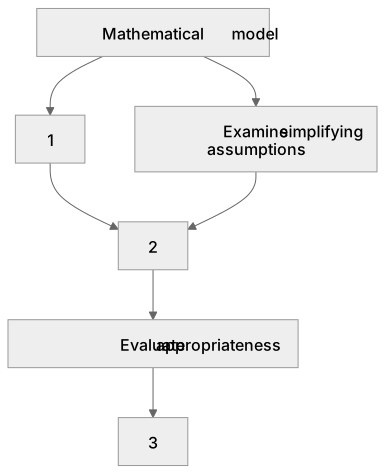
1Box 1
2Box 2
3Box 3
There is more to this lesson
The full lesson goes on to check your understanding and help you earn the marks. Create a free account to carry on, with your progress saved.
A week of Premium from your first lesson · Then the free plan continues · No card, no charge
Test your understanding of Overarching theme 3: Mathematical modelling: Understand that a mathematical model can be refined by considering its outputs and simplifying assumptions; evaluate whether the model is appropriate.
Active recall beats re-reading. Take an instant quiz now to test what you’ve learned and lock it into long-term memory.
A week of Premium from your first lesson · Then the free plan continues · No card, no charge