Pearson Edexcel · A-Level · Mathematics
Course version: 9MA0 · Version from Mar 2026
Modelling with probability, including critiquing assumptions made and the…
Full specification wording
Probability: 3.3 Modelling with probability, including critiquing assumptions made and the likely effect of more realistic assumptions.
Modelling with probability means representing a real situation with a probability model, then judging how well that model fits.
Checked against the Pearson Edexcel 9MA0 specification (opens in a new tab) on .
- Point 3 of 3
- 2 key terms
Study notes
From the checked teaching notes for this specification point.
The idea
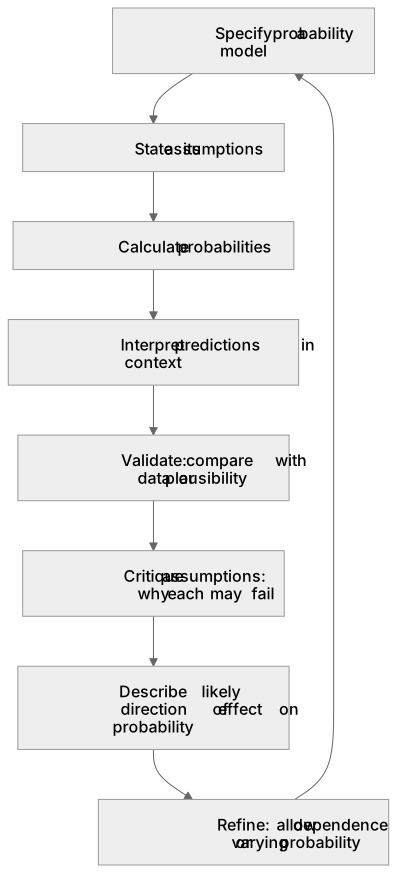
Modelling with probability means representing a real situation with a probability model, then judging how well that model fits. You choose a model, state its assumptions, calculate probabilities and compare predictions with data or with what is plausible. For example, modelling births as independent with P(girl) = 0.5 assumes a constant probability and no family-level or seasonal effects; if the true probability varies, the model misestimates runs of same-sex births. Critiquing assumptions means naming each assumption, explaining why it may fail, and describing the direction of the likely effect on the calculated probability. More realistic assumptions, such as allowing dependence between trials or a changing probability, usually make the model harder to use but more accurate. Assessment rewards clear reasoning about assumptions and their consequences, not just a numerical answer.
What earns the marks
- States the assumptions of a probability model, such as independence, constant probability, equally likely outcomes or a fixed number of trials.
- Explains why an assumption may not hold in the real context, referring to the situation rather than to the mathematics alone.
- Describes the likely direction of the effect of a more realistic assumption on a calculated probability, for example whether it would increase or decrease it.
- Compares model predictions with observed data or expected values and comments on the adequacy of the model.
- Suggests a specific refinement to the model, such as allowing dependence or a varying probability, and explains its consequence.
- Communicates the modelling cycle: specify, calculate, interpret, validate and refine.
Common mistakes and how to put them right
Listing assumptions without explaining their effect.
Put it right: State how each assumption changes the calculated probability if it fails.
Claiming a model is 'wrong' without saying which assumption fails or in which direction the estimate is affected.
Put it right: Link the criticism to a named assumption.
Assuming independence in a context where events are clearly linked, such as drawing counters without replacement.
Put it right: Use conditional probabilities for the second draw.
Exam tips
- Use the context words in the question when naming assumptions, so the critique is specific rather than generic.
- State the direction of the likely effect, such as 'the probability would be underestimated', to show genuine modelling insight.
- Keep numerical work separate from the critique so that both the calculation and the commentary are clearly visible.
Try the lesson
The start of the Probability: 3.3 Modelling with probability, including critiquing assumptions made and the likely effect of more realistic assumptions. lesson, made from checked teaching notes for this specification point.
Have a go first
A model treats the probability that a bus arrives on time as 0.9 every day. In reality, bad weather makes delays more likely on some days. Compared with the model, what effect would including bad weather have on the probability of an on-time arrival on a wet day?
Listen
Modelling with probability means representing a real situation with a probability model, then judging how well that model fits. You choose a model, state its assumptions, calculate probabilities and compare predictions with data or with what is plausible. For example, modelling births as independent with P(girl) = 0.5 assumes a constant probability and no family-level or seasonal effects; if the true probability varies, the model misestimates runs of same-sex births. Critiquing assumptions means naming each assumption, explaining why it may fail, and describing the direction of the likely effect on the calculated probability. More realistic assumptions, such as allowing dependence between trials or a changing probability, usually make the model harder to use but more accurate. Assessment rewards clear reasoning about assumptions and their consequences, not just a numerical answer. A strong answer earns marks for these points. States the assumptions of a probability model, such as independence, constant probability, equally likely outcomes or a fixed number of trials. Explains why an assumption may not hold in the real context, referring to the situation rather than to the mathematics alone. Describes the likely direction of the effect of a more realistic assumption on a calculated probability, for example whether it would increase or decrease it. Compares model predictions with observed data or expected values and comments on the adequacy of the model. A common slip: Listing assumptions without explaining their effect. Instead, state how each assumption changes the calculated probability if it fails. Exam tip: Use the context words in the question when naming assumptions, so the critique is specific rather than generic.
See it
Key words
Say what each word means before you turn the card.
Probability modelling
Try answering aloud or in your head before turning the card.
Interpretation in context
Try answering aloud or in your head before turning the card.
See every definition
- Probability modelling
- Representing a real situation with a probability model, then judging how well that model fits.
- Interpretation in context
- Comparing model predictions with data or with what is plausible, and commenting on the adequacy of the model.
Label the diagram
Some boxes have lost their names. Pick the right name for each number.
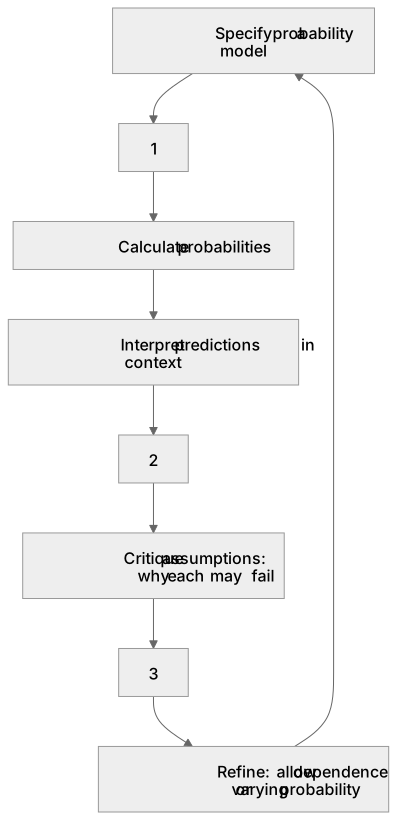
1Box 1
2Box 2
3Box 3
There is more to this lesson
The full lesson goes on to check your understanding and help you earn the marks. Create a free account to carry on, with your progress saved.
A week of Premium from your first lesson · Then the free plan continues · No card, no charge
Test your understanding of Probability: 3.3 Modelling with probability, including critiquing assumptions made and the likely effect of more realistic assumptions.
Active recall beats re-reading. Take an instant quiz now to test what you’ve learned and lock it into long-term memory.
A week of Premium from your first lesson · Then the free plan continues · No card, no charge