Pearson Edexcel · A-Level · Mathematics
Course version: 9MA0 · Version from Mar 2026
Understand and use the binomial expansion of (a + bx)ⁿ for positive…
Full specification wording
Sequences and series: 4.1 Understand and use the binomial expansion of (a + bx)ⁿ for positive integer n; the notations n! and ⁿCᵣ link to binomial probabilities. Extend to any rational n, including its use for approximation; be aware that the expansion is valid for |bx/a| < 1 (proof not required).
The binomial expansion writes (a + bx)ⁿ as a sum of terms.
Checked against the Pearson Edexcel 9MA0 specification (opens in a new tab) on .
- Point 1 of 6
- 4 key terms
Study notes
From the checked teaching notes for this specification point.
The idea
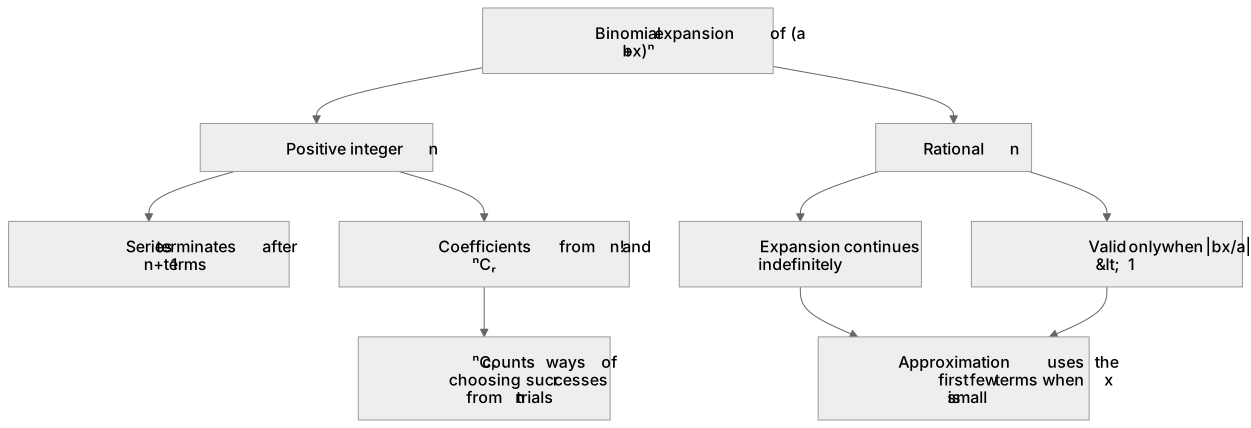
The binomial expansion writes (a + bx)ⁿ as a sum of terms. For positive integer n the series terminates after n + 1 terms, and coefficients come from n! and ⁿCᵣ, where n! = n × (n − 1) × ... × 1 and ⁿCᵣ = n! ÷ [r!(n − r)!]. These same coefficients count combinations in binomial probability. For rational n, including negative and fractional values, the expansion continues indefinitely and is valid only when |bx/a| < 1. For example, (1 + 2x)⁻¹ expands to 1 − 2x + 4x² − ... valid for |x| < 1/2. Approximation uses the first few terms when x is small, and the validity condition ensures the infinite series converges.
What earns the marks
- Expands (a + bx)ⁿ for positive integer n using ⁿCᵣ coefficients and correct ascending powers of x.
- Evaluates n! and ⁿCᵣ correctly, including cases such as ⁵C₂ = 10 and 4! = 24.
- Links binomial coefficients to binomial probability by identifying ⁿCᵣ as the number of ways of choosing r successes from n trials.
- Extends the expansion to rational n, forming the general term with the product of descending factors divided by r!.
- States and applies the validity condition |bx/a| < 1, and uses a sufficient number of terms to approximate a value to a required accuracy.
Common mistakes and how to put them right
Treating a rational-n expansion as finite and stopping after a few terms.
Put it right: Continue the pattern and state that the series is infinite.
Omitting the validity condition or writing it as |x| < 1 regardless of a and b.
Put it right: Derive |bx/a| < 1 from the ratio of successive terms.
Miscomputing ⁿCᵣ by cancelling factorials incorrectly.
Put it right: Use ⁿCᵣ = n! ÷ [r!(n − r)!] and check with a small case.
Exam tips
- Write the general term first, then substitute r values, so the pattern and signs stay consistent.
- State the validity condition in the same line as the expansion to avoid losing that mark.
- For approximations, keep one more term than the required accuracy suggests, then round at the end.
Try the lesson
The start of the Sequences and series: 4.1 Understand and use the binomial expansion of (a + bx)ⁿ for positive integer n; the notations n! and ⁿCᵣ link to binomial probabilities. Extend to any rational n, including its use for approximation; be aware that the expansion is valid for |bx/a| < 1 (proof not required). lesson, made from checked teaching notes for this specification point.
Have a go first
Use the binomial expansion to find the coefficient of x² in the expansion of (1 + 3x)⁵.
Listen
The binomial expansion writes (a + bx)ⁿ as a sum of terms. For positive integer n the series terminates after n + 1 terms, and coefficients come from n! and ⁿCᵣ, where n! = n × (n − 1) × ... × 1 and ⁿCᵣ = n! ÷ [r!(n − r)! These same coefficients count combinations in binomial probability. For rational n, including negative and fractional values, the expansion continues indefinitely and is valid only when |bx/a| < 1. For example, (1 + 2x)⁻¹ expands to 1 − 2x + 4x² − ... valid for |x| < 1/2. Approximation uses the first few terms when x is small, and the validity condition ensures the infinite series converges. A strong answer earns marks for these points. Expands (a + bx)ⁿ for positive integer n using ⁿCᵣ coefficients and correct ascending powers of x. Evaluates n! and ⁿCᵣ correctly, including cases such as ⁵C₂ = 10 and 4! = 24. Links binomial coefficients to binomial probability by identifying ⁿCᵣ as the number of ways of choosing r successes from n trials. Extends the expansion to rational n, forming the general term with the product of descending factors divided by r! A common slip: Treating a rational-n expansion as finite and stopping after a few terms. Instead, continue the pattern and state that the series is infinite. Exam tip: Write the general term first, then substitute r values, so the pattern and signs stay consistent.
See it
Key words
Say what each word means before you turn the card.
n!
Try answering aloud or in your head before turning the card.
ⁿCᵣ
Try answering aloud or in your head before turning the card.
Finite versus infinite binomial series
Try answering aloud or in your head before turning the card.
Validity condition
Try answering aloud or in your head before turning the card.
See every definition
- n!
- The product n × (n − 1) × ... × 1, used with ⁿCᵣ to give the coefficients of the expansion.
- ⁿCᵣ
- Equal to n! ÷ [r!(n − r)!], counting the number of ways of choosing r successes from n trials in binomial probability.
- Finite versus infinite binomial series
- For positive integer n the series terminates after n + 1 terms, while for rational n the expansion continues indefinitely.
- Validity condition
- The expansion for rational n is valid only when |bx/a| < 1, which ensures the infinite series converges.
Label the diagram
Some boxes have lost their names. Pick the right name for each number.
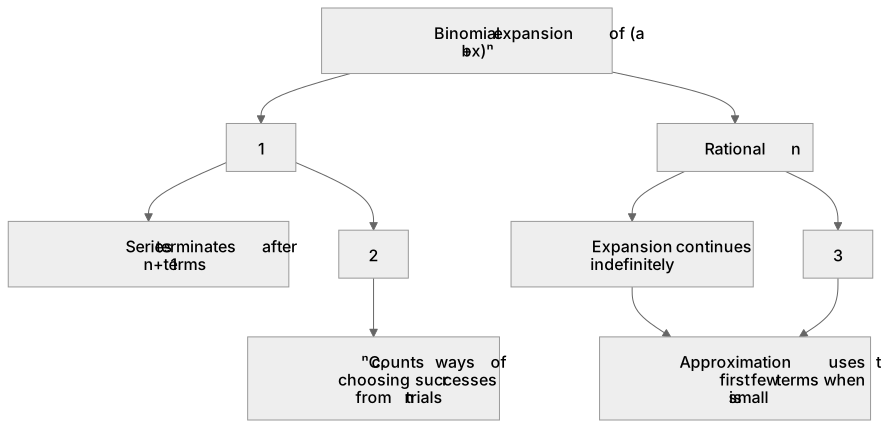
1Box 1
2Box 2
3Box 3
There is more to this lesson
The full lesson goes on to check your understanding and help you earn the marks. Create a free account to carry on, with your progress saved.
A week of Premium from your first lesson · Then the free plan continues · No card, no charge
Test your understanding of Sequences and series: 4.1 Understand and use the binomial expansion of (a + bx)ⁿ for positive integer n; the notations n! and ⁿCᵣ link to binomial probabilities. Extend to any rational n, including its use for approximation; be aware that the expansion is valid for |bx/a| < 1 (proof not required).
Active recall beats re-reading. Take an instant quiz now to test what you’ve learned and lock it into long-term memory.
A week of Premium from your first lesson · Then the free plan continues · No card, no charge