Pearson Edexcel · A-Level · Mathematics
Course version: 9MA0 · Version from Mar 2026
Work with sequences including those given by a formula for the nth term…
Full specification wording
Sequences and series: 4.2 Work with sequences including those given by a formula for the nth term and those generated by a simple relation of the form xₙ₊₁ = f(xₙ); increasing sequences; decreasing sequences; periodic sequences.
A sequence is an ordered list of terms.
Checked against the Pearson Edexcel 9MA0 specification (opens in a new tab) on .
- Point 2 of 6
- 4 key terms
Study notes
From the checked teaching notes for this specification point.
The idea
A sequence is an ordered list of terms. Some sequences have an explicit formula for the nth term, such as uₙ = 3n + 1, so any term can be found directly. Others are defined recursively by a relation like xₙ₊₁ = f(xₙ), where each term depends on the previous one; these need a starting value. Sequences are classified by behaviour: increasing if every term is greater than the one before, decreasing if every term is smaller, and periodic if a block of terms repeats, with the period being the length of that block. For example, xₙ₊₁ = xₙ + 4 with x₁ = 1 gives 1, 5, 9, 13, an increasing sequence. Checking differences or ratios between consecutive terms identifies the type.
What earns the marks
- Generates terms from an nth-term formula by substituting n = 1, 2, 3, ... in order.
- Uses a recurrence relation xₙ₊₁ = f(xₙ) with a given initial term to produce successive terms accurately.
- Classifies a sequence as increasing, decreasing or periodic by comparing consecutive terms or identifying a repeating block.
- States the period of a periodic sequence by counting the terms in the repeating cycle.
- Distinguishes between explicit and recursive definitions and explains when each is more useful.
Common mistakes and how to put them right
Starting a recurrence from the wrong initial value or using xₙ instead of xₙ₊₁.
Put it right: Label the first term clearly and apply the relation step by step.
Calling a sequence increasing when only some early terms rise.
Put it right: Check the general comparison xₙ₊₁ > xₙ across the stated range.
Miscounting the period by including the repeated term twice.
Put it right: Identify the shortest block that repeats exactly.
Exam tips
- List terms in a table with n and xₙ columns to keep the recurrence steps visible.
- For periodic sequences, write out at least two full cycles before stating the period.
- When asked to classify, give the comparison or repeating block as justification, not just the label.
Try the lesson
The start of the Sequences and series: 4.2 Work with sequences including those given by a formula for the nth term and those generated by a simple relation of the form xₙ₊₁ = f(xₙ); increasing sequences; decreasing sequences; periodic sequences. lesson, made from checked teaching notes for this specification point.
Have a go first
A sequence is defined by the formula uₙ = 3n + 2 for n ≥ 1. Find the first four terms of the sequence.
Listen
A sequence is an ordered list of terms. Some sequences have an explicit formula for the nth term, such as uₙ = 3n + 1, so any term can be found directly. Others are defined recursively by a relation like xₙ₊₁ = f(xₙ), where each term depends on the previous one; these need a starting value. Sequences are classified by behaviour: increasing if every term is greater than the one before, decreasing if every term is smaller, and periodic if a block of terms repeats, with the period being the length of that block. For example, xₙ₊₁ = xₙ + 4 with x₁ = 1 gives 1, 5, 9, 13, an increasing sequence. Checking differences or ratios between consecutive terms identifies the type. A strong answer earns marks for these points. Generates terms from an nth-term formula by substituting n = 1, 2, 3, ... in order. Uses a recurrence relation xₙ₊₁ = f(xₙ) with a given initial term to produce successive terms accurately. Classifies a sequence as increasing, decreasing or periodic by comparing consecutive terms or identifying a repeating block. States the period of a periodic sequence by counting the terms in the repeating cycle. A common slip: Starting a recurrence from the wrong initial value or using xₙ instead of xₙ₊₁. Instead, label the first term clearly and apply the relation step by step. Exam tip: List terms in a table with n and xₙ columns to keep the recurrence steps visible.
See it
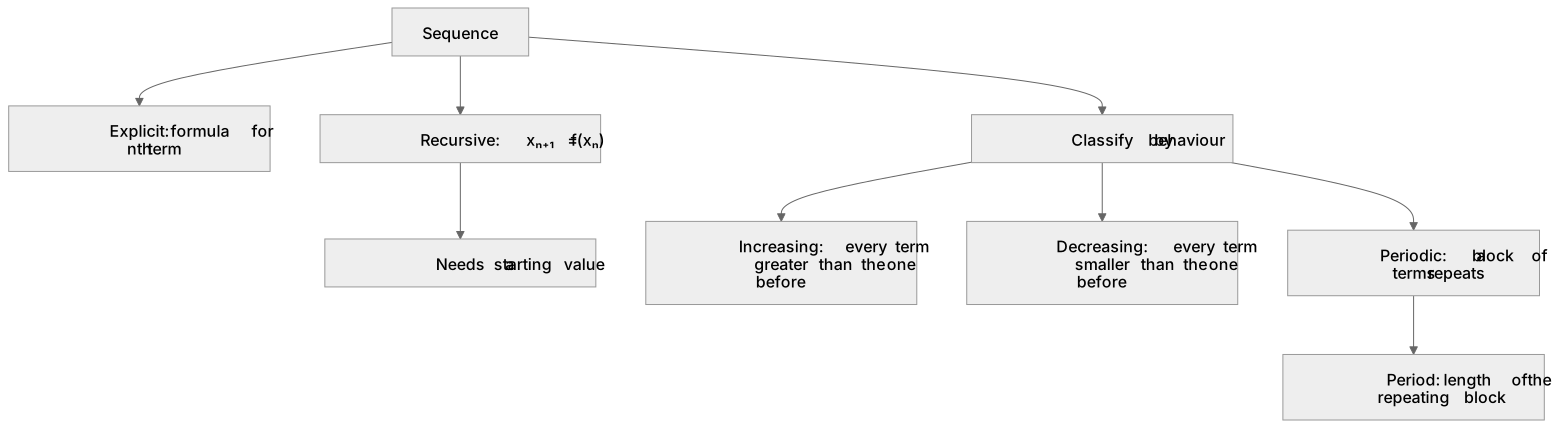
Key words
Say what each word means before you turn the card.
Explicit formula
Try answering aloud or in your head before turning the card.
Recursive definition
Try answering aloud or in your head before turning the card.
Increasing sequence
Try answering aloud or in your head before turning the card.
Periodic sequence
Try answering aloud or in your head before turning the card.
See every definition
- Explicit formula
- A formula for the nth term, such as uₙ = 3n + 1, so any term can be found directly.
- Recursive definition
- A relation like xₙ₊₁ = f(xₙ) where each term depends on the previous one, so a starting value is needed.
- Increasing sequence
- A sequence in which every term is greater than the one before.
- Periodic sequence
- A sequence in which a block of terms repeats, with the period being the length of that block.
Label the diagram
Some boxes have lost their names. Pick the right name for each number.
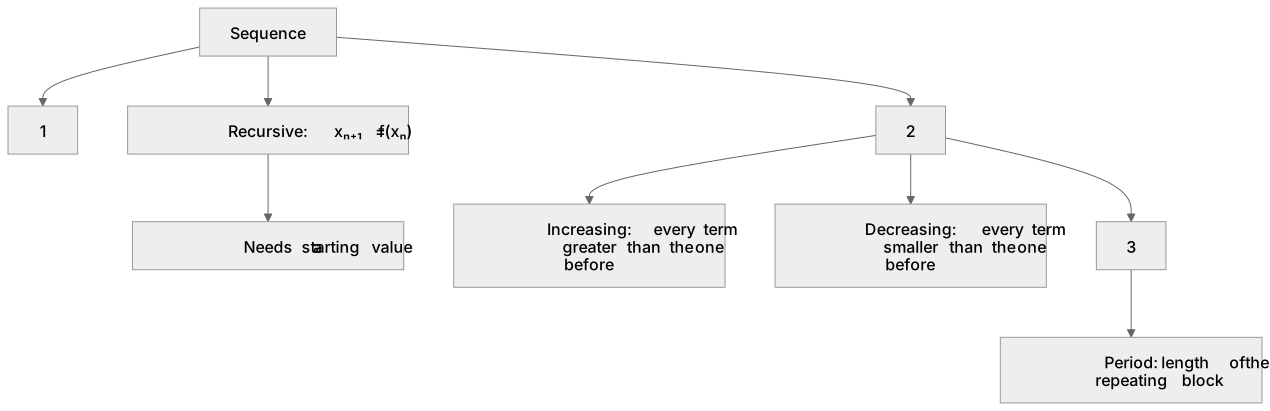
1Box 1
2Box 2
3Box 3
There is more to this lesson
The full lesson goes on to check your understanding and help you earn the marks. Create a free account to carry on, with your progress saved.
A week of Premium from your first lesson · Then the free plan continues · No card, no charge
Test your understanding of Sequences and series: 4.2 Work with sequences including those given by a formula for the nth term and those generated by a simple relation of the form xₙ₊₁ = f(xₙ); increasing sequences; decreasing sequences; periodic sequences.
Active recall beats re-reading. Take an instant quiz now to test what you’ve learned and lock it into long-term memory.
A week of Premium from your first lesson · Then the free plan continues · No card, no charge