Pearson Edexcel · A-Level · Mathematics
Course version: 9MA0 · Version from Mar 2026
Understand and work with arithmetic sequences and series, including the…
Full specification wording
Sequences and series: 4.4 Understand and work with arithmetic sequences and series, including the formulae for nth term and the sum to n terms.
An arithmetic sequence adds a constant common difference d to each term, so a, a + d, a + 2d, ...
Checked against the Pearson Edexcel 9MA0 specification (opens in a new tab) on .
- Point 4 of 6
- 4 key terms
Study notes
From the checked teaching notes for this specification point.
The idea
An arithmetic sequence adds a constant common difference d to each term, so a, a + d, a + 2d, ... The nth term is uₙ = a + (n − 1)d, where a is the first term. The sum of the first n terms is Sₙ = n/2[2a + (n − 1)d], equivalently Sₙ = n/2(a + l) when the last term l is known. For example, 5, 8, 11, 14, ... has a = 5 and d = 3, so u₁₀ = 5 + 9 × 3 = 32 and S₁₀ = 10/2(2 × 5 + 9 × 3) = 5 × 37 = 185. To work with these, identify a and d, substitute into the correct formula, and solve the resulting linear or quadratic equation. Recognise that d may be negative or a fraction, and that n must be a positive integer.
What earns the marks
- States uₙ = a + (n − 1)d and substitutes the correct a, d and n to find a term or to form an equation.
- Uses Sₙ = n/2[2a + (n − 1)d] or Sₙ = n/2(a + l), choosing the form that matches the given information.
- Finds a and d from contextual or algebraic information, for example from two given terms or from simultaneous equations.
- Solves equations arising from uₙ or Sₙ, including quadratic equations in n, and rejects non-integer or non-positive values of n.
- Interprets the result in context, such as identifying which term number gives a stated value or the total after a given number of terms.
Common mistakes and how to put them right
Using uₙ = a + nd instead of a + (n − 1)d.
Put it right by subtracting 1 from n before multiplying by d.
Treating d as always positive.
Put it right by calculating d = u₂ − u₁ and retaining its sign.
Accepting a negative or fractional value of n from a quadratic.
Put it right by rejecting it because n counts terms and must be a positive integer.
Exam tips
- Write down a and d explicitly before substituting, so arithmetic slips are easier to spot.
- When two terms are given, form two equations and solve simultaneously rather than guessing a and d.
- Check a sum by adding the first few terms manually or by using Sₙ = n/2(a + l) as a second method.
Try the lesson
The start of the Sequences and series: 4.4 Understand and work with arithmetic sequences and series, including the formulae for nth term and the sum to n terms. lesson, made from checked teaching notes for this specification point.
Have a go first
An arithmetic sequence begins 8, 13, 18, 23, ... What is the 20th term of this sequence?
Listen
An arithmetic sequence adds a constant common difference d to each term, so a, a + d, a + 2d, ... The nth term is uₙ = a + (n − 1)d, where a is the first term. The sum of the first n terms is Sₙ = n/2[2a + (n − 1)d], equivalently Sₙ = n/2(a + l) when the last term l is known. For example, 5, 8, 11, 14, ... has a = 5 and d = 3, so u₁₀ = 5 + 9 × 3 = 32 and S₁₀ = 10/2(2 × 5 + 9 × 3) = 5 × 37 = 185. To work with these, identify a and d, substitute into the correct formula, and solve the resulting linear or quadratic equation. Recognise that d may be negative or a fraction, and that n must be a positive integer. A strong answer earns marks for these points. States uₙ = a + (n − 1)d and substitutes the correct a, d and n to find a term or to form an equation. Uses Sₙ = n/2[2a + (n − 1)d] or Sₙ = n/2(a + l), choosing the form that matches the given information. Finds a and d from contextual or algebraic information, for example from two given terms or from simultaneous equations. Solves equations arising from uₙ or Sₙ, including quadratic equations in n, and rejects non-integer or non-positive values of n. A common slip: Using uₙ = a + nd instead of a + (n − 1)d. Instead, subtracting 1 from n before multiplying by d. Exam tip: Write down a and d explicitly before substituting, so arithmetic slips are easier to spot.
See it
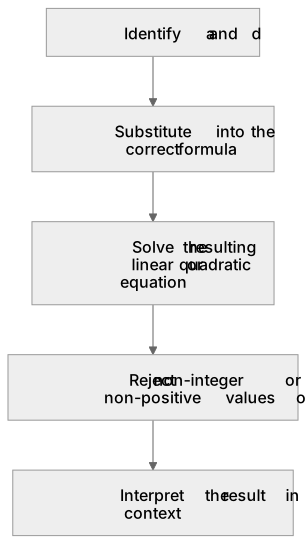
Put it in order
Put these steps in the order they happen.
- 1. Substitute into the correct formula
- 2. Solve the resulting linear or quadratic equation
- 3. Identify a and d
- 4. Interpret the result in context
- 5. Reject non-integer or non-positive values of n
Key words
Say what each word means before you turn the card.
nth term formula
Try answering aloud or in your head before turning the card.
Sum of an arithmetic series
Try answering aloud or in your head before turning the card.
Common difference and linear structure
Try answering aloud or in your head before turning the card.
Forming and solving equations in n
Try answering aloud or in your head before turning the card.
See every definition
- nth term formula
- The nth term is uₙ = a + (n − 1)d, where a is the first term and d is the common difference.
- Sum of an arithmetic series
- The sum of the first n terms is Sₙ = n/2[2a + (n − 1)d], equivalently Sₙ = n/2(a + l) when the last term l is known.
- Common difference and linear structure
- An arithmetic sequence adds a constant common difference d to each term, so a, a + d, a + 2d, ...; d may be negative or a fraction.
- Forming and solving equations in n
- Identify a and d, substitute into the correct formula, and solve the resulting linear or quadratic equation, rejecting non-integer or non-positive values of n.
Label the diagram
Some boxes have lost their names. Pick the right name for each number.
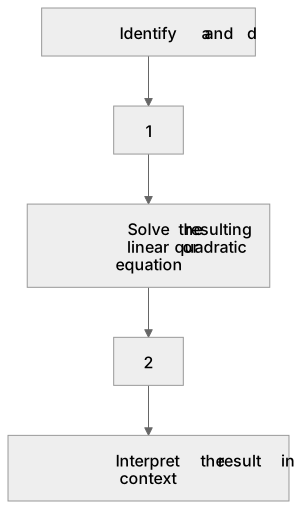
1Box 1
2Box 2
There is more to this lesson
The full lesson goes on to check your understanding and help you earn the marks. Create a free account to carry on, with your progress saved.
A week of Premium from your first lesson · Then the free plan continues · No card, no charge
Test your understanding of Sequences and series: 4.4 Understand and work with arithmetic sequences and series, including the formulae for nth term and the sum to n terms.
Active recall beats re-reading. Take an instant quiz now to test what you’ve learned and lock it into long-term memory.
A week of Premium from your first lesson · Then the free plan continues · No card, no charge