Pearson Edexcel · A-Level · Mathematics
Course version: 9MA0 · Version from Mar 2026
Understand and work with geometric sequences and series, including the…
Full specification wording
Sequences and series: 4.5 Understand and work with geometric sequences and series, including the formulae for the nth term and the sum of a finite geometric series; the sum to infinity of a convergent geometric series, including the use of |r| < 1; modulus notation.
A geometric sequence multiplies by a constant common ratio r each time, so a, ar, ar², ar³, ...
Checked against the Pearson Edexcel 9MA0 specification (opens in a new tab) on .
- Point 5 of 6
- 4 key terms
Study notes
From the checked teaching notes for this specification point.
The idea
A geometric sequence multiplies by a constant common ratio r each time, so a, ar, ar², ar³, ... The nth term is uₙ = ar^(n − 1). The sum of the first n terms is Sₙ = a(1 − rⁿ)/(1 − r) for r ≠ 1, or equivalently a(rⁿ − 1)/(r − 1). When |r| < 1 the terms shrink towards zero and the series converges to S∞ = a/(1 − r); the modulus notation |r| < 1 means r lies strictly between −1 and 1. For example, 8, 4, 2, 1, ... has a = 8 and r = ½, so u₆ = 8 × (½)⁵ = ¼ and S∞ = 8/(1 − ½) = 16. Identify a and r, check convergence before using S∞, and solve equations involving powers, often using logarithms.
What earns the marks
- States uₙ = ar^(n − 1) and substitutes the correct a, r and n to find a term or form an equation.
- Uses Sₙ = a(1 − rⁿ)/(1 − r) for a finite geometric series, including when r is negative or fractional.
- Applies the convergence condition |r| < 1 and calculates S∞ = a/(1 − r) only when that condition holds.
- Finds a or r from given terms, for example by dividing two terms to eliminate a, and handles negative or fractional ratios.
- Solves equations involving rⁿ, using logarithms where necessary, and interprets whether a series converges or diverges.
Common mistakes and how to put them right
Using uₙ = arⁿ instead of ar^(n − 1).
Put it right by using the exponent n − 1.
Applying S∞ = a/(1 − r) when |r| ≥ 1.
Put it right by checking the modulus condition first and stating that the series diverges.
Dividing terms in the wrong order when finding r.
Put it right by dividing a later term by the previous term, uₙ₊₁ ÷ uₙ.
Exam tips
- State the value of r and check |r| < 1 before quoting a sum to infinity.
- When r is negative, keep the sign throughout and check whether terms alternate.
- For equations in n, take logarithms of both sides and round up if the context requires a whole number of terms.
Try the lesson
The start of the Sequences and series: 4.5 Understand and work with geometric sequences and series, including the formulae for the nth term and the sum of a finite geometric series; the sum to infinity of a convergent geometric series, including the use of |r| < 1; modulus notation. lesson, made from checked teaching notes for this specification point.
Have a go first
A geometric sequence has first term 3 and common ratio 2. What is the 6th term of this sequence?
Listen
A geometric sequence multiplies by a constant common ratio r each time, so a, ar, ar², ar³, ... The nth term is uₙ = ar^(n − 1). The sum of the first n terms is Sₙ = a(1 − rⁿ)/(1 − r) for r ≠ 1, or equivalently a(rⁿ − 1)/(r − 1). When |r| < 1 the terms shrink towards zero and the series converges to S∞ = a/(1 − r); the modulus notation |r| < 1 means r lies strictly between −1 and 1. For example, 8, 4, 2, 1, ... has a = 8 and r = ½, so u₆ = 8 × (½)⁵ = ¼ and S∞ = 8/(1 − ½) = 16. Identify a and r, check convergence before using S∞, and solve equations involving powers, often using logarithms. A strong answer earns marks for these points. States uₙ = ar^(n − 1) and substitutes the correct a, r and n to find a term or form an equation. Uses Sₙ = a(1 − rⁿ)/(1 − r) for a finite geometric series, including when r is negative or fractional. Applies the convergence condition |r| < 1 and calculates S∞ = a/(1 − r) only when that condition holds. Finds a or r from given terms, for example by dividing two terms to eliminate a, and handles negative or fractional ratios. A common slip: Using uₙ = arⁿ instead of ar^(n − 1). Instead, using the exponent n − 1. Exam tip: State the value of r and check |r| < 1 before quoting a sum to infinity.
See it
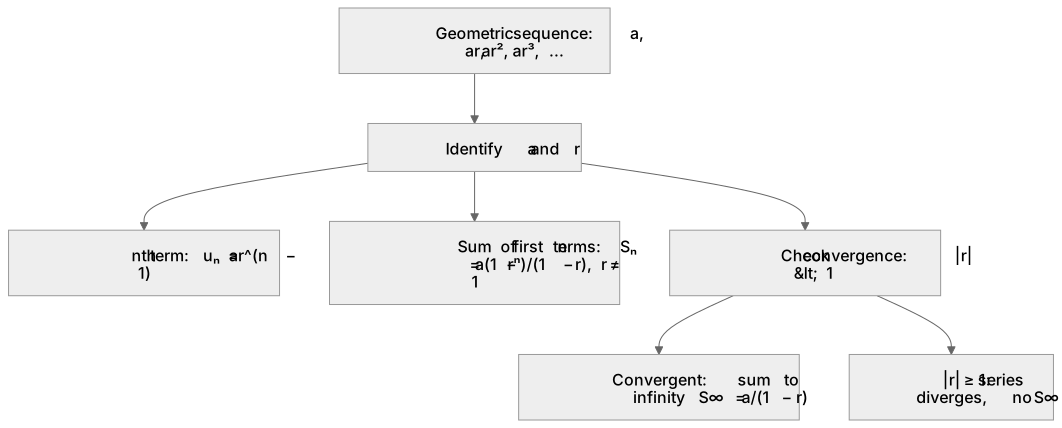
Key words
Say what each word means before you turn the card.
nth term formula
Try answering aloud or in your head before turning the card.
Sum of a finite geometric series
Try answering aloud or in your head before turning the card.
Convergence and sum to infinity
Try answering aloud or in your head before turning the card.
Modulus notation
Try answering aloud or in your head before turning the card.
See every definition
- nth term formula
- The nth term is uₙ = ar^(n − 1), found by substituting the correct a, r and n.
- Sum of a finite geometric series
- The sum of the first n terms is Sₙ = a(1 − rⁿ)/(1 − r) for r ≠ 1, or equivalently a(rⁿ − 1)/(r − 1).
- Convergence and sum to infinity
- When |r| < 1 the terms shrink towards zero and the series converges to S∞ = a/(1 − r).
- Modulus notation
- The notation |r| < 1 means r lies strictly between −1 and 1.
Label the diagram
Some boxes have lost their names. Pick the right name for each number.
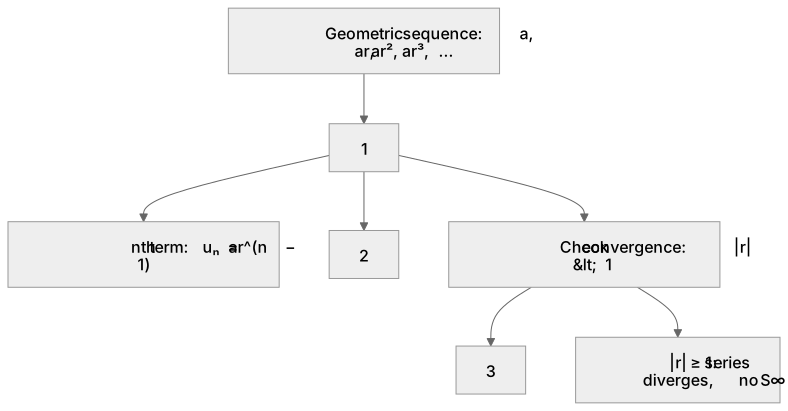
1Box 1
2Box 2
3Box 3
There is more to this lesson
The full lesson goes on to check your understanding and help you earn the marks. Create a free account to carry on, with your progress saved.
A week of Premium from your first lesson · Then the free plan continues · No card, no charge
Test your understanding of Sequences and series: 4.5 Understand and work with geometric sequences and series, including the formulae for the nth term and the sum of a finite geometric series; the sum to infinity of a convergent geometric series, including the use of |r| < 1; modulus notation.
Active recall beats re-reading. Take an instant quiz now to test what you’ve learned and lock it into long-term memory.
A week of Premium from your first lesson · Then the free plan continues · No card, no charge