Pearson Edexcel · A-Level · Mathematics
Course version: 9MA0 · Version from Mar 2026
Sequences and series: 4.6 Use sequences and series in modelling.
Modelling translates a real situation into a sequence (individual terms) or series (cumulative totals).
Checked against the Pearson Edexcel 9MA0 specification (opens in a new tab) on .
- Point 6 of 6
- 4 key terms
Study notes
From the checked teaching notes for this specification point.
The idea
Modelling translates a real situation into a sequence (individual terms) or series (cumulative totals). Decide if the pattern is arithmetic (constant difference) or geometric (constant ratio), define n, and state units. For example, a salary starting at £24 000 (n=1) with a £900 annual rise is arithmetic (a = 24 000, d = 900). The 10th year salary (sequence) is 24 000 + 9(900) = £32 100. The total earned over 10 years (series) is (10/2)[2(24 000) + 9(900)] = 5[48 000 + 8 100] = £280 500. A car worth £18 000 losing 15% each year is geometric (r = 0.85); after 5 full years, its value is 18 000 × 0.85⁵ ≈ £7 986.70. Check if n starts at 0 or 1, and if the answer needs rounding.
What earns the marks
- Identifies whether a context is arithmetic or geometric from the wording, such as a fixed annual increase or a percentage change.
- Defines a, d or r and n with correct units and states what n represents, including whether the first term corresponds to n = 0 or n = 1.
- Forms and solves an equation or inequality from the model, for example finding when a value first exceeds a target.
- Distinguishes between finding a specific term (sequence) and a cumulative total (series), applying the correct formula.
- Interprets the solution in context, including rounding to a sensible degree of accuracy and rejecting values that do not fit the situation.
Common mistakes and how to put them right
Confusing a percentage increase with a common difference.
Put it right by converting a percentage change into a multiplier, for example a 15% decrease gives r = 0.85.
Miscounting the number of steps because n starts at 0 rather than 1.
Put it right by writing out the first few terms to check the indexing and defining n explicitly.
Calculating the nth term instead of the sum of n terms (or vice versa).
Put it right by reading carefully whether the question asks for a value in a specific year or a total over a period.
Exam tips
- Underline the words that indicate the type of change, such as 'increases by £900' or 'decreases by 15% each year'.
- Define your variables in words before substituting, and keep units with every value.
Try the lesson
The start of the Sequences and series: 4.6 Use sequences and series in modelling. lesson, made from checked teaching notes for this specification point.
Have a go first
A savings scheme pays £50 in the first month and increases the payment by £10 each month. How much is paid in the 8th month?
Listen
Modelling translates a real situation into a sequence (individual terms) or series (cumulative totals). Decide if the pattern is arithmetic (constant difference) or geometric (constant ratio), define n, and state units. For example, a salary starting at £24 000 (n=1) with a £900 annual rise is arithmetic (a = 24 000, d = 900). The 10th year salary (sequence) is 24 000 + 9(900) = £32 100. The total earned over 10 years (series) is (10/2)[2(24 000) + 9(900)] = 5[48 000 + 8 100] = £280 500. A car worth £18 000 losing 15% each year is geometric (r = 0.85); after 5 full years, its value is 18 000 × 0.85⁵ ≈ £7 986.70. Check if n starts at 0 or 1, and if the answer needs rounding. A strong answer earns marks for these points. Identifies whether a context is arithmetic or geometric from the wording, such as a fixed annual increase or a percentage change. Defines a, d or r and n with correct units and states what n represents, including whether the first term corresponds to n = 0 or n = 1. Forms and solves an equation or inequality from the model, for example finding when a value first exceeds a target. Distinguishes between finding a specific term (sequence) and a cumulative total (series), applying the correct formula. A common slip: Confusing a percentage increase with a common difference. Instead, converting a percentage change into a multiplier, for example a 15% decrease gives r = 0.85. Exam tip: Underline the words that indicate the type of change, such as 'increases by £900' or 'decreases by 15% each year'.
See it
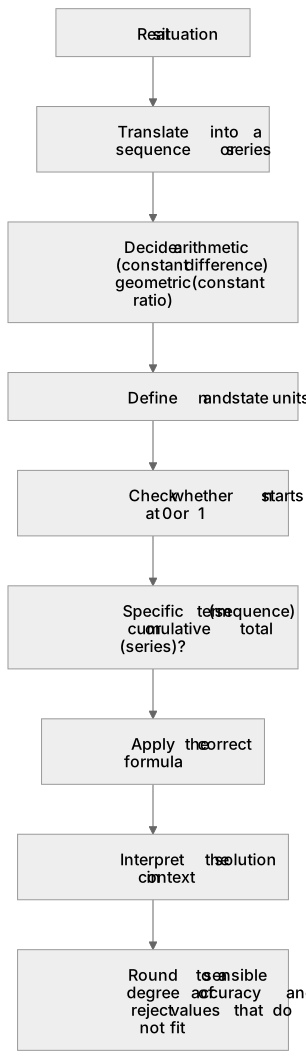
Key words
Say what each word means before you turn the card.
Modelling
Try answering aloud or in your head before turning the card.
Arithmetic
Try answering aloud or in your head before turning the card.
Geometric
Try answering aloud or in your head before turning the card.
Series
Try answering aloud or in your head before turning the card.
See every definition
- Modelling
- Translates a real situation into a sequence of individual terms or a series of cumulative totals.
- Arithmetic
- Describes a pattern with a constant difference between terms.
- Geometric
- Describes a pattern with a constant ratio between terms.
- Series
- Represents cumulative totals, as opposed to a sequence of individual terms.
Label the diagram
Some boxes have lost their names. Pick the right name for each number.
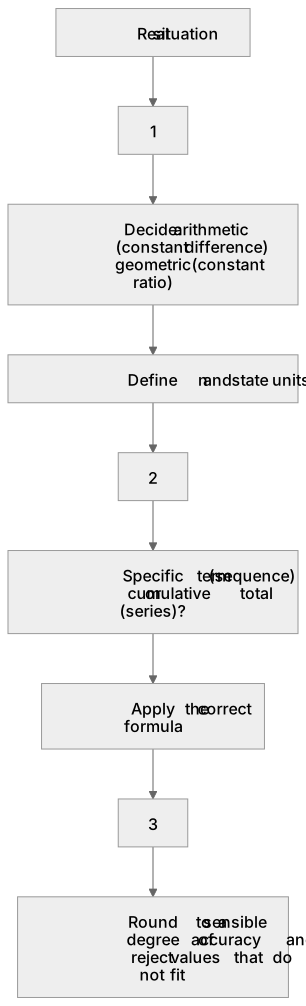
1Box 1
2Box 2
3Box 3
There is more to this lesson
The full lesson goes on to check your understanding and help you earn the marks. Create a free account to carry on, with your progress saved.
A week of Premium from your first lesson · Then the free plan continues · No card, no charge
Test your understanding of Sequences and series: 4.6 Use sequences and series in modelling.
Active recall beats re-reading. Take an instant quiz now to test what you’ve learned and lock it into long-term memory.
A week of Premium from your first lesson · Then the free plan continues · No card, no charge