OCR · GCSE · Music
Accuracy
This guide provides a comprehensive overview of Accuracy (1.2) for OCR GCSE Music, a critical component of the Technical Control assessment. It details how to achieve precision in pitch, rhythm, and fluency to secure top marks in both performance and listening exams.
- 8 min read
- 3 worked examples
- 4 practice questions
- 6 key terms
Check what you remember
Read the wording for your board, then hide it and explain Accuracy in your own words. Rough notes are fine. This is a self-check, with no mark or grade.
Reference: OCR
The correct execution of pitch, rhythm, and fluency in a musical performance, as dictated by the score and stylistic conventions.
Study Notes
Overview
In OCR GCSE Music, Accuracy is a foundational assessment criterion within the ‘Technical Control’ strand of the Integrated Portfolio (AO2) and Practical Component. It underpins all successful performances and is a prerequisite for earning credit in expressive and interpretative domains. Examiners define accuracy through three key pillars: pitch accuracy, rhythmic accuracy, and fluency. Without a secure demonstration of all three, candidates cannot access the higher mark bands. This guide will break down exactly what examiners are listening for and provide practical strategies to improve your technical precision.
Key Knowledge & Theory
Core Concepts
Accuracy is not merely about avoiding errors; it is about demonstrating complete control over the musical material. This involves a deep understanding of notation and the ability to translate it into sound with precision.
-
Pitch Accuracy & Intonation: This refers to playing or singing the correct notes as written in the score. For instruments with variable pitch (e.g., strings, voice, brass), this extends to intonation—the precise centering of each note. An examiner’s report might state, ‘Credit was given for secure intonation across the full tessitura of the instrument.’ This means the candidate was in tune even in the very high and low registers.
-
Rhythmic Accuracy & Pulse: This involves performing the correct durations for all notes and rests. Crucially, it also includes the ability to maintain a consistent pulse (tempo) throughout a piece. Rushing in difficult passages or dragging in slower ones is a common fault. In an ensemble context, rhythmic accuracy also covers synchronisation—the ability to stay perfectly in time with other performers.
-
Fluency: This is the seamless connection of notes and phrases. A performance can be note-perfect but still lack fluency if it sounds hesitant or cautious. The OCR mark scheme explicitly links fluency to accuracy; any stumbling, hesitation, or restarting will significantly lower the mark awarded for Technical Control.
Key Practitioners/Artists/Composers
While accuracy is a universal skill, studying performers known for their technical precision can provide an excellent model. Listening to their recordings can help internalise what flawless execution sounds like.
| Name | Period/Style | Key Works | Relevance |
|---|---|---|---|
| Glenn Gould | 20th Century / Baroque Specialist | Bach: Goldberg Variations (1955 & 1981 recordings) | Famed for his almost mechanical precision and clarity of articulation. His recordings are masterclasses in rhythmic and pitch accuracy, even if his interpretations were sometimes unconventional. |
| Hilary Hahn | Contemporary / Classical & Modern | Bach: Sonatas and Partitas for Solo Violin | Renowned for her flawless intonation and technical command. Her playing demonstrates how accuracy forms the foundation for profound musical expression. |
| Steve Reich | 20th Century / Minimalism | Music for 18 Musicians | Reich's music demands extreme rhythmic accuracy and synchronisation from performers, often involving complex polyrhythms and phasing patterns. It highlights the importance of a shared, stable pulse. |
Technical Vocabulary
Using this terminology in your coursework annotations and written exam answers will demonstrate a higher level of understanding.
- Intonation: The accuracy of pitch in playing or singing. Being ‘in tune’.
- Tessitura: The most comfortable and commonly used part of a vocalist's or instrument's range.
- Pulse: The underlying steady beat of a piece of music.
- Syncopation: A rhythmic device where the emphasis is placed on off-beats or weak beats.
- Fluency: The quality of flowing smoothly and without hesitation.
- Articulation: The manner in which a note is played or a phrase is shaped (e.g., staccato, legato). While distinct from accuracy, poor articulation can sometimes be mistaken for rhythmic inaccuracy.
Practical Skills
Techniques & Processes
- Slow, Deliberate Practice: Use a metronome at a very slow tempo (e.g., half-speed). Focus on playing every note and rhythm perfectly. Only increase the speed when you can play the passage flawlessly three times in a row.
- Isolate Difficult Passages: Don't just play the piece from start to finish. Identify the 2-4 bars that always cause trouble. Loop them repeatedly, applying the slow practice technique.
- Rhythmic Gridding: For complex rhythms, write the counting (e.g., ‘1 e & a 2 e & a’) underneath the notes in your score. Clap or tap the rhythm while counting aloud before playing it.
- Record and Analyse: Record your practice sessions. When you listen back, you are acting as the examiner. You will hear intonation issues and rhythmic inconsistencies that you miss while playing.
Materials & Equipment
- Metronome: Your most important tool for developing rhythmic accuracy and a stable pulse. Use a physical metronome or a reliable app.
- Tuner: Essential for string, brass, and woodwind players to check and improve intonation. Use it to tune your instrument before playing and to check the pitch of sustained notes.
- Recording Device: A smartphone is perfectly adequate. The purpose is not high-fidelity audio, but an objective record of your performance for self-assessment.
Portfolio/Coursework Guidance
Assessment Criteria
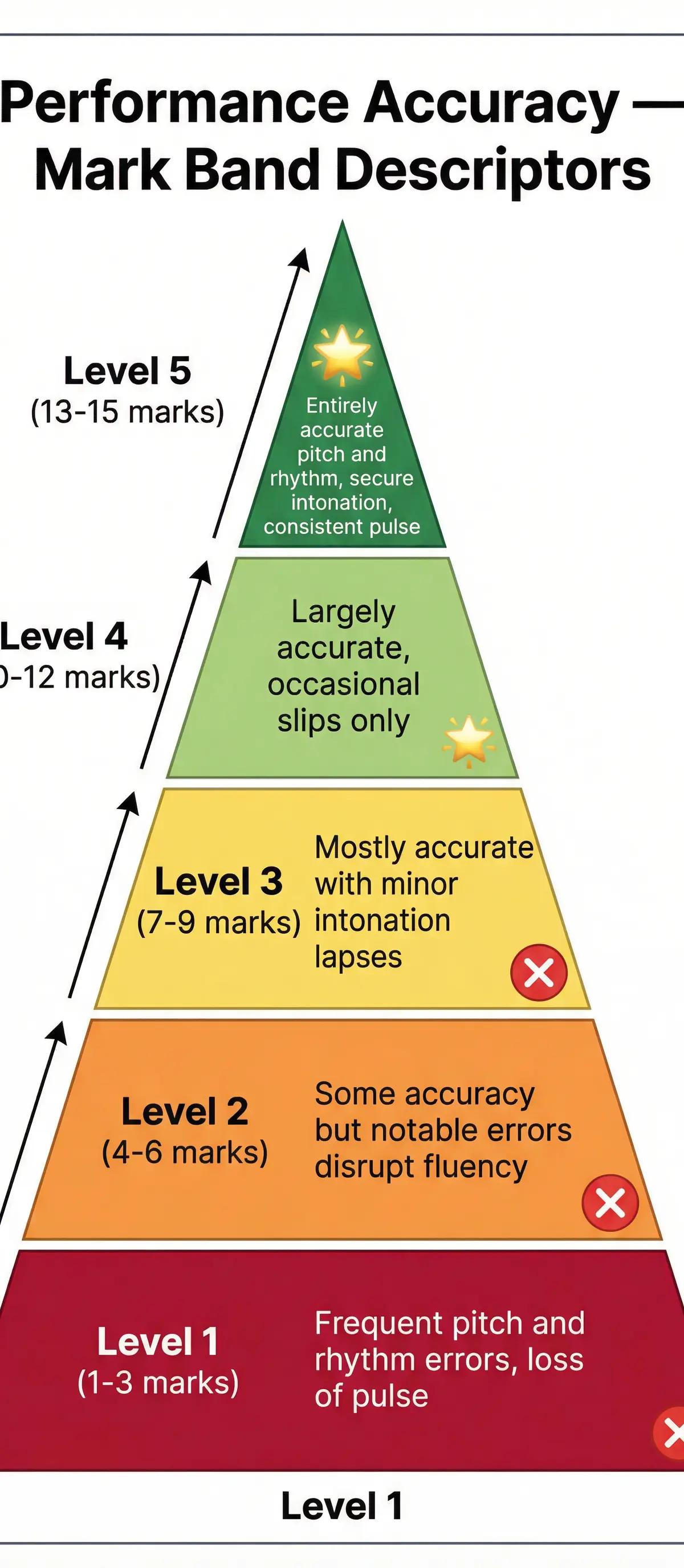
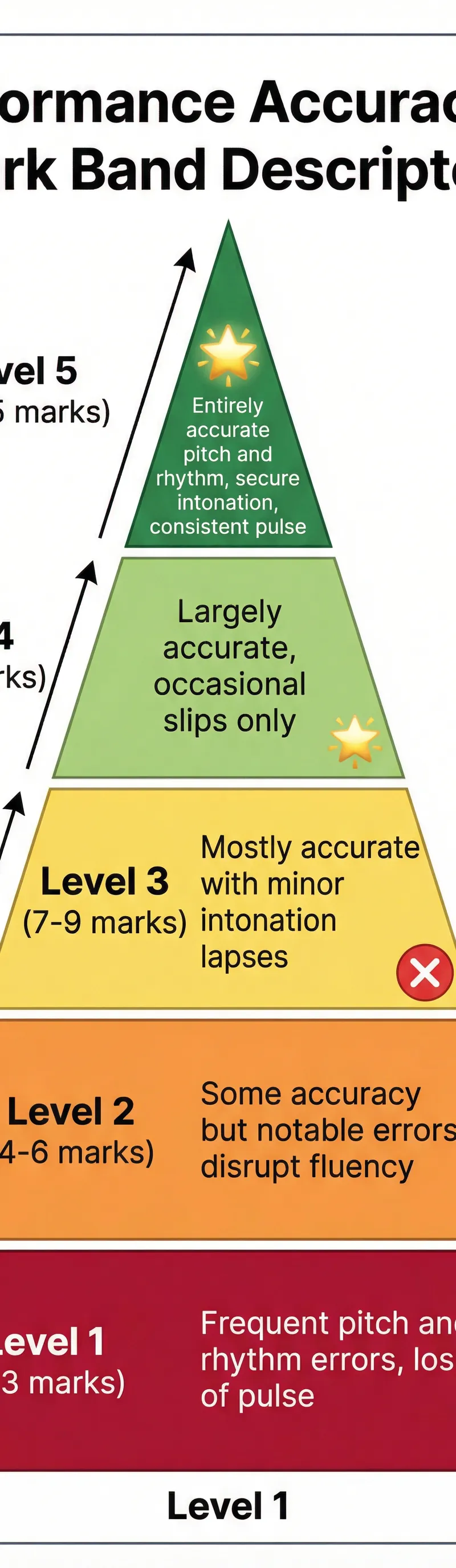
For your Integrated Portfolio, examiners are assessing AO2: Perform music with technical control, expression and interpretation. Accuracy is the largest component of ‘technical control’.
- Top Band (13-15 marks): Pitch and rhythm are entirely accurate with no audible slips. Intonation is secure. Pulse is consistent.
- Mid Band (7-9 marks): Mostly accurate, but with minor lapses in intonation or rhythm that may disrupt fluency.
- Low Band (1-3 marks): Frequent errors in pitch and rhythm; loss of pulse.
Building a Strong Portfolio
- Choose Repertoire Wisely: Select a piece you can perform flawlessly. A simpler piece played perfectly will always score higher than a difficult piece with mistakes.
- Annotate Your Score: Mark your score with reminders for difficult passages. Circle accidentals you often miss. Write in counting for tricky rhythms. This provides evidence of your developmental process.
- Log Your Practice: Keep a brief practice diary. Note which passages you worked on, what tempo you used with the metronome, and what you discovered from listening to recordings. This can be valuable supporting evidence.
Exam Component
Written Exam Knowledge (AO4)
Accuracy is directly tested in the listening paper through melodic and rhythmic dictation questions. You will hear a short phrase played several times and must notate it on a stave.
- Strategy: Before the audio starts, check the key signature and time signature. Write them on your manuscript. On the first listening, focus on the rhythm. Tap along and try to get the rhythmic pattern down. On subsequent listenings, fill in the pitches. Remember to add accidentals where necessary.
Practical Exam Preparation
Your final performance is assessed under exam conditions. The key is to replicate this pressure in your practice.
- Mock Performances: Perform your piece for family, friends, or your teacher. This simulates the feeling of being watched and helps you practice managing nerves.
- The ‘No-Stop’ Rule: In the two weeks before your exam, implement a rule in your practice: you are not allowed to stop and correct mistakes. If you make an error, you must continue, maintaining the pulse. This trains you to recover instantly, which is a key skill that examiners credit under ‘fluency’.
Visual Resources
2 diagrams and illustrations
Interactive Diagrams
1 interactive diagram to visualise key concepts
Conceptual Flow Outline
The cyclical process of practicing for accuracy.
Worked Examples
3 worked examples — open one to explore the question and available guidance.
Practice Questions
Try the question, then reveal an answer plan or example response
Identify three common reasons a candidate might be limited to Level 3 (7-9 marks) for Technical Control.
Hint: Think about the specific descriptors for Level 3 and what separates it from Level 4.
Explain the difference between rhythmic accuracy and maintaining a consistent pulse.
Hint: One is about individual notes, the other is about the overall feel. How do they relate?
A candidate is preparing for their performance exam. They can play their difficult Grade 5 piece with about 90% accuracy, or their simpler Grade 3 piece with 100% accuracy. Which should they choose and why? Justify your answer with reference to the assessment criteria.
Hint: Consider the relative importance of difficulty vs. accuracy in the mark scheme.
Analyse the role of 'fluency' in a musical performance and explain its relationship with 'accuracy'.
Hint: How can a performance be accurate but not fluent? How does a lack of fluency impact the listener?
Exam technique
How to turn what you know into marks
How to approach the question
For dictation, use the first playing for rhythm, subsequent ones for pitch. For performance, your approach is your practice strategy: slow, deliberate, and focused on consistency.
How to structure your answer
For extended response questions asking for evaluation of a performance, use the 'Point, Evidence, Explain' structure. Point: 'The performance lacked rhythmic accuracy.' Evidence: 'For example, in the syncopated passage at bar 15.' Explain: 'This disrupted the groove and demonstrated a lack of technical control.'
Timing
For the listening exam, you typically have just under a minute per mark. For dictation questions, the time is structured by the number of playings. For performance, timing is about choosing a piece of appropriate length (usually 3-4 minutes).
Common pitfalls
- Choosing a piece that is too difficult.
- Stopping and restarting after a mistake.
- Neglecting metronome practice.
- Forgetting to check the key signature in dictation questions.
- Focusing only on notes and ignoring fluency and pulse.
What the command words want
- Analyse
- Break down the components of accuracy in a performance ('The pitch was generally secure, but the rhythmic accuracy was weak, particularly in the dotted rhythms, which undermined the overall fluency').
- Compare
- Compare the accuracy of two performances ('Performer A was more rhythmically precise, whereas Performer B had better intonation').
- Explain
- Say WHY it was an error and what the effect was ('By rushing, the performer lost synchronisation with the accompaniment').
- Describe
- Say what the error sounded like (e.g., 'the rhythm in bar 5 was rushed').
- Evaluate
- Make a judgement on the overall level of accuracy, referencing the mark bands ('Overall, this was a Level 3 performance because...').
- Identify
- Name the error (e.g., 'a wrong note').
Watch or listen (optional)
Test your understanding of Accuracy
Active recall beats re-reading. Take an instant quiz now to test what you’ve learned and lock it into long-term memory.
7 days Premium · Then the free plan continues · No card, no charge