OCR · GCSE · Music
Structure
This guide provides a comprehensive overview of Musical Structure (4.8) for OCR GCSE Music. It covers essential forms from Western Classical and Popular Music, equipping candidates with the theoretical knowledge and aural recognition skills needed to secure top marks in the listening exam.
- 8 min read
- 3 worked examples
- 4 practice questions
Study Notes
Overview
Understanding musical structure is fundamental to success in the OCR GCSE Music course. It involves identifying how composers and artists organise their musical ideas over time. This topic is not just theoretical; it is a crucial aural skill that is tested across all listening-based questions in Areas of Study 2-5. Marks are awarded for the precise identification of forms and the correct use of technical vocabulary. This guide will break down the key structures, provide practical exam advice, and offer strategies to help you analyse music with confidence.

Key Knowledge & Theory
Core Concepts
The core of this topic is recognising distinct musical forms. These can be broadly categorised into Western Classical Tradition and Popular Music forms.
Western Classical Forms:
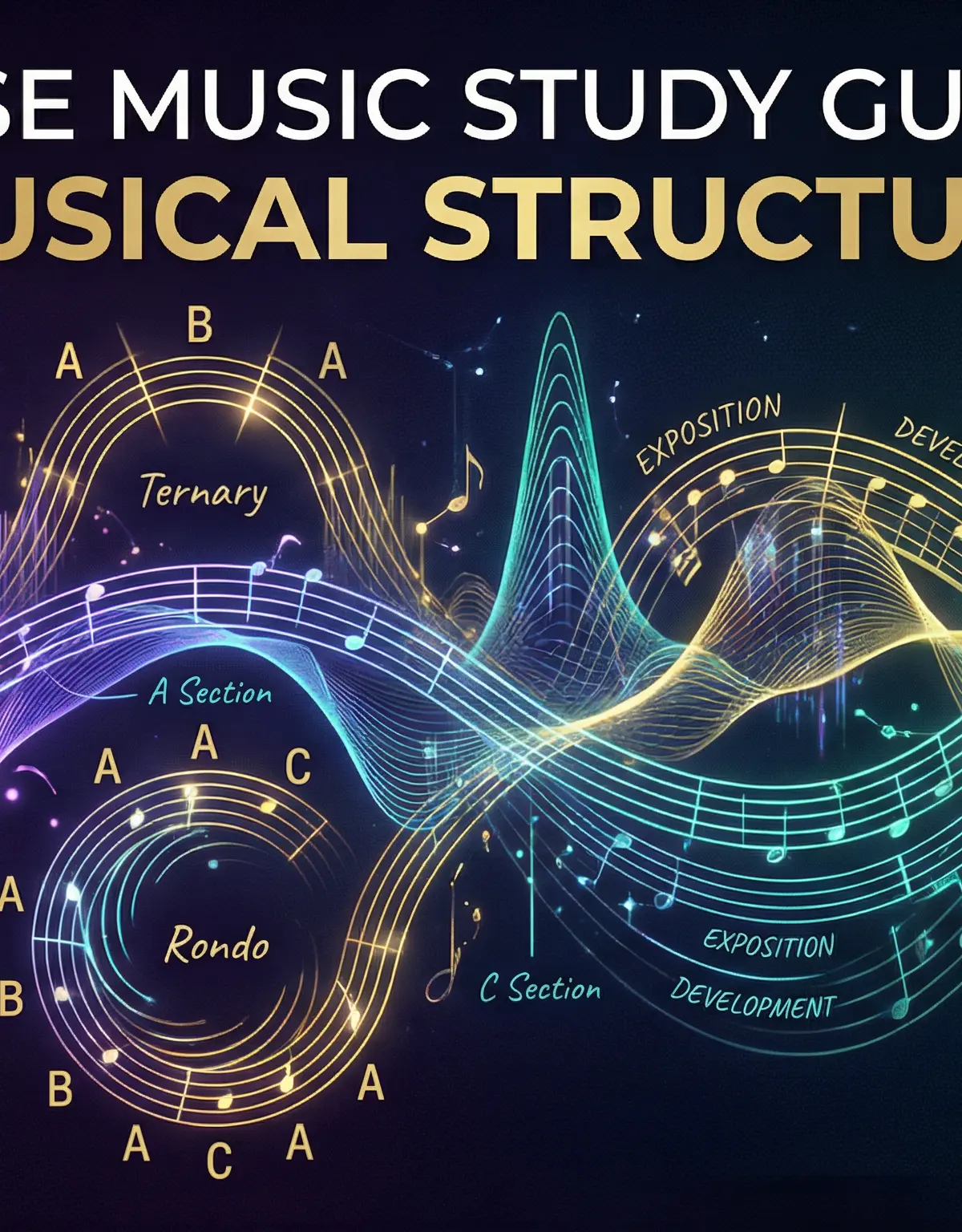
- Binary Form (AB): The simplest form, consisting of two contrasting sections. Section A is the main idea, and Section B provides a point of contrast, often in a related key (e.g., the dominant or relative major). Think of it as a musical conversation. It is common in Baroque dance suite movements.
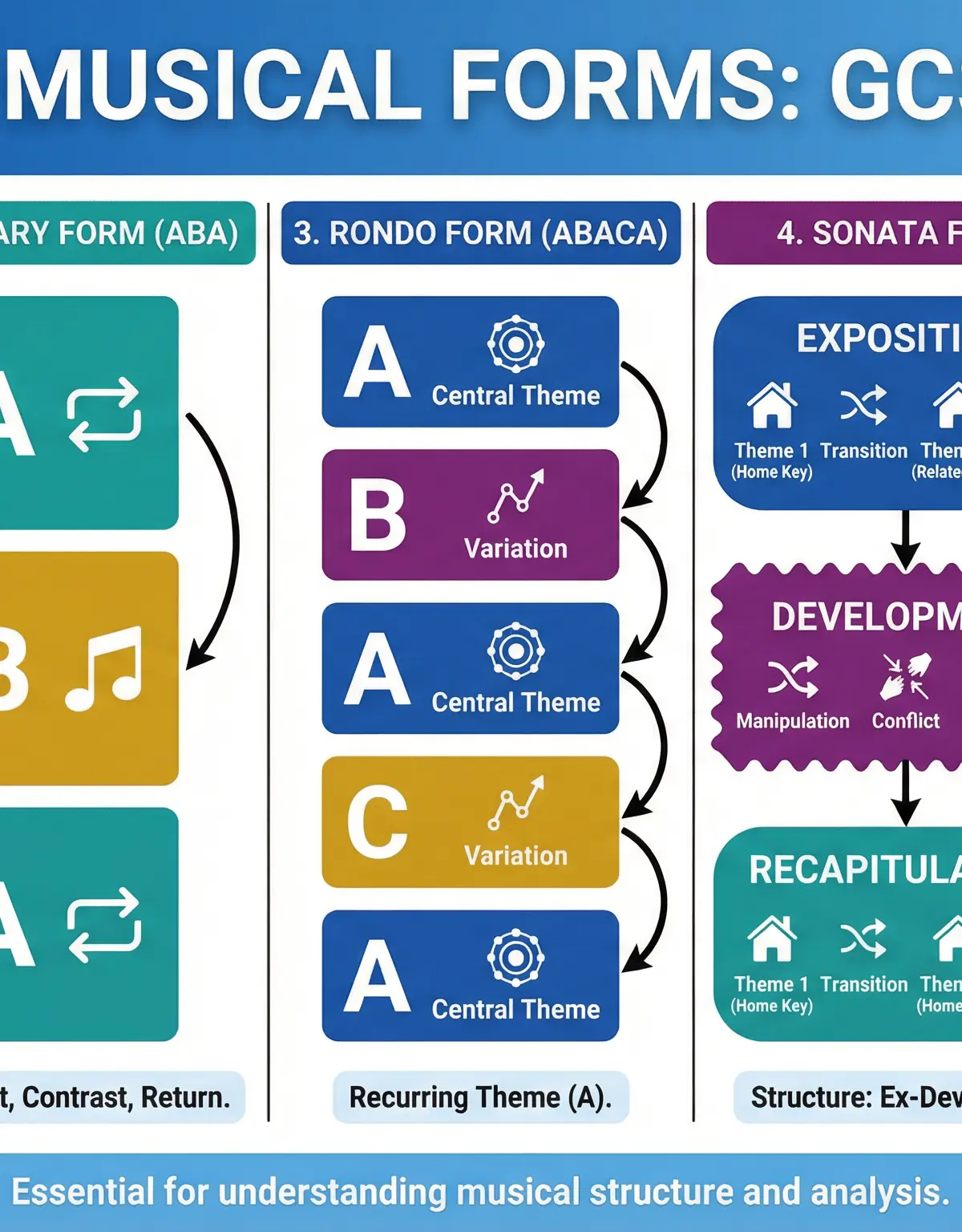
- Ternary Form (ABA): Also known as 'arch form', this structure features a return to the opening material after a contrasting middle section. The 'A' section presents the main theme, the 'B' section offers contrast, and the final 'A' section provides a sense of closure. The return of A can be an exact repeat or slightly varied (A1).
- Rondo Form (ABACA): Characterised by a recurring main theme (A) interspersed with contrasting episodes (B, C, etc.). The main theme acts as a refrain or 'ritornello'. This form creates unity while allowing for variety and is often found in the final movements of Classical symphonies and concertos.
- Sonata Form: A more complex and dramatic structure, central to AoS2 (The Concerto Through Time). It has three main parts:
- Exposition: Two contrasting themes (subjects) are introduced. The first is in the home key (tonic), and the second is in a related key (often the dominant).
- Development: The composer creatively explores and manipulates the themes from the exposition, often modulating through many different keys and creating tension.
- Recapitulation: The themes from the exposition return, but this time both are in the home key, providing a sense of resolution and stability. A Coda may be added at the end.
- Minuet and Trio: A large-scale ternary form (Minuet-Trio-Minuet) where each section is itself a smaller dance form, usually in binary or rounded binary form. The Trio section provides a contrast in texture and instrumentation.
Popular Music Forms:
- Verse-Chorus Form: The most common structure in pop and rock music. The verses contain the narrative and have different lyrics, while the chorus is the memorable, repeated section containing the main hook.
- 12-Bar Blues: A structure defined by its specific 12-bar chord progression (I-I-I-I-IV-IV-I-I-V-IV-I-I). It forms the basis for countless blues, jazz, and rock and roll songs.
- 32-Bar Song Form (AABA): A staple of early 20th-century popular music and jazz standards. It consists of four 8-bar sections, with the 'B' section (the bridge or middle 8) providing contrast.
- Strophic Form: A simple structure where the same music is repeated for each verse of lyrics. Common in hymns, carols, and traditional folk songs. Candidates must not confuse this with Verse-Chorus form.
Key Practitioners/Artists/Composers
| Name | Period/Style | Key Works | Relevance |
|---|---|---|---|
| J.S. Bach | Baroque | Brandenburg Concertos | Master of Ritornello form, a precursor to Rondo and Concerto forms. |
| W.A. Mozart | Classical | Symphony No. 40, Eine Kleine Nachtmusik | Exemplifies perfect use of Sonata, Rondo, and Minuet and Trio forms. |
| Ludwig van Beethoven | Classical/Romantic | Symphony No. 5, Piano Sonata No. 8 | Pushed the boundaries of Sonata form, expanding the development and coda. |
| The Beatles | Pop/Rock (20th Cent.) | '''Yesterday''', '''Hey Jude''' | Innovators in Verse-Chorus structure, use of bridges and outros. |
| Muddy Waters | Chicago Blues | '''Mannish Boy''', '''Hoochie Coochie Man''' | A key figure in the development and popularisation of the 12-bar Blues. |
Technical Vocabulary
Using precise terminology is essential for gaining marks. Do not use vague terms like 'the start bit'; instead, use the correct technical term.
- Introduction (Intro): The opening section of a piece.
- Outro: The closing section of a piece.
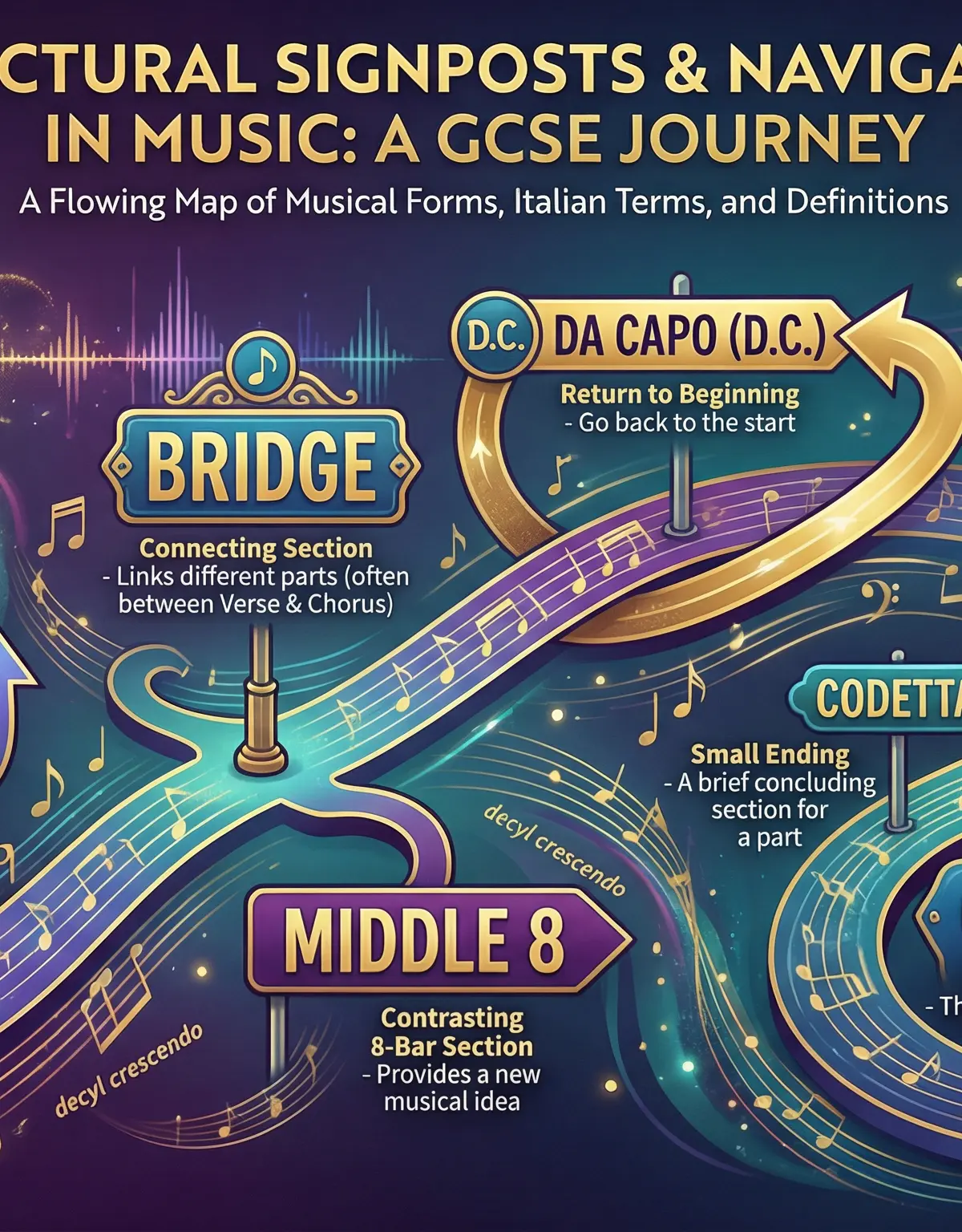
- Coda/Codetta: An ending section. A Coda is substantial, while a Codetta is a brief ending to a section.
- Verse/Chorus/Bridge/Middle 8: Sections within popular song structures.
- Pre-Chorus: A short section that builds anticipation for the chorus.
- Ritornello: The recurring theme in Rondo or Baroque concerto movements.
- Episode: The contrasting sections between statements of the ritornello in Rondo form.
- Exposition/Development/Recapitulation: The three main sections of Sonata form.
- Da Capo (D.C.): 'From the head'. An instruction to repeat from the beginning.
- Dal Segno (D.S.): 'From the sign'. An instruction to repeat from a specific sign (\S).
Practical Skills
Techniques & Processes
The primary skill for this topic is Active Listening. You must learn to listen with a focus on form.
- First Listen - The Big Picture: On the first hearing of an exam extract, try to get a general sense of the music. Is it fast or slow? What style is it? Who might have composed it?
- Second Listen - Mapping the Sections: Use your rough paper. As the music plays, note down every time you hear a distinct section change. Use letters (A, B, C) to label them. Note down timings.
- Third Listen - Identifying Repetition and Contrast: Listen again, specifically for repetition. When does the 'A' section come back? Is it identical or varied (A1)? Is there a completely new section (C)? This process will help you distinguish between Ternary (ABA) and Rondo (ABACA).
- Analysis - Applying Terminology: Once you have your map (e.g., A-B-A), you can apply the correct term: Ternary Form. Then, add detail. How does the B section contrast with A? (e.g., 'The B section is in the relative minor and has a thinner texture.')
Exam Component
Written Exam Knowledge
In the OCR listening exam, you will be played an extract of music and asked questions about it. Structure is a guaranteed topic.
- Question Types: Questions can range from multiple-choice (e.g., 'Which form best describes this extract?') to short-answer (e.g., 'Identify the form of this piece and give a reason for your answer.') to longer, 6-mark questions requiring detailed analysis of the structure in relation to other musical elements.
- Aural Recognition: You must be able to aurally identify all the forms listed above. The only way to master this is through practice. Listen to examples of each form until you can recognise them instinctively.
- Linking to other Elements: Examiners award high marks to candidates who can link structure to other musical elements. For example, 'The move to the B section is marked by a modulation to the dominant key and a change in texture to homophonic.'
Worked Examples
3 worked examples — open one to explore the question and available guidance.
Practice Questions
Test your understanding — click to reveal model answers
What is the defining characteristic of Binary form?
Hint: Think about the number of sections.
A piece of music has the structure A-B-A-C-A-D-A. What form is this?
Hint: Focus on the recurring section.
Explain the role of the Development section in Sonata form.
Hint: Think about key, theme, and tension.
Compare and contrast Minuet and Trio form with Ternary form.
Hint: Think about structure on both a large and small scale.