OCR · GCSE · Music
Rhythm
This guide provides a comprehensive overview of Rhythm for OCR GCSE Music (4.2), focusing on the core theoretical knowledge and practical skills required to excel in the exam. It covers everything from understanding pulse, metre, and time signatures to analysing complex rhythmic devices, ensuring candidates are fully prepared for both the listening paper and composition coursework.
- 8 min read
- 3 worked examples
- 4 practice questions
- 6 key terms
Check what you remember
Read the wording for your board, then hide it and explain Metre in your own words. Rough notes are fine. This is a self-check, with no mark or grade.
Reference: OCR
The organisation of beats into regular groups, indicated by a time signature.
Study Notes
Overview
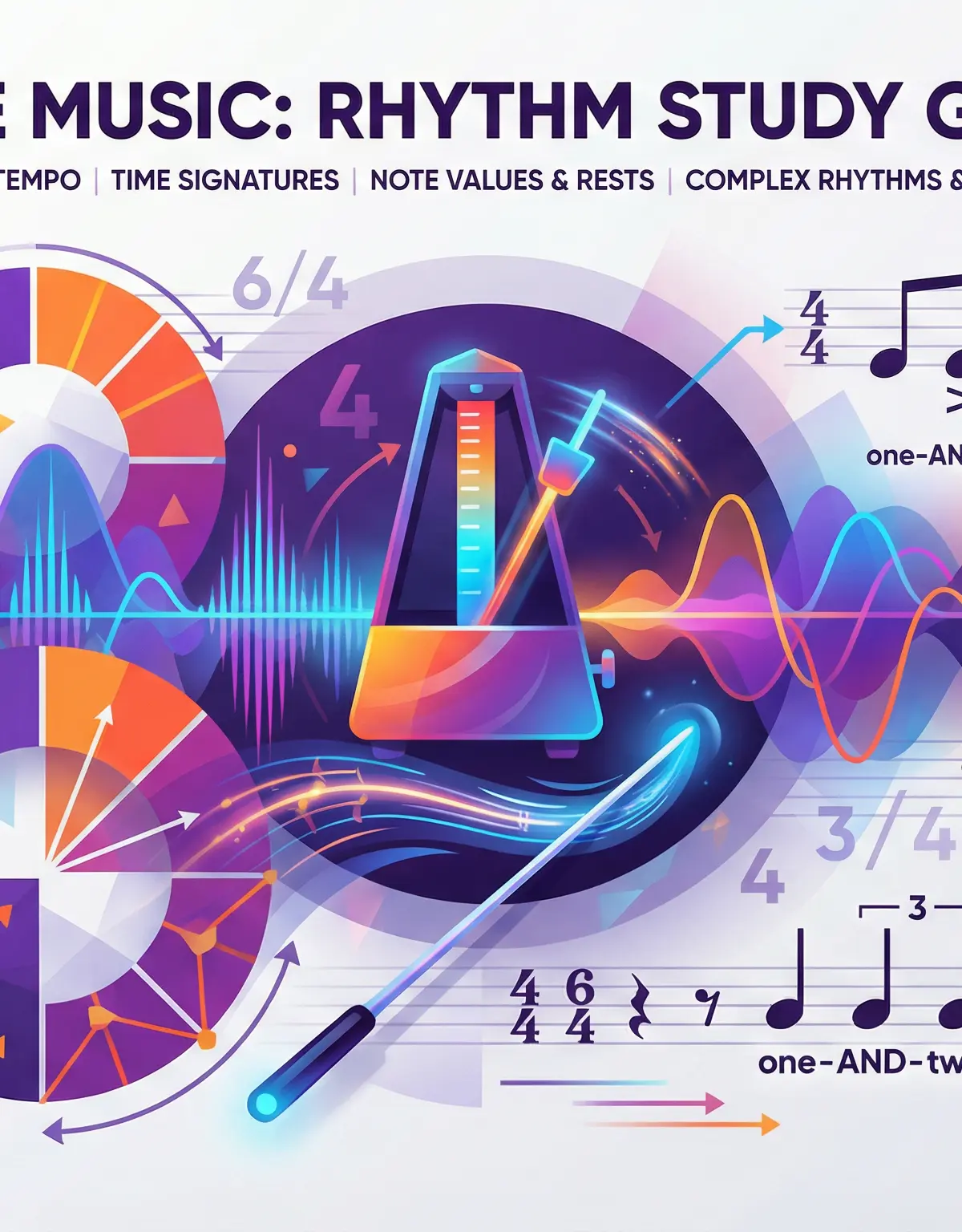
Rhythm is the lifeblood of music. It is the arrangement of sounds in time, creating the patterns of duration and silence that give music its sense of movement and energy. For the OCR GCSE Music course, a deep understanding of rhythm is not just optional; it is a fundamental requirement that underpins success across all Areas of Study (AoS). Examiners will assess your ability to aurally identify, notate, and analyse rhythmic features, as well as your capacity to use them creatively in your own compositions. This guide will equip you with the precise language and analytical skills needed to deconstruct the music you hear and to earn marks for your insights.
Key Knowledge & Theory
Core Concepts
At the heart of rhythm are three core concepts: pulse, beat, and metre.
- Pulse: The steady, underlying heartbeat of a piece of music. It is the constant, regular pulse that you might tap your foot to. It can be explicit (played by an instrument) or implicit (felt by the listener).
- Beat: The individual instance of a pulse. Beats are the fundamental unit of time in music.
- Metre: The organisation of beats into regular groups, creating a sense of a recurring pattern of strong and weak beats. This is defined by the time signature.
It is crucial that candidates do not confuse rhythm with tempo. Tempo refers to the speed of the music (fast or slow), whereas rhythm refers to the specific patterns of long and short notes within that tempo.
Time Signatures: Simple vs. Compound
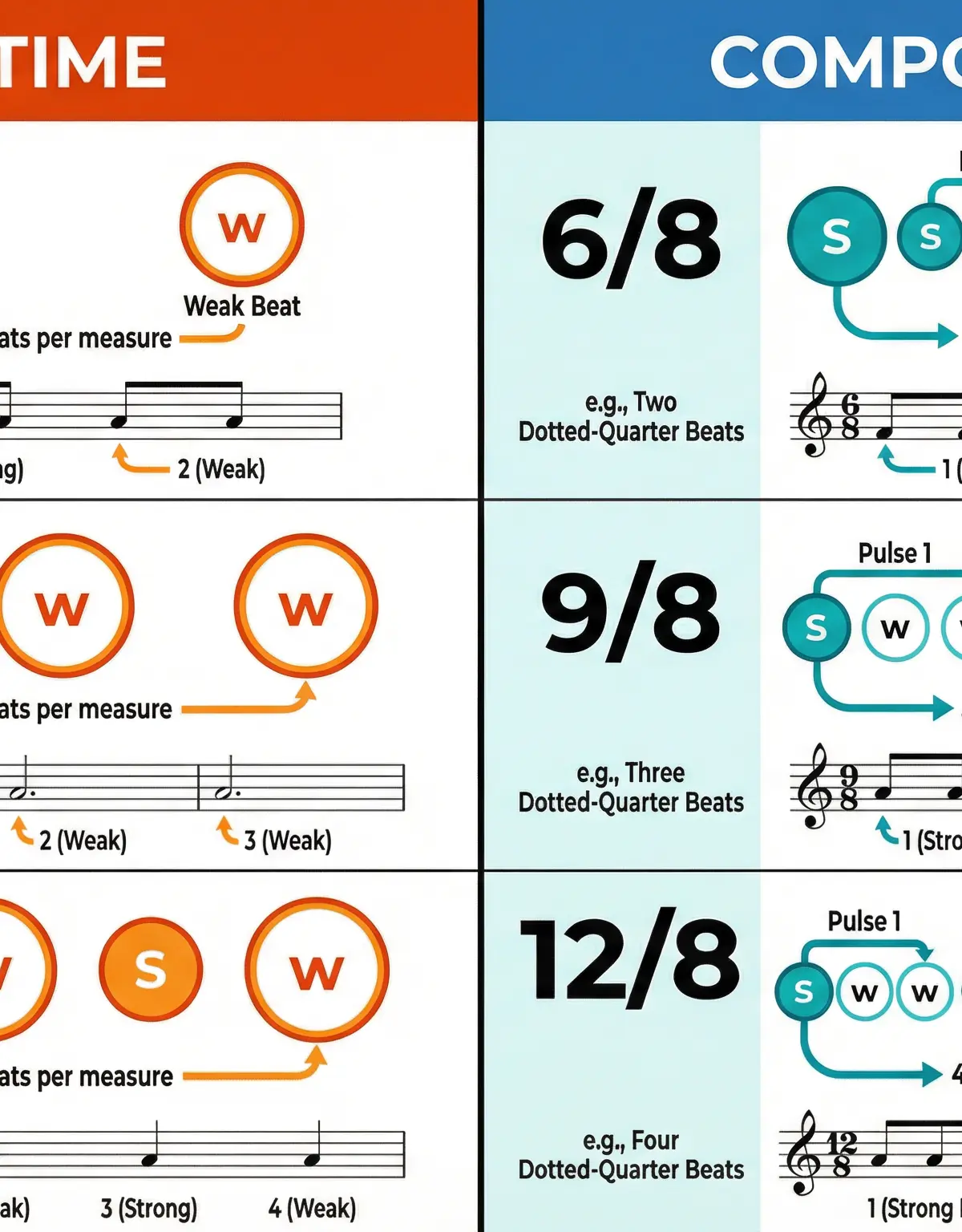
A time signature tells a performer how the music is to be counted. The top number indicates the number of beats per bar, and the bottom number indicates the type of note that receives one beat. They are divided into two main categories: simple and compound.
- Simple Time: The beat is divided into two equal parts. Examples include 2/4, 3/4, and 4/4. In 4/4 time, there are four crotchet beats per bar, and each beat can be subdivided into two quavers.
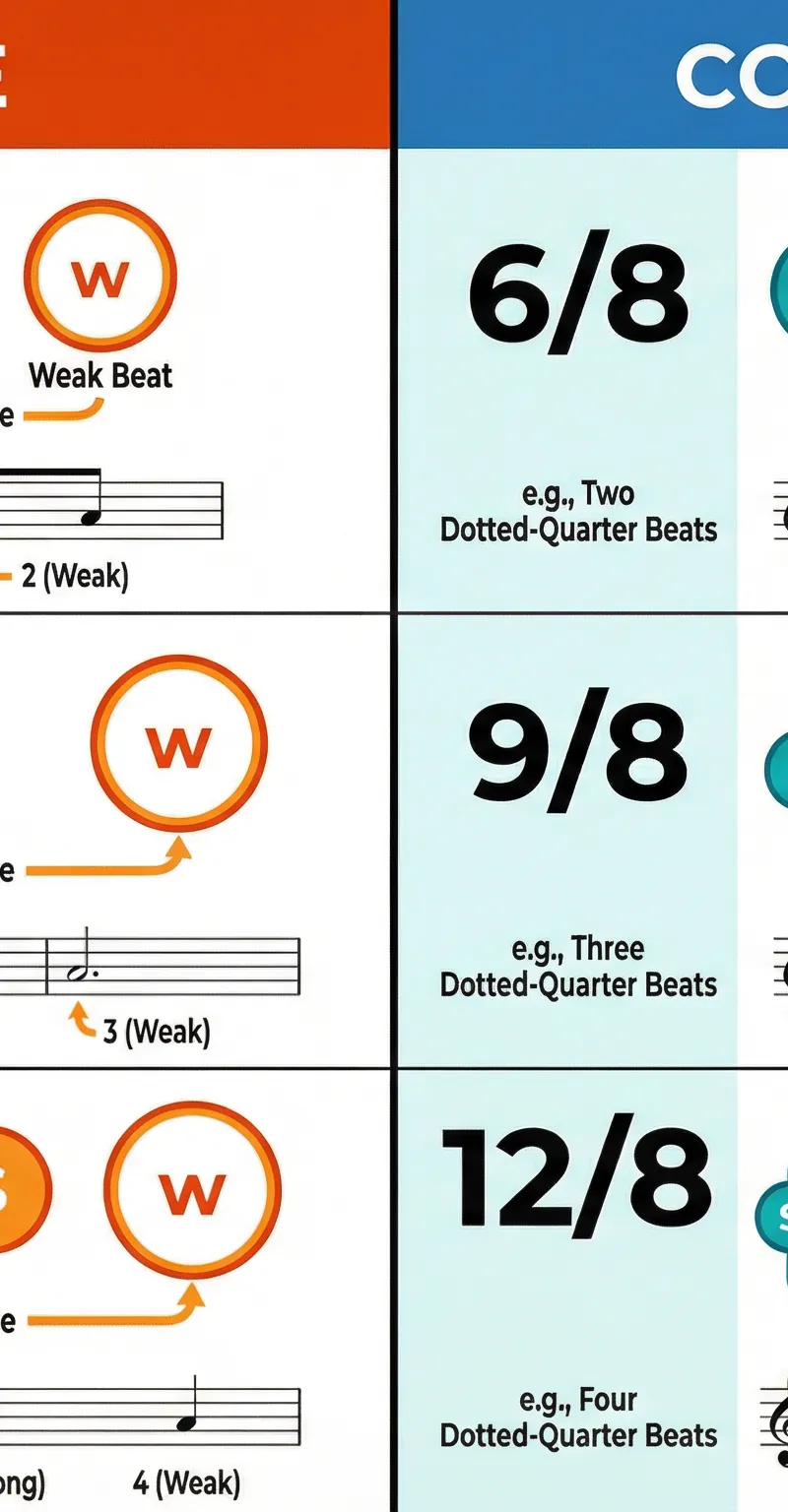
- Compound Time: The beat is divided into three equal parts, creating a triplet feel. The beat is a dotted note. Examples include 6/8, 9/8, and 12/8. A common mistake is to think 6/8 has six beats; it has two dotted crotchet beats per bar, with each beat dividing into three quavers.
Rhythmic Devices
Composers use a variety of devices to create rhythmic interest. Using the correct terminology for these is essential for gaining marks.
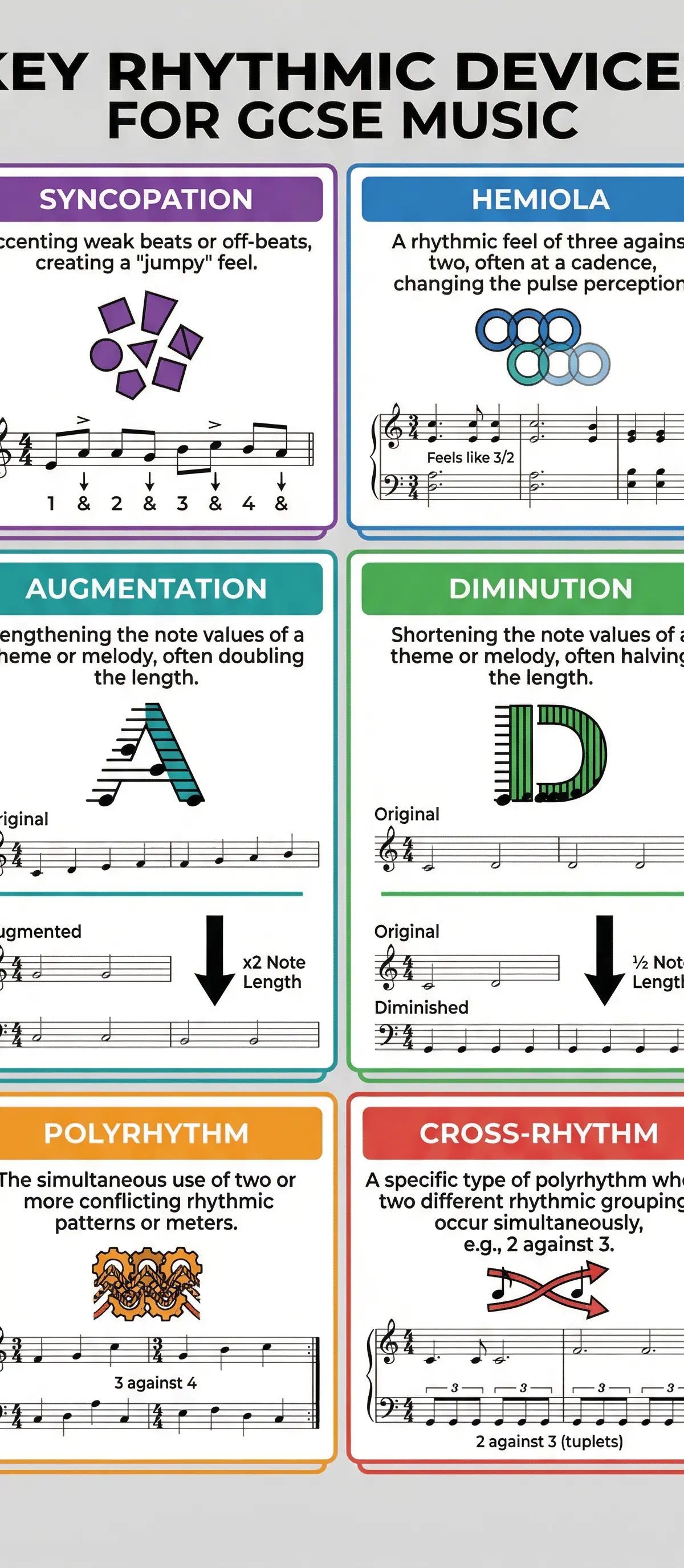
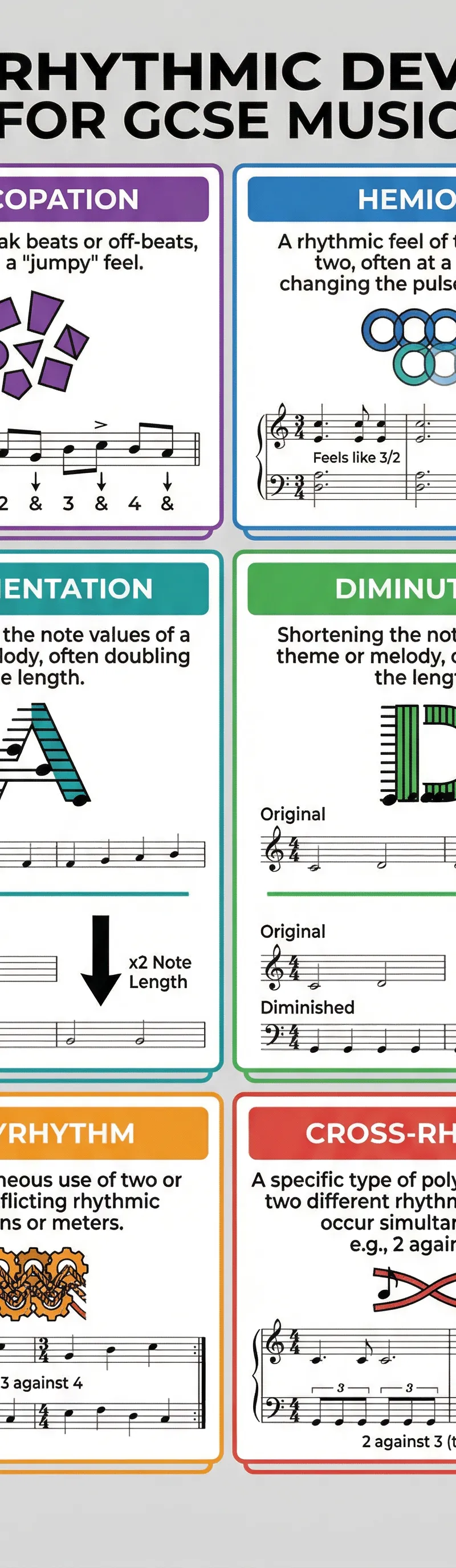
- Syncopation: The accenting of weak or off-beats, creating a ‘jumpy’ or unexpected feel. Prevalent in jazz, pop, and many world music styles.
- Hemiola: A rhythmic device where the established metre is temporarily disrupted, creating a feeling of three against two. For example, in a piece in 6/8 time (two beats), a pattern of three crotchets might be introduced, implying a 3/4 feel.
- Augmentation & Diminution: The lengthening (augmentation) or shortening (diminution) of the note values of a rhythmic motif. This is a key developmental technique in composition.
- Polyrhythm: The simultaneous use of two or more conflicting rhythms (e.g., three against four).
- Cross-rhythm: A specific type of polyrhythm where different rhythmic groupings occur at the same time (e.g., two quavers against a quaver triplet).
- Anacrusis: An ‘upbeat’ or ‘pickup’ – one or more notes that occur before the first strong beat of a phrase.
- Rhythmic Ostinato: A short, constantly repeated rhythmic pattern. A famous example is the ‘Son Clave’ rhythm found in Latin American music.
Key Practitioners/Artists/Composers
| Name | Period/Style | Key Works | Relevance |
|---|---|---|---|
| Steve Reich | Minimalism | Clapping Music, Music for 18 Musicians | A master of polyrhythm, phasing, and rhythmic displacement. His work is a case study in rhythmic process. |
| Igor Stravinsky | 20th Century | The Rite of Spring | Revolutionised rhythm with complex, irregular metres, violent syncopation, and powerful ostinatos. |
| Dave Brubeck | Cool Jazz | Take Five, Blue Rondo à la Turk | Popularised the use of unusual time signatures in jazz, such as 5/4 and 9/8. |
| James Brown | Funk | Funky Drummer, Get on the Good Foot | The architect of funk, where syncopated, interlocking rhythmic patterns between drums, bass, and guitar are key. |
Technical Vocabulary
Using precise terminology is critical. Instead of ‘off-beat’, use syncopation. Instead of ‘clashing rhythms’, use polyrhythm or cross-rhythm. Instead of ‘fast’, describe the tempo and then analyse the rhythmic duration and patterns.
Practical Skills
Techniques & Processes
Rhythmic Dictation: This is a core skill for the listening exam. When faced with a dictation question:
- Identify the Metre: Listen to the first few bars and conduct to establish if it is in 2, 3, or 4. Is the beat simple or compound?
- Notate the Rhythm: Listen to the melody again, focusing only on the rhythm. Tap it out. Write the rhythm down above a single line before attempting to add pitch.
- Check Beaming: Ensure your note groupings are correct for the time signature. In 4/4, do not beam across the central divide (between beats 2 and 3). In 6/8, beam in two groups of three quavers.
Compositional Development:
- Use augmentation and diminution to develop your motifs.
- Introduce syncopation to create energy and drive.
- Experiment with a rhythmic ostinato as a unifying feature.
Materials & Equipment
- Metronome: An essential tool for developing a strong internal pulse and for practising at different tempos.
- Notation Software (e.g., Sibelius, Musescore): Invaluable for composing, allowing you to hear your rhythmic ideas instantly and ensuring professional presentation and correct beaming.
Portfolio/Coursework Guidance
Assessment Criteria
For your composition (AO2), examiners award credit for rhythmic coherence and the development of rhythmic ideas. A simple but well-developed rhythmic motif will score more highly than a piece with lots of complex but unrelated rhythms. You must demonstrate control and purpose in your rhythmic choices.
Building a Strong Portfolio
- Annotate Your Score: Clearly label where you have used rhythmic devices like syncopation, augmentation, or a specific ostinato. Explain why you made these choices.
- Show Development: Your portfolio should show how a simple rhythmic idea is transformed and developed throughout the piece.
- Experiment: Try writing a section in an irregular metre (e.g., 5/4 or 7/8) or introduce a polyrhythmic texture. Even if it’s not perfect, it demonstrates ambition.
Exam Component
Written Exam Knowledge
The listening exam (AO3 & AO4) will test your aural recognition of all the concepts in this guide. You will be asked to identify time signatures, spot rhythmic devices in unfamiliar music, and comment on how rhythm is used in relation to the Area of Study. For example, how does the rhythm contribute to the tension in a piece of Film Music (AoS 4)? How is the Son Clave used in the piece of World Music (AoS 3)?
Practical Exam Preparation
For the composition component, you will need to respond to a brief set by the exam board. Often, this will require you to demonstrate specific skills. If the brief asks for a ‘dance track’, your use of a strong, syncopated 4/4 rhythm will be critical. If it asks for a ‘lullaby’, you might choose a gentle, rocking 6/8 compound time signature. Your choice and handling of rhythm must be appropriate to the brief.
Visual Resources
2 diagrams and illustrations
Interactive Diagrams
1 interactive diagram to visualise key concepts
Conceptual Flow Outline
A decision-making flowchart for identifying time signatures aurally.
Worked Examples
3 worked examples — open one to explore the question and available guidance.
Practice Questions
Try the question, then reveal an answer plan or example response
Define the term ‘augmentation’.
Hint: Think about what ‘augment’ means in everyday English. How does this apply to note lengths?
You are given a short rhythmic motif. Compose a 4-bar melody in 4/4 time for clarinet, developing the motif using diminution and syncopation.
Hint: Start by writing the original motif. Then, halve the note values for diminution. Finally, shift some of the notes onto the off-beats to create syncopation.
Listen to an extract of Samba music. Identify and describe two characteristic rhythmic features.
Hint: Listen for layers. What is the bass drum doing? What are the shakers doing? Are there any repeated patterns?
Compare how rhythm is used in the first movement of Mozart’s Eine kleine Nachtmusik with its use in ‘Take Five’ by the Dave Brubeck Quartet.
Hint: Think about metre, tempo, rhythmic devices, and the overall feel. One is Classical, one is Cool Jazz. How does this affect the rhythm?
Exam technique
How to turn what you know into marks
How to approach the question
For listening questions, use the first hearing to get a general feel for the music (tempo, style, mood). Use the second hearing to focus on the specific details required by the question (e.g., the exact rhythm, the instrumentation). Use the final hearing to check your answer.
How to structure your answer
For extended response questions (AO4), use the PEE structure: **P**oint (make a statement about rhythm), **E**vidence (describe the specific musical feature, e.g., ‘a syncopated rhythm in the trumpet’), **E**xplain (explain the effect of this feature, linking it to the question).
Timing
Aim for approximately 1.5 minutes per mark in the written listening paper. For a 4-mark dictation, this gives you 6 minutes, which is roughly three hearings.
Common pitfalls
- Confusing simple triple (3/4) and compound duple (6/8) time.
- Incorrect beaming in rhythmic dictation.
- Describing rhythm as just ‘fast’ or ‘slow’ instead of analysing patterns and devices.
- Failing to use specific terminology like ‘hemiola’ or ‘anacrusis’.
What the command words want
- Analyse
- Break it down. e.g., ‘The polyrhythm is created by the strings playing in 3/4 while the woodwind play in 6/8’.
- Compare
- Identify similarities and differences. e.g., ‘Both pieces use syncopation, but Piece A uses it in the melody whereas Piece B uses it in the accompaniment’.
- Explain
- Give reasons. e.g., ‘The rhythm is syncopated *in order to* create a groovy, energetic feel’.
- Describe
- Say what you hear. e.g., ‘The rhythm is syncopated, with accents on the off-beats’.
- Evaluate
- Make a judgement. e.g., ‘The use of a rhythmic ostinato is highly effective in creating a hypnotic and driving texture’.
- Identify
- Name the feature, e.g., ‘Syncopation’ or ‘6/8 time’.
Test your understanding of Rhythm
Active recall beats re-reading. Take an instant quiz now to test what you’ve learned and lock it into long-term memory.
A week of Premium from your first lesson · Then the free plan continues · No card, no charge