OCR · GCSE · Music
Development of ideas
This guide provides a comprehensive overview of Topic 2.7, Development of Ideas, for OCR GCSE Music. It covers the essential compositional techniques and analytical skills required to achieve top marks in both the Integrated Portfolio (AO2) and the Listening and Appraising exam (AO3)."
- 7 min read
- 3 worked examples
- 4 practice questions
Study Notes

Overview
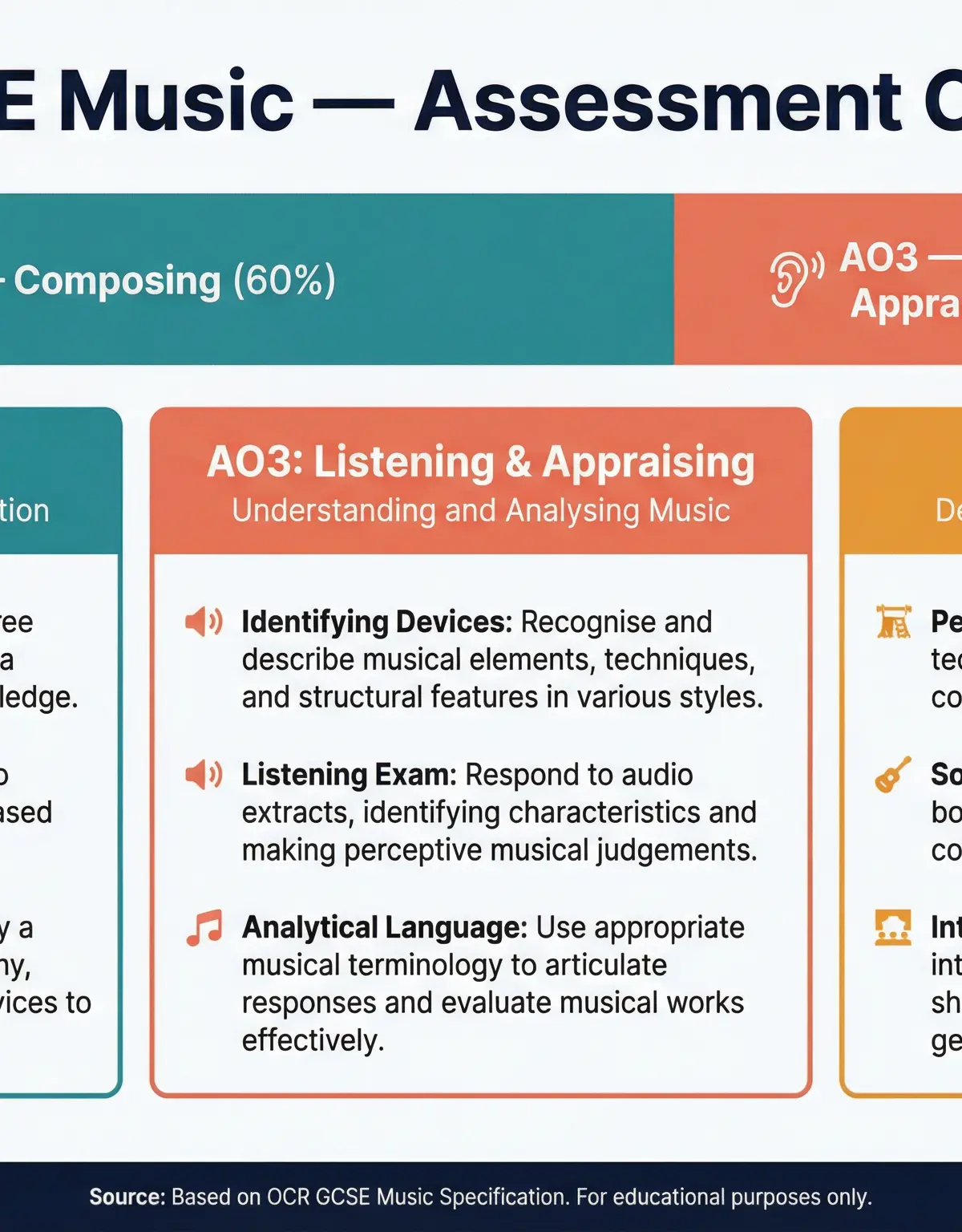
The development of musical ideas is a cornerstone of musical composition and a critical area of study for the OCR GCSE Music specification. It assesses a candidate's ability to take a simple musical motif and transform it in a coherent and imaginative way. This skill is not just about creating variety; it's about ensuring a composition has thematic unity and a clear sense of direction. Examiners are looking for evidence that a candidate can move beyond simple repetition and use established compositional devices to build a musically satisfying structure. This topic carries significant weight, impacting 60% of the marks through the composition portfolio (AO2) and 30% through the listening exam (AO3).
Key Knowledge & Theory
Core Concepts
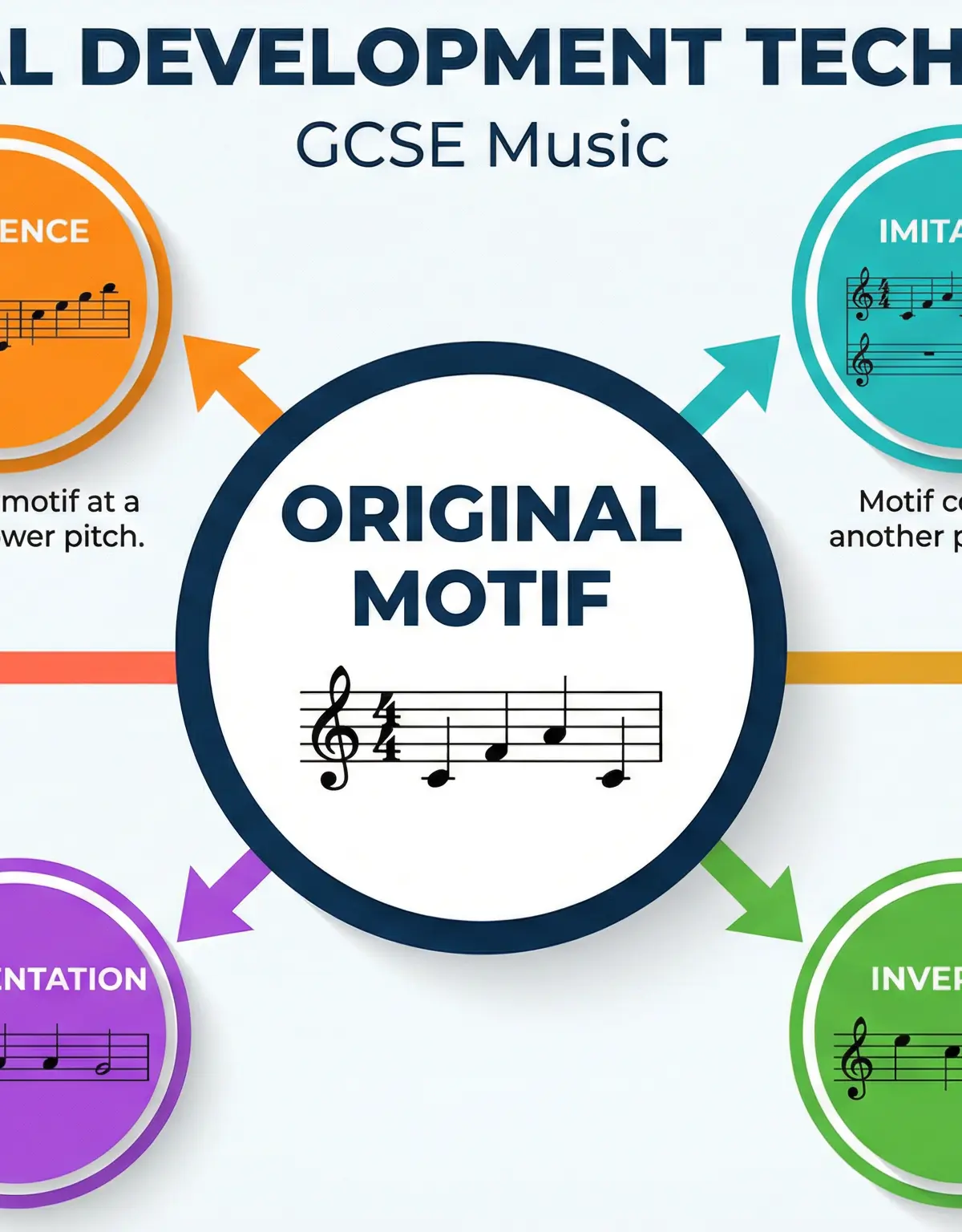
Mastery of this topic requires a deep understanding of the specific techniques composers use to develop their material. While simple repetition can establish an idea, it is the development of that idea that creates interest and structural integrity. The core techniques are:
- Sequence: Repeating a melodic or harmonic pattern at a higher or lower pitch. An ascending sequence can build tension, while a descending sequence can release it.
- Imitation: A melodic idea is repeated shortly after its first appearance in a different part or voice. This creates a conversational texture between instruments.
- Fragmentation: Breaking a motif down into smaller, more manageable cells. These fragments can then be repeated, sequenced, or inverted to create new material that is still thematically linked to the original.
- Augmentation & Diminution: Altering the rhythmic values of a motif. Augmentation involves lengthening the note values (e.g., crotchets become minims), often creating a sense of grandeur. Diminution is the opposite, shortening the note values to create urgency.
- Modulation: Changing key. This is a powerful tool for changing the mood and character of a piece. Common modulations include moving to the dominant, subdominant, or relative minor/major key.
- Inversion: Turning a melody upside down. The intervals of the melody remain the same, but their direction is reversed. An ascending third becomes a descending third.
- Retrograde: Playing a melody backwards. This is a more complex technique often found in 20th-century music but can be used to create symmetry.
Key Practitioners/Artists/Composers
| Name | Period/Style | Key Works | Relevance |
|---|---|---|---|
| Ludwig van Beethoven | Classical/Romantic | Symphony No. 5, 1st Mvt | A masterclass in fragmentation. The entire movement is built from the opening four-note rhythmic motif (short-short-short-long). |
| Johann Sebastian Bach | Baroque | Brandenburg Concerto No. 2 | Demonstrates extensive use of sequence and imitation, creating complex polyphonic textures. |
| Steve Reich | Minimalism | Music for 18 Musicians | Explores development through gradual process, phase-shifting, and rhythmic augmentation. |
| John Williams | Film Music | Star Wars Main Theme | Excellent example of using leitmotifs that are developed and transformed to represent characters and situations. |
Technical Vocabulary
Using precise terminology is essential for gaining marks in the listening exam. Candidates must be able to distinguish between these terms and use them accurately in their analysis.
- Motif: A short, recurring musical idea.
- Ostinato: A persistently repeated pattern, usually in the bass.
- Counter-melody: A secondary melody played alongside the main theme.
- Polyphony: A texture consisting of two or more independent melodic lines.
- Homophony: A texture with one main melody accompanied by chords.
- Cadence: A two-chord progression at the end of a phrase (e.g., Perfect, Plagal, Imperfect, Interrupted).
- Thematic Unity: The sense that all parts of a composition are derived from the same core musical ideas.
Practical Skills
Techniques & Processes
For the composition portfolio, candidates must demonstrate practical application of these devices. A successful approach involves:
- Create a Strong Motif: Start with a clear, memorable 2-4 bar motif. It should have a distinct rhythmic and melodic shape.
- Plan Your Structure: Map out a simple structure (e.g., Ternary form: A-B-A). Section A introduces the motif. Section B develops it.
- Apply Techniques Deliberately: In Section B, choose at least three developmental techniques. For example:
- Begin with a sequence of your main motif.
- Follow with fragmentation, isolating a rhythmic cell and passing it between instruments (imitation).
- Build to a climax by modulating to a new key.
- Ensure Coherence: The development section should feel like a logical extension of the opening, not a collection of unrelated ideas.
Materials & Equipment
Whether using notation software (Sibelius, Musescore) or a DAW (Logic, GarageBand), the principles are the same. Use software features to your advantage:
- Copy and Paste: Use this to create sequences and repetitions, then alter the pitches as needed.
- Transpose Function: Instantly modulate sections to new keys.
- MIDI Editing: Easily manipulate rhythmic values for augmentation and diminution.
Portfolio/Coursework Guidance
Assessment Criteria
Examiners assess the Integrated Portfolio against AO2, looking for:
- Imagination and Creativity: Is the composition original and engaging?
- Technical Control: Are the chosen techniques applied accurately and effectively?
- Structural Coherence: Does the piece feel unified and well-planned? Is the development logical?
Building a Strong Portfolio
- Annotate Your Score: Clearly label where you have used techniques like 'sequence' or 'inversion'. This shows the examiner you are making conscious compositional choices.
- Show Experimentation: Keep drafts of your work. Show how you tried different ideas before settling on the final version. This evidences the creative process.
- Refine Your Work: Don't just stop at the first idea. Ask for feedback. How could the transition be smoother? Could the texture be more interesting? Good compositions are rewritten and refined.
Exam Component
Written Exam Knowledge
In the Listening and Appraising exam (AO3), you will be tested on your ability to identify and explain these techniques in unfamiliar music. Questions will be based on excerpts of music from a wide range of styles.
- Aural Recognition: You must be able to hear the difference between a sequence, imitation, and simple repetition.
- Analytical Language: You need the vocabulary to describe what you hear. Credit is given for explaining how the development affects the mood or character of the music.
Podcast Episode
For a detailed audio walkthrough of these concepts, including exam tips and common mistakes, listen to our dedicated podcast episode.
"

Worked Examples
3 worked examples — open one to explore the question and available guidance.
Practice Questions
Test your understanding — click to reveal model answers
Identify the developmental device used in the bass line between bars 5 and 8.
Hint: Listen for a repeating pattern in the bass. Does it change pitch?
Describe the relationship between the violin and viola parts in this excerpt.
Hint: Listen to how the viola part responds to the violin part.
Explain two ways a composer could develop a motif to create a sense of climax.
Hint: Think about techniques that build tension and excitement.
Analyse how Beethoven uses development of ideas in the first movement of his 5th Symphony.",
"marks": 8