OCR · GCSE · Music
Dynamics
This guide provides a comprehensive overview of Dynamics in OCR GCSE Music, covering essential Italian terminology, practical application in performance and composition, and key strategies for the listening and appraising exam. Mastering dynamics is crucial for adding expression and securing top marks across all components.
- 7 min read
- 3 worked examples
- 4 practice questions
- 6 key terms
Study Notes
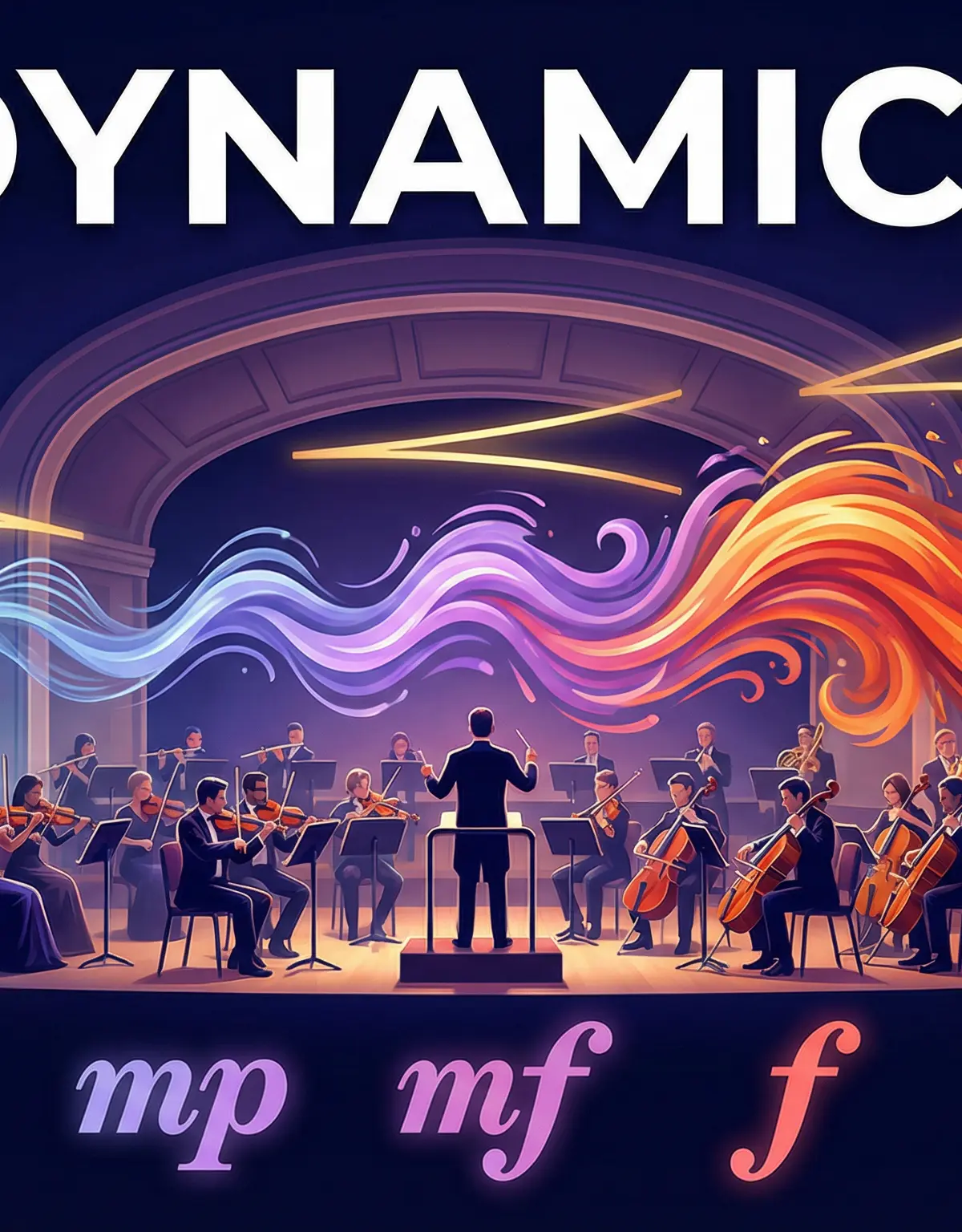
Overview
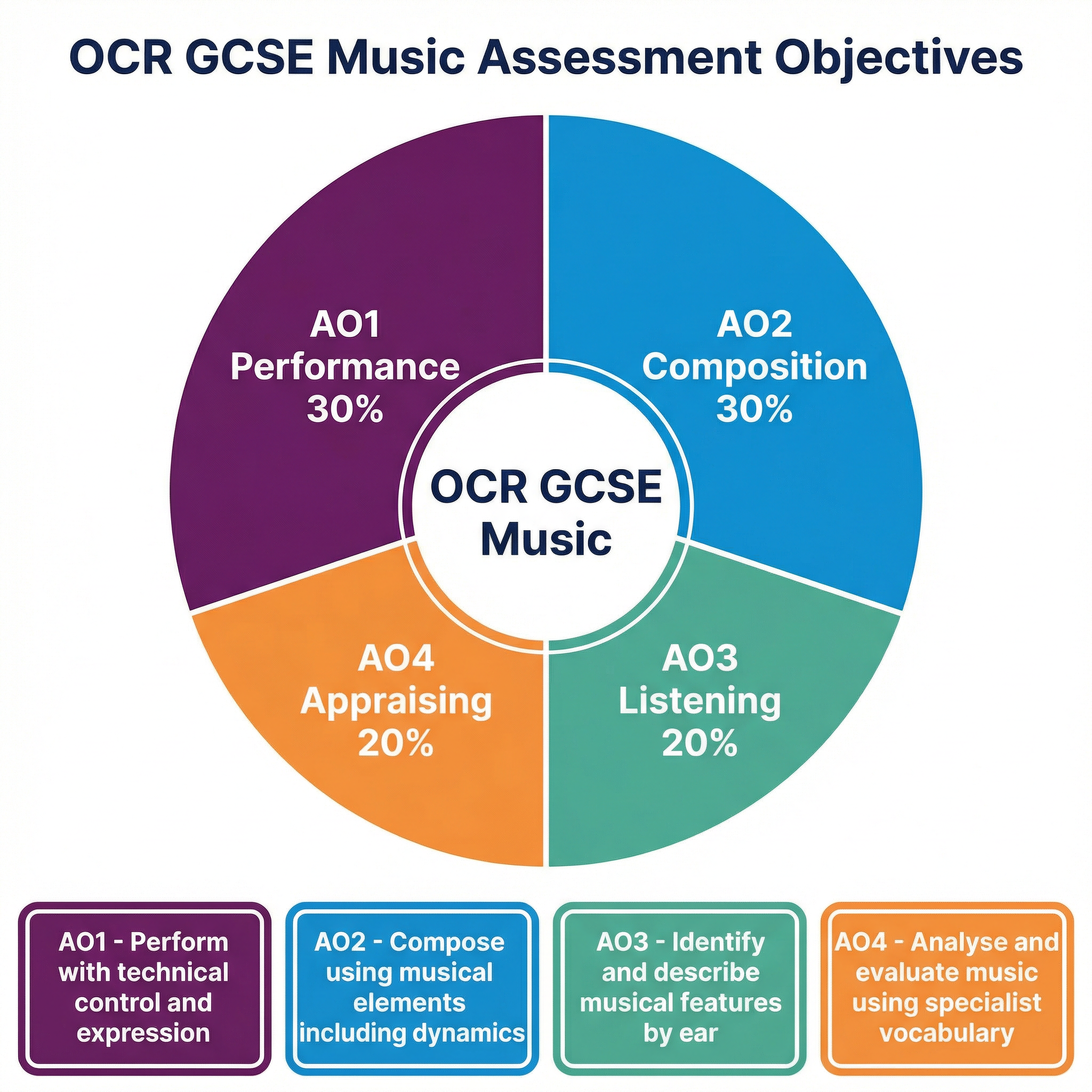
Dynamics are a fundamental element of music, referring to the volume of the sound — how loud or soft it is. In your OCR GCSE Music course, a sophisticated understanding and application of dynamics is essential for success. It is not merely about playing loudly or quietly; it is about using volume to shape musical phrases, create emotional impact, and articulate structure. Examiners will assess your use of dynamics in your Performance (Component 01), your Composition (Component 02), and your ability to identify and analyse them in the Listening and Appraising exam (Component 03). This guide will equip you with the knowledge and skills to excel in all three areas.

Key Knowledge & Theory
Core Concepts
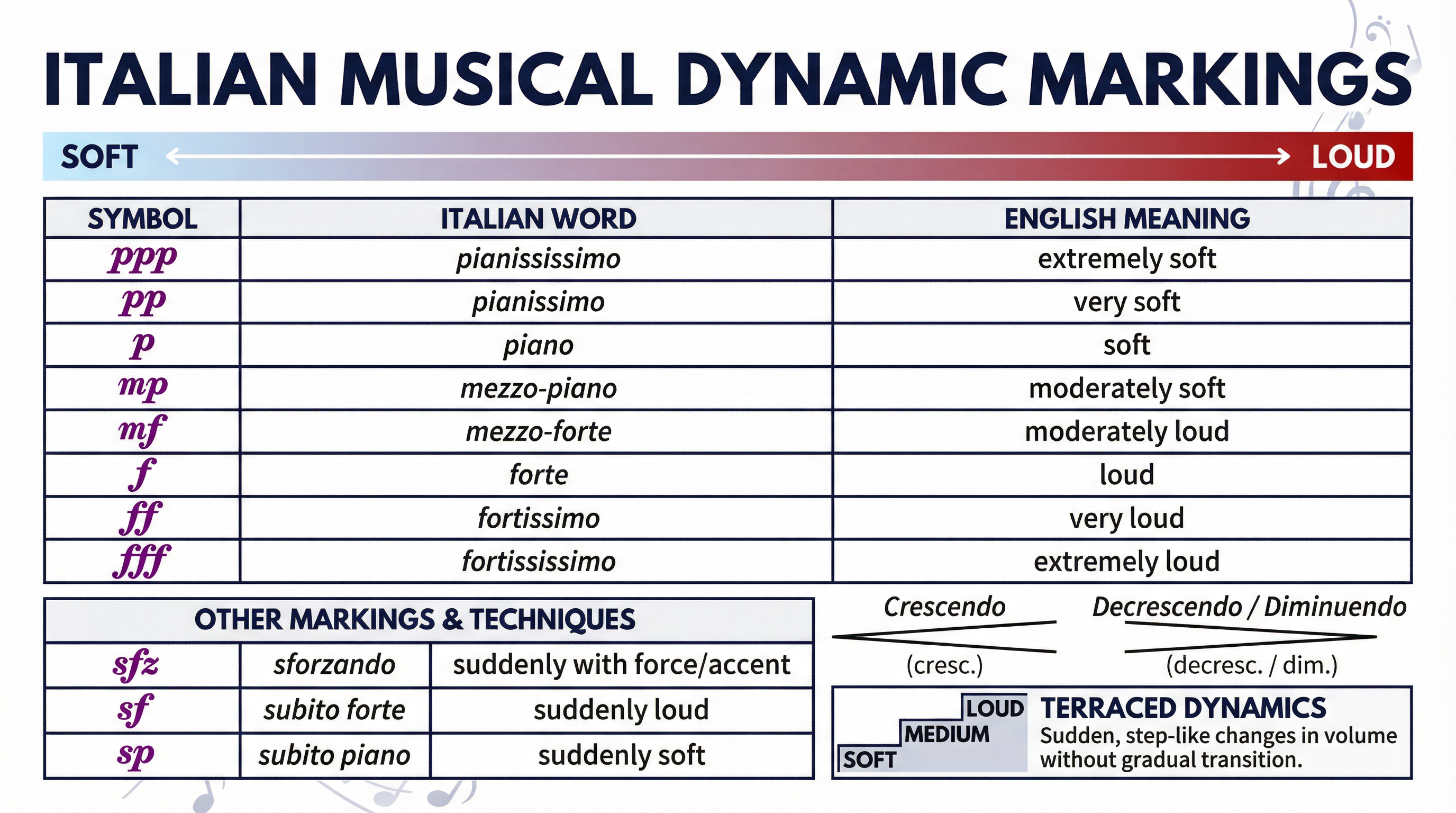
At the heart of dynamics is a system of Italian terms used to notate volume. Candidates are expected to know these terms, their symbols, and their meanings. The range extends from extremely soft to extremely loud. Gradual changes are indicated with hairpin symbols or text, while sudden changes use specific terms like subito.
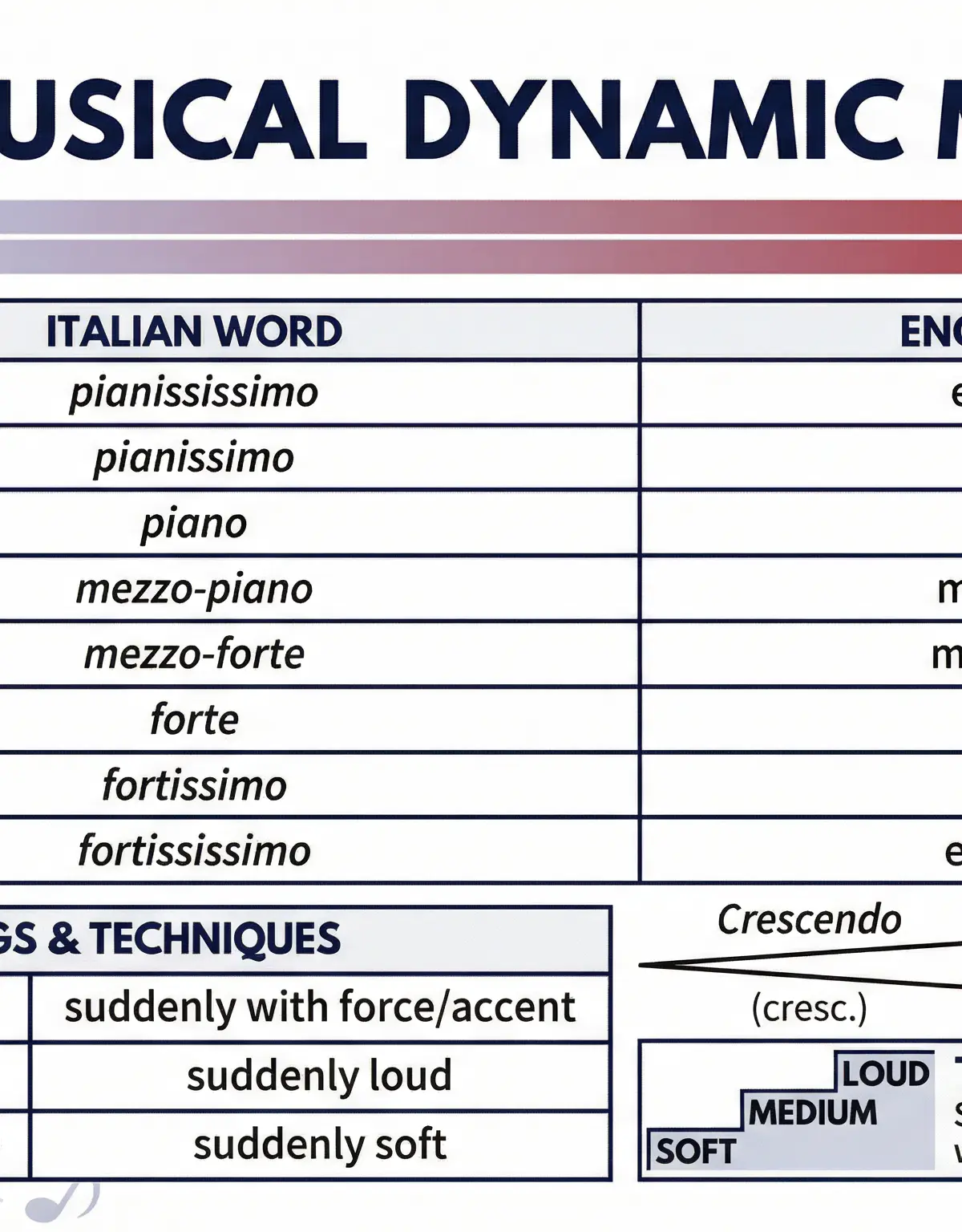
Another key concept is terraced dynamics, a defining feature of the Baroque era (c. 1600-1750). Due to the limitations of instruments like the harpsichord, which could not create gradual changes in volume, Baroque composers created contrast by abruptly shifting between loud and soft sections. This is often achieved by contrasting a small group of soloists (concertino) with the full orchestra (ripieno).
Key Practitioners/Artists/Composers
| Name | Period/Style | Key Works | Relevance |
|---|---|---|---|
| Giovanni Gabrieli | Late Renaissance/Early Baroque | Sonata Pian' e Forte (1597) | One of the first composers to explicitly write dynamic markings into the score, contrasting sections of piano and forte. |
| Ludwig van Beethoven | Classical/Romantic | Symphony No. 5 | Pushed the boundaries of dynamic range, using extreme contrasts from pianissimo to fortissimo and pioneering the use of long, dramatic crescendos to build tension. |
| Igor Stravinsky | 20th Century | The Rite of Spring | Used dynamics with brutal force, employing savage accents (sforzando) and rapid, extreme shifts in volume to create a sense of primitive energy and shock. |
| Steve Reich | Minimalism | Music for 18 Musicians | Explores dynamics in a different way, with gradual, subtle shifts in volume and texture creating a hypnotic, slowly evolving soundscape. |
Technical Vocabulary
- Dynamics: The volume of music.
- Pianissimo (pp): Very soft.
- Piano (p): Soft.
- Mezzo-piano (mp): Moderately soft.
- Mezzo-forte (mf): Moderately loud.
- Forte (f): Loud.
- Fortissimo (ff): Very loud.
- Crescendo (cresc.): Gradually getting louder.
- Decrescendo/Diminuendo (decresc./dim.): Gradually getting softer.
- Sforzando (sfz): A sudden, forced accent on a single note or chord.
- Subito: Suddenly (e.g., subito piano means suddenly soft).
- Hairpins: The symbols used to notate crescendo and decrescendo.
- Terraced Dynamics: Abrupt shifts from loud to soft (or vice versa) without gradual transition.
- Velocity: In a DAW, the value assigned to a MIDI note that determines its volume (0-127).
Practical Skills
Techniques & Processes
In Performance (AO1):
- Practice with intention: When learning a piece, don't just play the notes. From the beginning, incorporate the written dynamics. Exaggerate them at first to build the physical control required.
- Control your breath/bow/touch: For singers and wind/brass players, dynamic control comes from breath support. For string players, it's bow speed and pressure. For pianists, it's the weight and velocity of your touch.
- Maintain tone: The challenge is to play piano with a full, supported tone, not a weak, thin one. Conversely, forte should be powerful but not harsh or uncontrolled.
- Balance: In an ensemble or with an accompanist, listen to ensure the main melodic line can always be heard. Adjust your dynamic level relative to others.
In Composition (AO2):
- Plan your dynamic shape: Before you even write the notes, think about the emotional arc of your piece. Where is the climax? Where are the moments of intimacy? Sketch a dynamic map for your structure.
- Notate clearly: Use standard dynamic markings (p, f, hairpins, etc.) in your score. Place them directly under the staff where the dynamic should begin.
- Use a DAW effectively: If using software like Logic Pro or Cubase, don't rely on the default velocity. Manually edit the velocity of your MIDI notes to create humanised phrasing, crescendos, and accents. A crescendo should be a gradual ramp of increasing velocity values, not a sudden jump.
Materials & Equipment
- Your Instrument/Voice: The primary tool for realising dynamics.
- Acoustic Space: Be aware of how the room you are in affects your sound. A very resonant hall might require less effort to produce a forte sound.
- Music Notation Software (e.g., Sibelius, Musescore): Essential for notating dynamics clearly in your compositions.
- Digital Audio Workstation (DAW) (e.g., Logic Pro, GarageBand, FL Studio): Allows for precise control over MIDI velocity to realise your dynamic intentions in a recording.
Portfolio/Coursework Guidance
Assessment Criteria
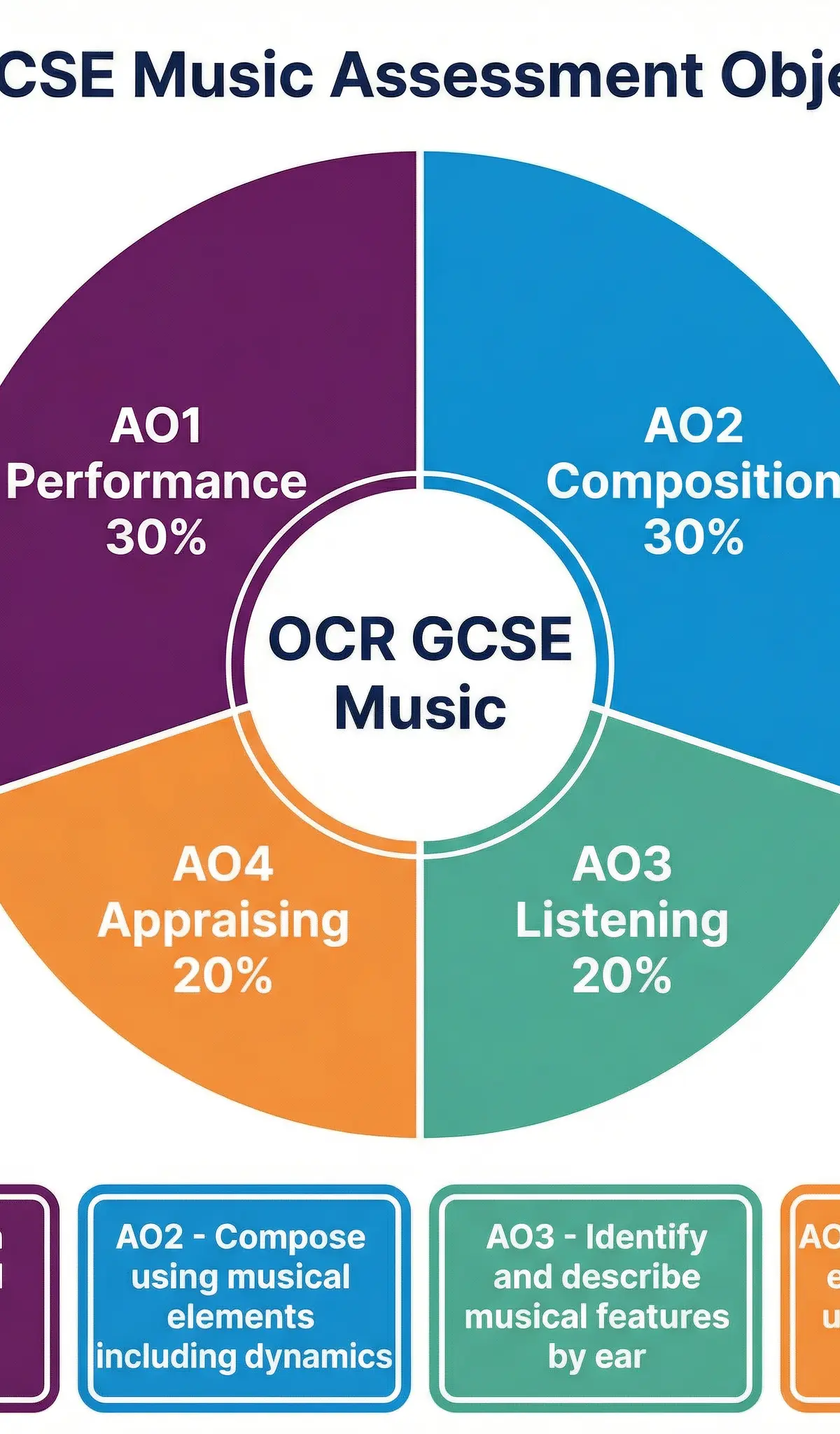
For your composition portfolio, examiners are looking for evidence that you can 'develop musical ideas' and 'use musical elements' (including dynamics) with control and imagination. A composition with a flat or random dynamic scheme will not score highly.
Building a Strong Portfolio
- Annotate your score: Briefly explain why you made certain dynamic choices. For example: "A subito piano is used here to create a moment of surprise and intimacy after the fortissimo climax."
- Show development: Your initial ideas might be dynamically simple. Your final composition should show refinement. You could show an early version of a melody and then the final version with detailed dynamic phrasing added.
- Record with expression: Your audio recording submitted for your composition must reflect the dynamics written in your score. This is where editing MIDI velocity is crucial. A mechanical, unmusical performance of a well-written score will lose marks.
Exam Component
Written Exam Knowledge
In the Listening and Appraising exam (Component 03), you will be tested on your ability to identify and describe dynamics by ear. This includes:
- Identifying specific Italian terms (e.g., pianissimo, crescendo, sforzando).
- Recognising techniques like terraced dynamics.
- Describing the effect of the dynamics on the mood and character of the music.
- In the Section B essay, you must link your observations about dynamics to the specific Area of Study and use specialist vocabulary.
Practical Exam Preparation
While there isn't a 'practical exam' for composition, the submission of your portfolio is the equivalent. For your performance, the recording is your exam. Prepare by:
- Recording yourself: Listen back to your performances. Are the dynamics clear? Is there a wide range between your softest and loudest playing?
- Peer feedback: Play for a teacher or fellow student and ask them specifically about your dynamic expression. Was the crescendo effective? Was the piano section audible but gentle?
Visual Resources
2 diagrams and illustrations
Interactive Diagrams
1 interactive diagram to visualise key concepts
Conceptual Flow Outline
A flowchart showing how a composer might decide which dynamics to use when scoring a dramatic scene.
Worked Examples
3 worked examples — open one to explore the question and available guidance.
Practice Questions
Test your understanding — click to reveal model answers
What is the Italian term for 'gradually getting softer' and what symbol is used to notate it?
Hint: Think of the opposite of crescendo.
Listen to an excerpt of music. Describe the use of dynamics in the opening 4 bars. You should use at least two different Italian terms in your answer.
Hint: Listen for the overall volume level and any sudden changes.
Explain how a composer from the Baroque period and a composer from the Romantic period would typically approach creating a long passage of increasing tension using dynamics.
Hint: Think about the instrumental and stylistic conventions of each era. Link to terraced dynamics and the invention of the crescendo.
You are creating a composition in a DAW. Your piece requires a very slow, subtle increase in volume over 32 bars. How would you achieve this technically?
Hint: Think beyond just writing 'crescendo' on a score. How do you make the computer perform it?