OCR · GCSE · Music
Evaluating Musical Effectiveness
This guide focuses on AO4, the crucial skill of evaluating musical effectiveness in OCR GCSE Music. It moves beyond simply describing music to making critical judgements about how musical elements create impact, a skill essential for top marks in the listening exam.
- 7 min read
- 3 worked examples
- 4 practice questions
- 6 key terms
Study Notes
Overview
Welcome to the study guide for Topic 3.3: Evaluating Musical Effectiveness. This is a cornerstone of the OCR GCSE Music course, carrying a significant weight in the listening exam (Paper 1). This topic is not about what you like, but about what is effective. It requires you to combine your knowledge of musical elements (AO3) with your critical judgement (AO4) to form a reasoned argument. You will be asked to evaluate music from a range of Areas of Study, including Film Music, Rhythms of the World, and the Set Works. Mastering this skill means moving from a simple description of what you hear to a sophisticated appraisal of why the composer's choices matter.

Key Knowledge & Theory
Core Concepts
At the heart of this topic are two Assessment Objectives:
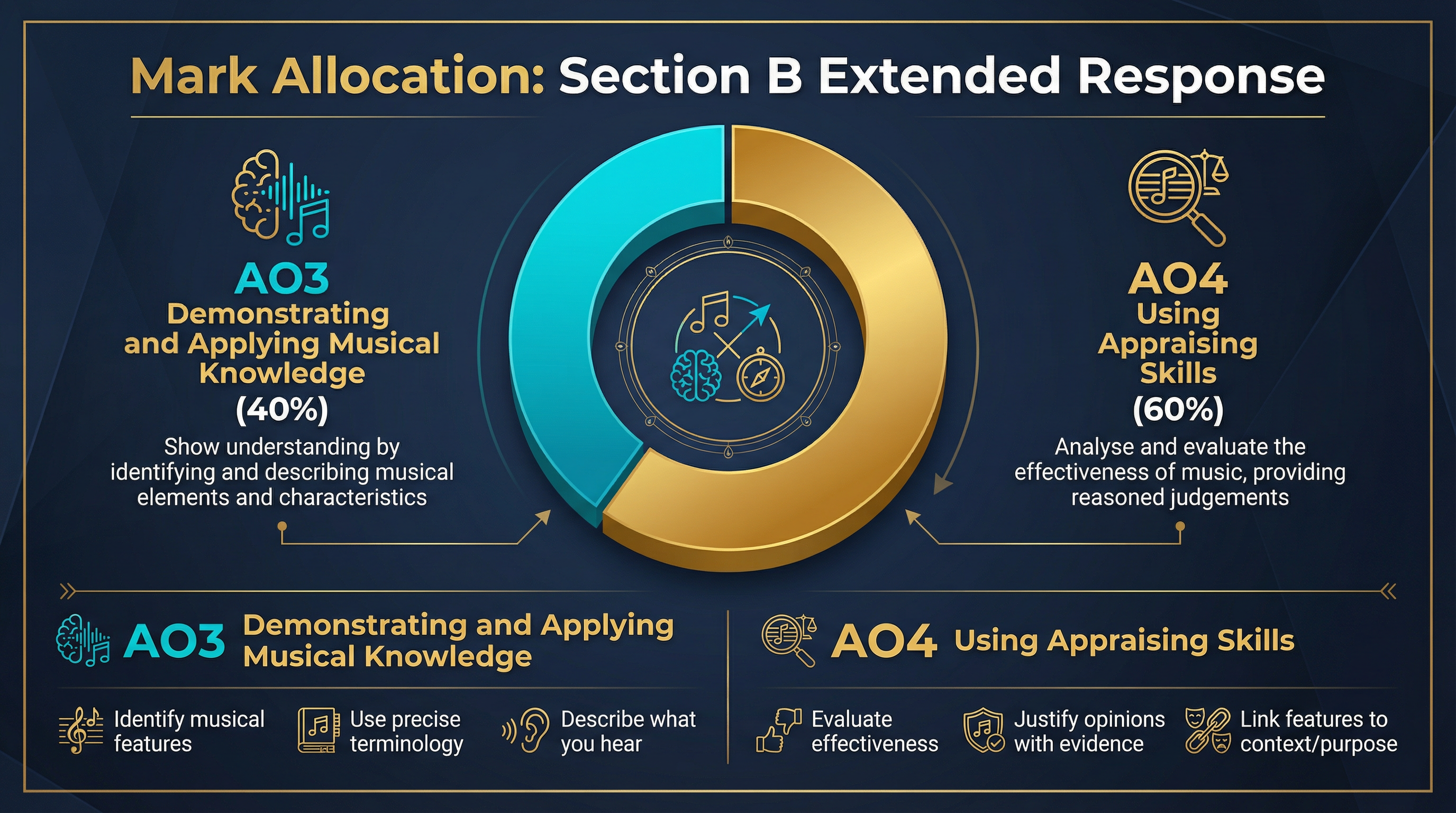
- AO3: Demonstrating and Applying Musical Knowledge (40%): This is your ability to identify and describe musical features using correct terminology. It is the 'what' of your analysis.
- AO4: Using Appraising Skills (60%): This is your ability to evaluate the effectiveness of those features within a specific context. It is the 'why' and 'how' of your analysis, and as you can see, it carries more marks.
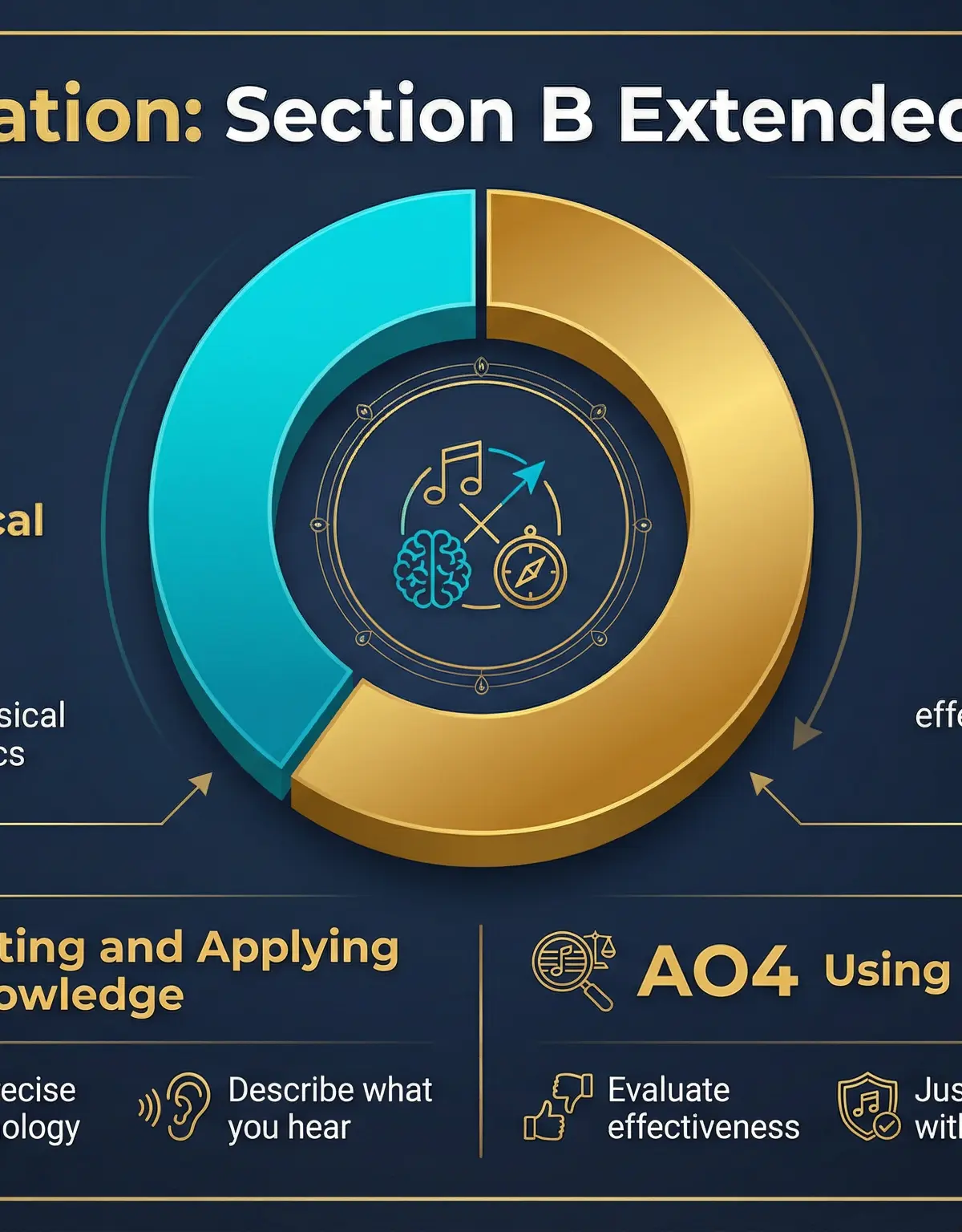
To effectively evaluate, you must have a robust vocabulary and a systematic approach. The key is to build a chain of reasoning for every point you make: Feature -> Effect -> Context.
- Identify the Feature: Name the specific musical device being used with precise terminology (e.g., 'a syncopated rhythm', 'a chromatic descending scale', 'a polyphonic texture').
- Explain the Effect: Describe the immediate impact this feature has on the listener (e.g., 'creates a sense of unease', 'builds rhythmic momentum', 'adds complexity and interest').
- Link to the Context: Justify why this effect is successful for the music's specific purpose (e.g., '...which is highly effective in heightening the tension during the chase scene', '...which is characteristic of this style of dance music').
Key Practitioners/Artists/Composers
Understanding the work of key composers is vital, as their music provides the case studies for your evaluation.
| Name | Period/Style | Key Works | Relevance |
|---|---|---|---|
| John Williams | 20th/21st Century Film | Star Wars, Jaws, Harry Potter | Master of the leitmotif, using specific melodic ideas to represent characters or concepts. His use of orchestration is highly effective in creating powerful dramatic moods. |
| Hans Zimmer | 20th/21st Century Film | The Dark Knight, Inception, Gladiator | Known for his fusion of electronic and orchestral sounds. His scores often rely on powerful rhythmic drive and textural layering to build immense tension and scale. |
| Anoushka Shankar | 21st Century World Music | Breathing Underwater, Land of Gold | A virtuoso sitar player and composer who blends traditional Indian classical music with contemporary Western styles. Her work is a key example for evaluating fusions in Rhythms of the World. |
| Queen | 20th Century Rock | 'Bohemian Rhapsody', 'Killer Queen' | Exemplars for the 'Conventions of Pop' Area of Study. Their music features complex vocal harmonies, adventurous structures, and innovative studio production techniques. |
Technical Vocabulary
Using precise terminology is non-negotiable for earning AO3 marks. Below is a list of essential terms you must know and use.
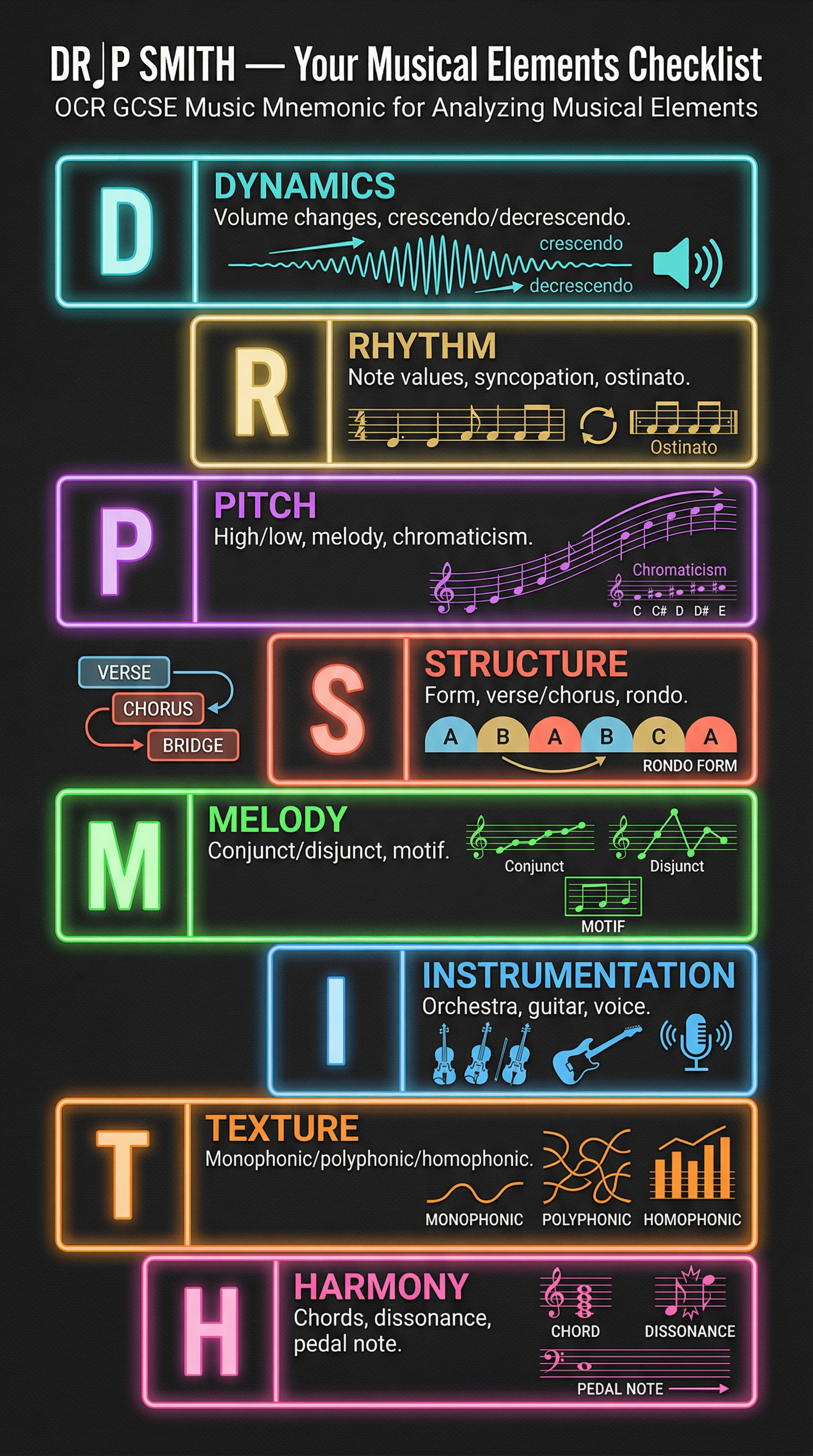
- Dynamics: crescendo, diminuendo, sforzando, forte, piano, terraced dynamics
- Rhythm: syncopation, ostinato, dotted rhythms, triplets, polyrhythm, tempo, rubato
- Pitch: conjunct, disjunct, chromaticism, diatonic, arpeggio, sequence, glissando
- Structure: binary, ternary, rondo, theme and variations, strophic, through-composed
- Melody: motif, sequence, ornamentation, improvisation, call and response
- Instrumentation: pizzicato, arco, mute, distortion, reverb, a cappella, timbre
- Texture: monophonic, homophonic, polyphonic, heterophonic, melody and accompaniment
- Harmony: major, minor, modal, atonal, dissonance, consonance, pedal note, drone, perfect cadence
Practical Skills
Techniques & Processes
This topic is primarily assessed in a listening exam, but the core skill is active, analytical listening. You must train your ear to deconstruct what you hear.
- Systematic Scanning: On first hearing an extract, do not try to write. Instead, use a mnemonic like DR P SMITH to scan the music for key features. Mentally tick off what you hear for Dynamics, Rhythm, Pitch, Structure, Melody, Instrumentation, Texture, and Harmony.
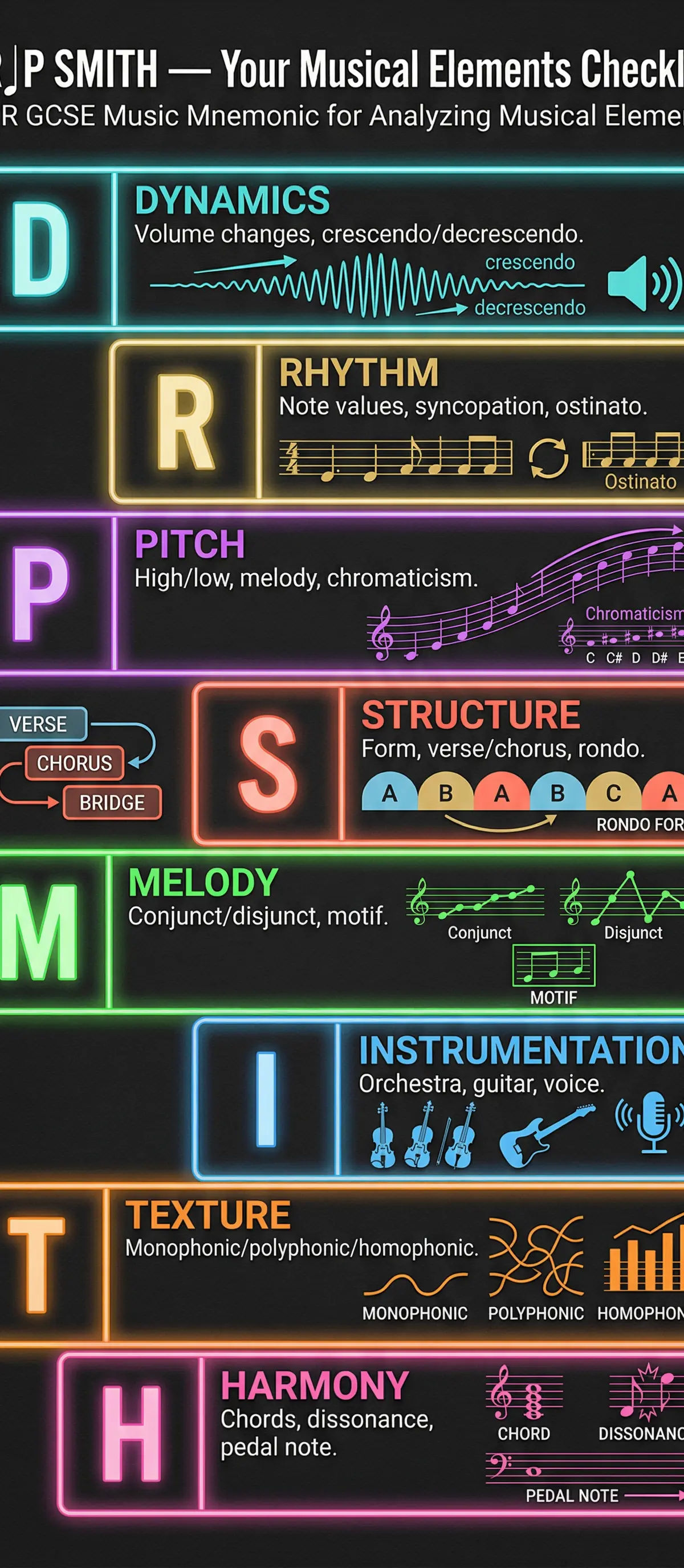
- Short-form Annotation: In the exam, you will have space to make notes. Develop a personal shorthand to quickly capture ideas. For example: 'Str cresc -> tension' could stand for 'A crescendo in the strings creates tension'.
- Comparative Listening: When preparing for comparison questions, listen to two pieces of music from the same genre or with a similar purpose (e.g., two film chase scenes). Create a Venn diagram or a table to map their similarities and differences across the DR P SMITH elements. This forces you to think comparatively.
Materials & Equipment
Your primary equipment for this topic is your ear and your brain. However, using technology can significantly enhance your preparation.
- DAW (Digital Audio Workstation): Software like GarageBand, Logic Pro, or Soundtrap allows you to visualise music. Seeing the waveform of a crescendo or the layered tracks of a polyphonic texture can be revelatory.
- Notation Software: Using Sibelius or Musescore to transcribe a short melody or rhythm you hear helps to solidify your understanding of pitch and rhythmic notation.
- High-Quality Headphones: When listening for analysis, good headphones are essential to pick out subtle details in the texture, instrumentation, and harmony.
Exam Component
Written Exam Knowledge
This entire topic is geared towards the Listening and Appraising exam (Paper 1), specifically Section B, which contains the extended response questions (often 8 or 12 marks).
- Section A will test your knowledge of the set works and prepared extracts, often with shorter-answer questions that build towards evaluative thinking.
- Section B presents you with unfamiliar music from the Areas of Study and asks you to evaluate its effectiveness or compare it with another piece. This is where your AO4 skills are paramount.
You will be expected to write about music from:
- Area of Study 2: The Language of Music
- Area of Study 3: Music for Ensemble
- Area of Study 4: Film and Game Music
- Area of Study 5: Conventions of Pop
Your evaluation must always be framed by the context provided in the question (e.g., 'evaluate the effectiveness of the music in creating a sense of mystery').
Visual Resources
2 diagrams and illustrations
Interactive Diagrams
1 interactive diagram to visualise key concepts
Conceptual Flow Outline
The Feature-Effect-Context chain for writing high-scoring evaluative responses.
Worked Examples
3 worked examples — open one to explore the question and available guidance.
Practice Questions
Test your understanding — click to reveal model answers
Identify the texture of this extract.
Hint: How many independent melodic lines can you hear?
Describe the rhythm of the bass line in this extract of funk music. [4 marks]
Hint: Listen for off-beat notes and repetition.
Evaluate how the composer uses instrumentation to create a peaceful and serene atmosphere in this piece. [6 marks]
Hint: Focus on the specific timbres of the instruments and why those choices are effective.
'The composer is highly successful in creating a sense of heroic triumph in this extract.' Evaluate this statement with reference to at least three musical elements. [8 marks]
Hint: This is an 'evaluate this statement' question. You must agree or disagree (or both) and justify your position using DR P SMITH.