OCR · GCSE · Music
Fusions
This guide explores Fusions in OCR GCSE Music, focusing on how traditional world music (Bhangra, Eastern Mediterranean, African) blends with Western Pop/Rock. It's a key part of Area of Study 2, 'Rhythms of the World', and tests your ability to analyse and compare musical elements from different cultures.
- 8 min read
- 3 worked examples
- 4 practice questions
- 6 key terms
Study Notes

Overview
Welcome to the exciting world of musical Fusions! In your OCR GCSE Music course, this topic is where different cultures collide to create vibrant, innovative sounds. You'll be exploring how artists and producers take elements from traditional heritage music—specifically Bhangra, Eastern Mediterranean, and African traditions—and fuse them with the structures, instruments, and technologies of Western Pop and Rock. This isn't just about listening; it's about becoming a musical detective, identifying the clues that reveal a track's cultural DNA and explaining how they've been woven together. A strong understanding of Fusions is crucial for the listening exam, particularly for the high-mark comparison questions where you need to demonstrate sharp analytical skills.

Key Knowledge & Theory
Core Concepts
At the heart of Fusions is the principle of synthesis—the blending of disparate elements to form a new whole. For your exam, you need to be able to identify both the 'traditional' and the 'Western' components in a piece of music.
Bhangra Fusion: This is the most common style you'll encounter. Originating from the Punjab region of India and Pakistan, traditional Bhangra is celebratory folk music. The fusion involves layering its distinctive rhythms and instruments over a Western pop framework.
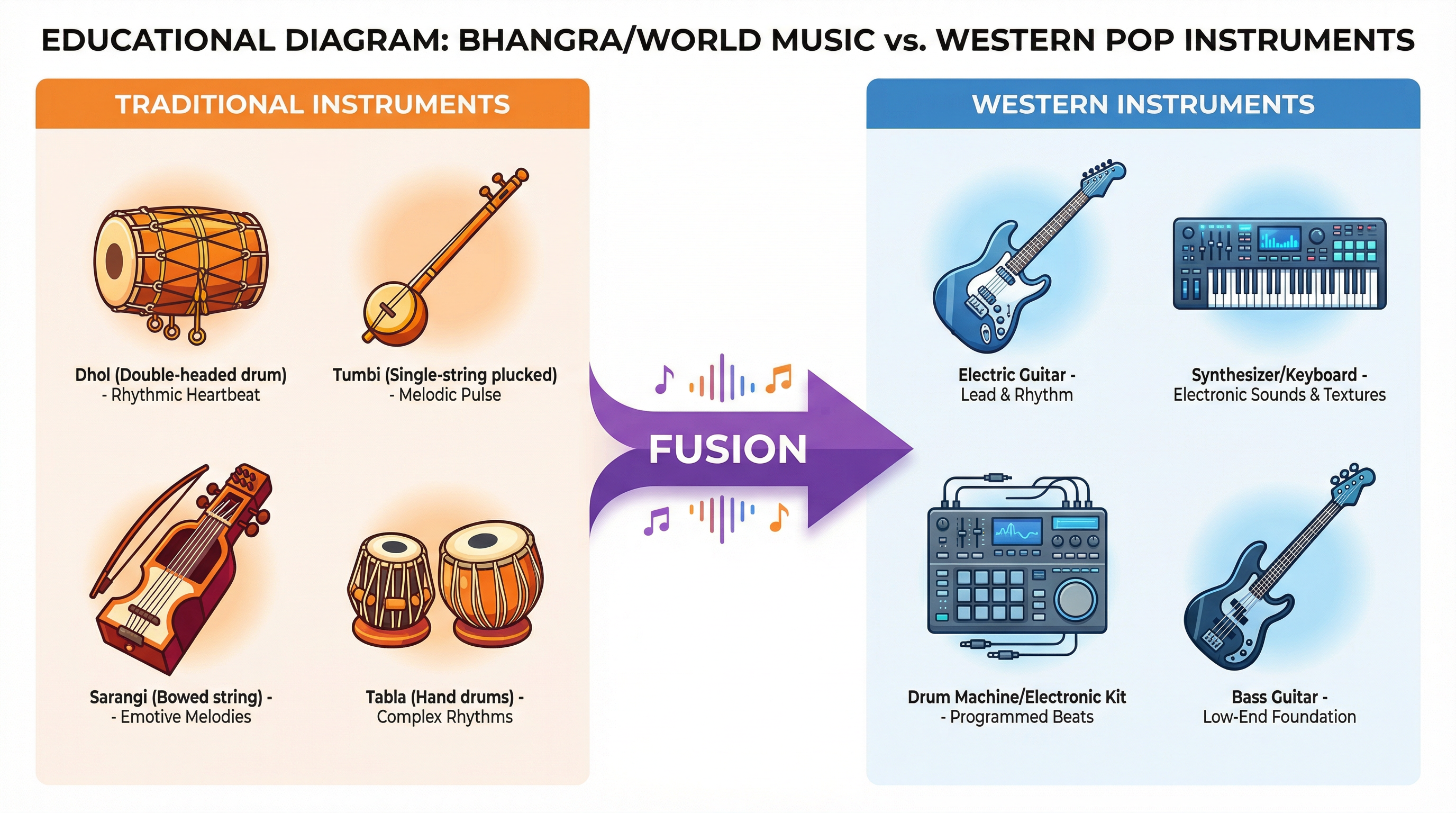
- Rhythm: The core traditional rhythm is the Chaal, which has a characteristic triplet or 'swing' feel. This is often superimposed over a steady 4/4 rock or pop beat created by a drum machine or Western drum kit. Credit is given for identifying this rhythmic layering.
- Instrumentation: The Dhol drum is the sonic signature. You must be able to identify its deep bass 'thud' and high-pitched treble 'crack'. The Tumbi, a single-stringed instrument, plays high, catchy riffs. Do not confuse it with the multi-stringed Sitar from Indian Classical music.
- Vocals: Vocal lines often use microtonal ornamentation (notes between the standard Western semitones) and may feature code-switching (mixing languages like Punjabi and English).
Eastern Mediterranean & African Fusions:
- Eastern Mediterranean: Look for the use of modes (scales other than major/minor, like the Phrygian mode), quarter-tones, and instruments like the Oud (a pear-shaped lute) or the Bouzouki (a long-necked Greek lute).
- African: Key features include polyrhythms (multiple conflicting rhythms played at once), call-and-response vocal patterns, and instruments like the Kora (a West African harp-lute).
Key Practitioners/Artists/Composers
| Name | Period/Style | Key Works | Relevance |
|---|---|---|---|
| Panjabi MC | 1990s-Present | 'Mundian To Bach Ke' (1998) | A landmark Bhangra fusion track that famously sampled the bassline from the TV show 'Knight Rider'. It's a perfect example of sampling, looping, and the blend of Dhol, Tumbi, and a Western hip-hop beat. |
| Alaap | 1970s-1980s | 'Bhabiye Ni Bhabiye' | Pioneers of the UK Bhangra sound, they were among the first to fuse traditional Punjabi folk melodies with Western instruments like the electric guitar, bass, and synthesizers. |
| Apache Indian | 1990s-Present | 'Boom Shack-A-Lak' | Fused Bhangra with Jamaican Dancehall and Reggae, demonstrating a different kind of fusion. His work highlights the importance of lyrical flow and vocal style in creating a fusion identity. |
| Nitin Sawhney | 1990s-Present | 'Nadia' (from 'Beyond Skin') | A highly sophisticated producer who blends Indian classical, flamenco, and electronic music. His work is more complex and shows how fusion can be artistic and experimental, not just commercial. |
Technical Vocabulary
- Chaal Rhythm: The fundamental rhythmic pattern of Bhangra, with a distinctive triplet feel.
- Microtone: An interval smaller than a semitone, often found in non-Western vocal and melodic lines.
- Ornamentation: The decoration of a melody with extra notes, such as trills or slides.
- Sampling: Taking a portion (a 'sample') of one sound recording and reusing it in a different piece.
- Looping: Repeating a sample continuously.
- Remix: Creating a new version of a song by adding or changing its elements.
- Drum Machine: An electronic instrument used to program and play back drum patterns.
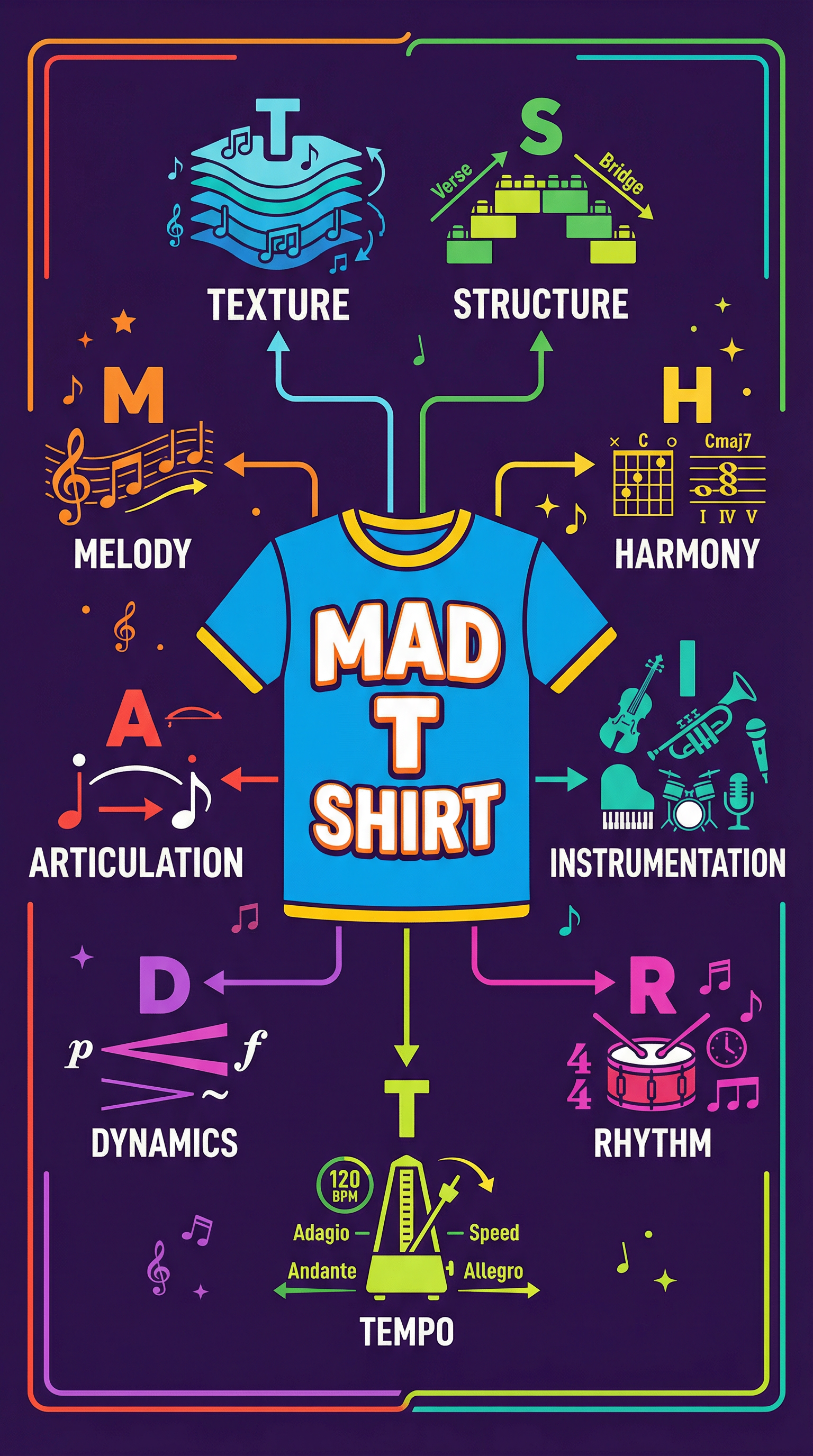
- Verse-Chorus Structure: A standard Western song structure.
- Melody-Dominated Homophony: The most common texture in pop music, where a single melody is supported by chords.
- Polyrhythm: The simultaneous use of two or more conflicting rhythms.
Practical Skills
Techniques & Processes
For your composition portfolio, you might be asked to create a piece in a Fusion style. Here's a process:
- Establish the Foundation: Start with a Western beat. Program a simple 4/4 rock or hip-hop beat using a drum machine in your DAW (Digital Audio Workstation). This provides the structural backbone.
- Import the 'World' Element: Find high-quality samples of traditional instruments. Look for a Dhol loop with a clear Chaal rhythm. Layer this over your Western beat. Listen to how the triplet feel of the Chaal interacts with the straight 4/4 beat.
- Add a Riff: Use a Tumbi sample or a synthesizer patch that mimics its sound to create a short, catchy, repetitive riff. This will be your main melodic hook.
- Develop the Harmony: Create a simple chord progression using a synth pad or bass guitar. This will establish the diatonic harmony typical of Western pop.
- Structure the Piece: Arrange your loops and ideas into a clear verse-chorus structure. Think about how you can vary the texture, for example, by dropping out the Dhol during the verse and bringing it back for the chorus to create impact.
Materials & Equipment
- DAW (Digital Audio Workstation): Software like Logic Pro, GarageBand, Cubase, or BandLab is essential for composing and producing fusion tracks.
- Sample Libraries: Access to high-quality sample packs of world instruments is crucial. Services like Splice or Loopcloud are invaluable for this.
- MIDI Keyboard: A keyboard controller allows you to play and record synthesizer parts, basslines, and programmed drums.
- Microphone: If you plan to include vocals or record your own live instruments, a good quality microphone is necessary.
Portfolio/Coursework Guidance
Assessment Criteria
Examiners are looking for evidence of your understanding of the style. For a Fusion composition, they will award marks for:
- Developing Ideas: How you took initial ideas (e.g., a Dhol loop) and developed them into a full piece.
- Technical Control: Your ability to use the DAW effectively to layer sounds, control balance, and apply effects like reverb or EQ.
- Compositional Coherence: Does the piece make sense? Does it have a clear structure? Do the different elements work together effectively?
- Understanding of Style: This is key. Have you successfully combined elements from both a traditional and a Western style? Your annotation must explain how you have done this, referencing specific musical features.
Building a Strong Portfolio
- Annotate Everything: Keep a detailed log of your composition process. For every track, explain why you made a particular choice. For example: "I layered the Chaal rhythm played by the Dhol over a 4/4 drum machine beat to create the characteristic rhythmic tension of Bhangra fusion."
- Show Experimentation: Don't just stick with your first idea. Try different beats, different samples, different structures. Screenshot your experiments and explain why you chose one path over another. This shows refinement.
- Link to Set Works: In your commentary, reference the OCR set works or other relevant commercial examples. "My use of a sampled vocal hook is influenced by Panjabi MC's 'Mundian To Bach Ke'."
Exam Component
Written Exam Knowledge
The listening exam is where your theoretical knowledge of Fusions will be tested. You will be played unfamiliar extracts and asked to identify features. The 8-mark comparison question is the ultimate test.
Key Listening Skills:
- Instrument Recognition: Can you tell a Dhol from a drum kit? A Tumbi from a Sitar? An Oud from an electric guitar?
- Rhythmic Analysis: Can you hear the difference between a straight 4/4 beat and a syncopated Chaal rhythm?
- Textural Awareness: Can you describe how the different instrumental layers are interacting?
Practical Exam Preparation
While there isn't a 'practical exam' for Fusions in the same way as performance, your composition coursework is the practical application of this knowledge. The best way to prepare for the listening exam is to try creating your own fusion pieces. This hands-on experience will train your ear to identify the key ingredients of the style much more effectively than passive listening ever could.
Visual Resources
2 diagrams and illustrations
Interactive Diagrams
1 interactive diagram to visualise key concepts
Conceptual Flow Outline
The core process of musical fusion, showing the combination of Western and Traditional elements.
Worked Examples
3 worked examples — open one to explore the question and available guidance.
Practice Questions
Test your understanding — click to reveal model answers
Identify the single-stringed instrument that plays the main riff in many Bhangra tracks.
Hint: Think of the 'Tiny, Twangy, Top-line' memory hook.
Describe two ways technology is used to create Bhangra fusion music.
Hint: Think about how the beat is made and how sounds are borrowed.
Explain how the rhythm in a Bhangra fusion track creates a sense of 'fusion'.
Hint: It's about the interaction between two different rhythmic ideas. What are they, and how do they work together?
You are a composer tasked with creating a 1-minute piece of Eastern Mediterranean fusion. Describe how you would approach this task, making reference to melody, rhythm, and instrumentation.
Hint: Start with your Western elements, then decide how you will incorporate the Eastern Mediterranean flavour.