Harmony — OCR GCSE Study Guide
Exam Board: OCR | Level: GCSE
This guide provides a comprehensive overview of Harmony for OCR GCSE Music. It covers core concepts like chords, cadences, and harmonic devices, essential for success in the listening, composition, and appraising components of the exam.
## Overview
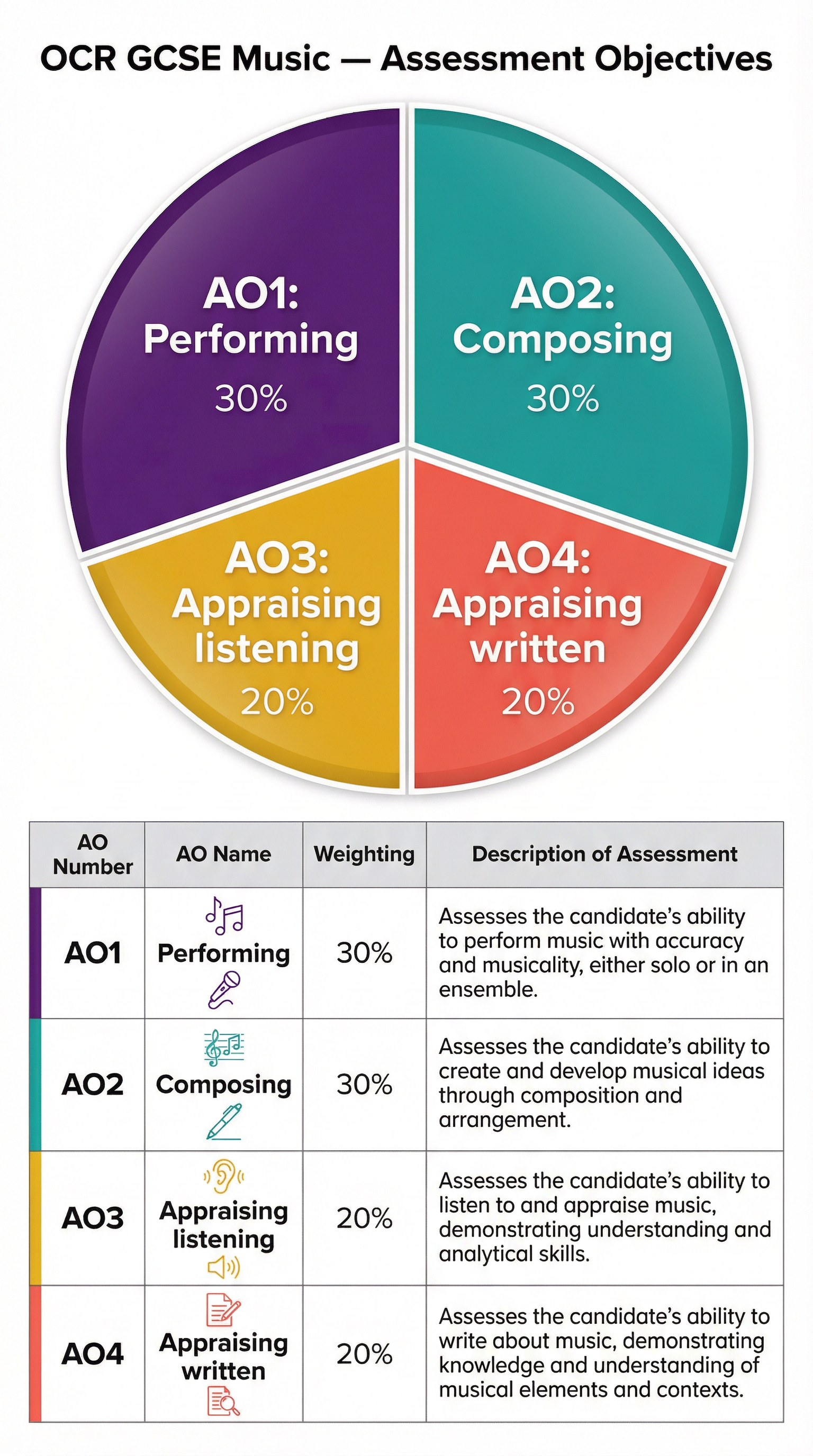
Harmony is a cornerstone of the OCR GCSE Music course, assessed across all components. It is the art of combining notes to create chords and progressions that give music its emotional depth and structure. A strong grasp of harmony is essential for candidates wishing to achieve high marks, as it underpins performance (AO1), composition (AO2), and appraisal (AO3 & AO4). This guide will equip you with the technical vocabulary, theoretical knowledge, and practical skills to master it.
## Key Knowledge & Theory
### Core Concepts
- **Diatonic Harmony**: The foundation of Western music, using notes and chords that belong to a specific major or minor key. The primary chords are the Tonic (I), Subdominant (IV), and Dominant (V).
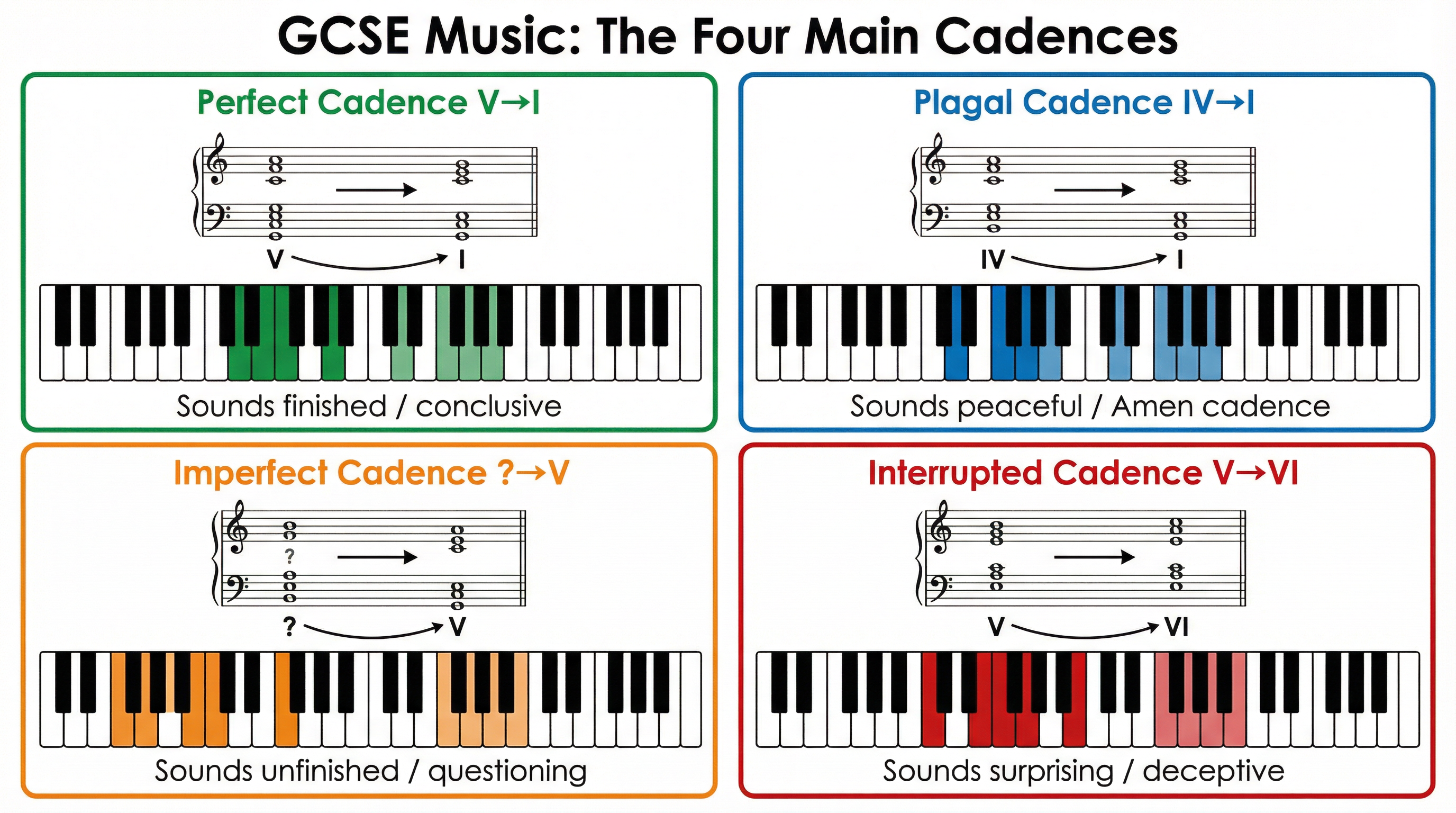
- **Cadences**: These are the punctuation marks of music, occurring at the end of phrases. There are four key types: Perfect (V-I, sounds finished), Plagal (IV-I, sounds peaceful), Imperfect (ends on V, sounds unfinished), and Interrupted (V-VI, sounds surprising).
- **Harmonic Devices**: Techniques used to add interest and tension. Key devices include:
- **Pedal Note**: A sustained or repeated note (usually tonic or dominant) in the bass while harmonies change above it.
- **Drone**: Two or more sustained notes, common in folk and world music.
- **Chromaticism**: The use of notes outside the home key to create colour, dissonance, and tension. Essential in Film Music.
- **Modulation**: The process of changing from one key to another, most commonly to the dominant or relative major/minor.
- **Extended Chords**: Chords with added notes beyond the basic triad, such as 7ths (e.g., V7) and sus4 chords. Using these demonstrates sophistication in composition.
### Key Practitioners/Artists/Composers
| Name | Period/Style | Key Works | Relevance |
|---|---|---|---|
| J.S. Bach | Baroque | Brandenburg Concertos | Master of diatonic functional harmony and counterpoint. His use of perfect cadences and clear modulations is a model for the 'Concerto Through Time' area of study. |
| W.A. Mozart | Classical | Piano Concerto No. 20 in D minor | Exemplifies Classical harmony with balanced phrasing, clear cadences, and elegant modulation. A key reference for understanding concerto form and harmony. |
| John Williams | Contemporary | Star Wars, Jaws | A master of cinematic harmony. He uses chromaticism, dissonance, and powerful leitmotifs to manipulate audience emotion, making his work essential for the 'Film Music' study area. |
| Steve Reich | Minimalism | Electric Counterpoint | Explores harmony through layered ostinato patterns and slowly shifting textures, demonstrating a different approach to harmonic development relevant to the 'Rhythms of the World' area of study. |
### Technical Vocabulary
- **Diatonic**: Notes or chords that belong to the prevailing key.
- **Chromatic**: Notes or chords that are foreign to the prevailing key.
- **Consonant**: Harmonies that sound stable and pleasing.
- **Dissonant**: Harmonies that sound tense, clashing, and unstable, requiring resolution.
- **Tonality**: The character of a piece of music as determined by the key in which it is played or the relations between the notes of a scale or key.
- **Atonal**: Music that lacks a clear tonal centre or key.
- **Pedal Note**: A sustained or repeated note held while harmonies change.
- **Voice Leading**: The way in which individual melodic lines (voices) move from one chord to the next. Good voice leading avoids parallel 5ths and 8ves.
## Practical Skills
### Techniques & Processes
1. **Identifying Cadences by Ear**: The most crucial practical skill. Listen to the bass line movement. A leap of a 4th/5th often indicates a Perfect or Plagal cadence. Stepwise motion can suggest an Imperfect or Interrupted cadence. Isolate the final two chords of a phrase and hum the bass notes.
2. **Composing a Chord Progression**: Start with a clear structure (e.g., I-IV-V-I).
- **Step 1**: Establish the tonic (I).
- **Step 2**: Move away from the tonic, often to the subdominant (IV).
- **Step 3**: Create tension by moving to the dominant (V), often using a V7 for extra pull.
- **Step 4**: Resolve back to the tonic (I) with a perfect cadence.
- **Experiment**: Try substituting chord VI for I to create an interrupted cadence, or use a sus4 chord on the dominant for added colour.
3. **Harmonising a Melody**: When given a melody, identify the key notes that fall on strong beats. These notes will suggest the underlying chord. For example, if the melody features the tonic note on beat 1, a tonic chord (I) is a safe choice.
### Materials & Equipment
- **Your Instrument/Voice**: For trying out chord progressions and hearing voice leading in practice.
- **Notation Software (e.g., Sibelius, Musescore)**: Essential for composing. These tools allow you to hear your harmonic ideas instantly and check for errors like parallel 5ths.
- **Piano/Keyboard**: The most effective tool for visualising and understanding harmony. Seeing the relationship between notes in a chord makes the theory concrete.
## Portfolio/Coursework Guidance
### Assessment Criteria
For AO2 (Composing), examiners are looking for:
- **Development of musical ideas**: How you take a simple idea and develop it using harmonic techniques.
- **Technical control**: Your ability to write idiomatically for the chosen instruments and use harmony correctly (e.g., correct cadences, smooth voice leading).
- **Use of musical elements**: How harmony interacts with melody, rhythm, and texture to create a cohesive whole.
- **Creativity and coherence**: A composition that is musically interesting and has a clear sense of direction and structure.
### Building a Strong Portfolio
- **Annotate your score**: Clearly label your cadences, modulations, and any harmonic devices like pedal notes. This is crucial for showing the examiner your understanding.
- **Show your working**: Keep drafts of your composition. This evidences your creative process and shows how you have refined your harmonic ideas.
- **Experiment with harmony**: Don't just use I-IV-V. Try using minor chords (ii, iii, vi), extended chords (7ths, 9ths), and at least one modulation. This demonstrates ambition.
## Exam Component

### Written Exam Knowledge
In the listening exam (AO3), you will be asked to identify harmonic features from an excerpt of music. Questions will focus on:
- **Cadence identification**: You will hear a short phrase and be asked to name the cadence.
- **Chord recognition**: Identifying specific chords like the dominant 7th.
- **Harmonic devices**: Spotting pedals, drones, or ostinato patterns.
- **Tonality**: Describing the music as major, minor, modal, or atonal.
- **Contextual understanding**: Describing the harmony of an unfamiliar piece from one of the areas of study, using correct technical vocabulary.
### Practical Exam Preparation
For the composition brief (AO2), you will be given a stimulus (e.g., a short melodic fragment, a set of chords, a picture). You must compose a piece based on this stimulus. To prepare:
- **Practice harmonising short melodies** in different styles.
- **Create a bank of effective chord progressions** that you can adapt.
- **Set yourself timed composition exercises**: Can you write a convincing 8-bar phrase with a perfect cadence in 10 minutes? This simulates exam conditions.