OCR · GCSE · Music
Tempo
This guide provides a comprehensive overview of Tempo (3.9) for OCR GCSE Music. It covers the essential Italian terminology, application in performance and composition, and key analysis skills required for the Listening and Appraising exam, ensuring candidates can secure maximum marks across all assessment objectives."
- 8 min read
- 3 worked examples
- 4 practice questions
Study Notes
Overview
Tempo, the speed of music, is a fundamental element that shapes the character and structure of a piece. For OCR GCSE Music, a precise understanding of tempo is not optional; it is essential for gaining credit across all three assessment objectives: Performance (AO1), Composition (AO2), and Listening and Appraising (AO3). This guide will equip you with the technical vocabulary, theoretical knowledge, and practical skills to master tempo in all its forms.

Key Knowledge & Theory
Core Concepts
At its heart, tempo is the speed of the underlying beat or pulse in a piece of music, measured in Beats Per Minute (BPM). It is crucial to distinguish tempo from rhythm; while tempo is the speed of the steady pulse, rhythm refers to the varied patterns of note durations that sit on top of that pulse. Examiners will penalise candidates who confuse these two distinct elements.
Tempo is indicated in music using Italian terms or a metronome marking (e.g., = 120). Candidates must be fluent in the Italian terminology as this is the standard required in the listening exam.
The Tempo Spectrum
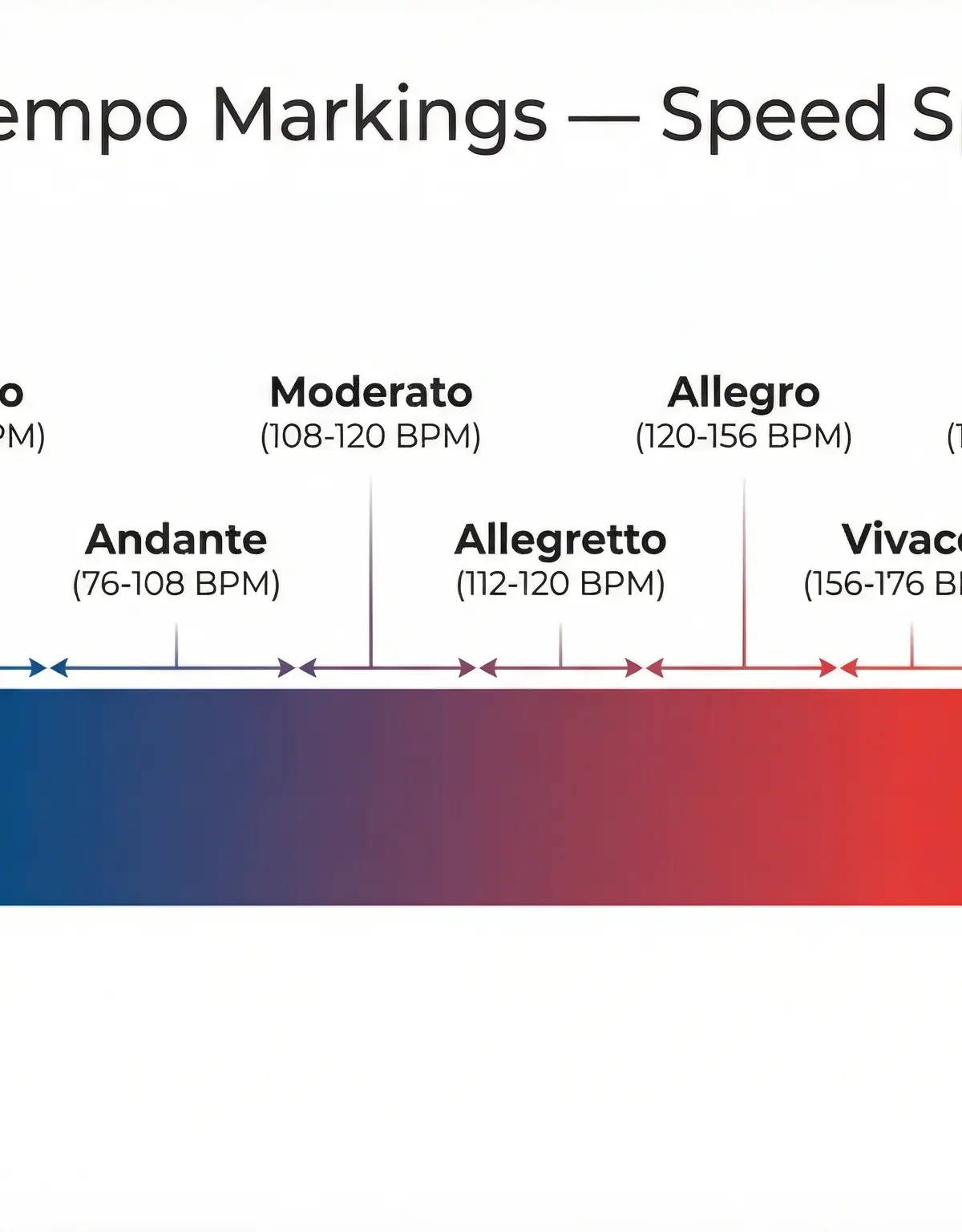
Understanding the full range of tempo markings is vital. They are not just labels, but instructions that dictate the entire mood of a piece. The spectrum ranges from extremely slow to incredibly fast:
- Very Slow: Grave, Largo (broadly), Lentamente
- Slow: Adagio (at ease), Larghetto (a little faster than Largo)
- Moderate: Andante (at a walking pace), Andantino (slightly faster than Andante), Moderato (moderately)
- Fast: Allegretto (moderately fast), Allegro (fast and lively), Vivace (lively and brisk)
- Very Fast: Presto (very fast), Prestissimo (as fast as possible)
Tempo Changes
Music rarely stays at one speed. Gradual changes in tempo are used to create expression and shape phrases.
- Accelerando (accel.): Gradually getting faster. Used to build tension and excitement.
- Ritardando (rit.) / Rallentando (rall.): Gradually getting slower. Often used to signal the end of a section or for expressive effect.
- A tempo: Return to the original speed after a change.
- Rubato: 'Robbed time'. The performer can subtly speed up and slow down for expressive purposes, without altering the overall tempo. This is a key feature of Romantic music.
Key Practitioners/Artists/Composers
| Name | Period/Style | Key Works | Relevance |
|---|---|---|---|
| Ludwig van Beethoven | Classical/Romantic | Symphony No. 5, 1st Mvt. (Allegro con brio) | A master of dramatic tempo. His use of Allegro con brio (fast with spirit) creates immense energy and drive. He pushed the boundaries of tempo for expressive means. |
| Frédéric Chopin | Romantic | Nocturne in E-flat Major, Op. 9 No. 2 | The quintessential composer for rubato. His piano works require a flexible and expressive approach to tempo to convey their emotional depth. |
| John Williams | Film Music | 'The Imperial March' from Star Wars | A modern master of using tempo to manipulate audience emotion. The relentless Moderato march tempo gives the theme its menacing and powerful character. |
| Steve Reich | Minimalism | Music for 18 Musicians | Explores gradual process and pulse. While the tempo might be consistent, the shifting rhythmic patterns create a unique and evolving sense of speed and momentum. |
Technical Vocabulary
Using precise, subject-specific terminology is non-negotiable for achieving high marks. Examiners are looking for candidates who can 'talk the talk'. Ensure you can spell and define these terms correctly.
- Pulse: The underlying steady beat of the music.
- BPM (Beats Per Minute): The unit for measuring tempo.
- Metronome: A device used to indicate tempo precisely.
- Accelerando (accel.): Gradually getting faster.
- Ritardando (rit.): Gradually getting slower.
- Rallentando (rall.): Broadening and slowing down.
- A tempo: Return to the original speed.
- Rubato: Expressive flexibility of tempo.
- Syncopation: Accenting the off-beats, which can create rhythmic interest against a steady tempo.
Practical Skills
Techniques & Processes
For Performers (AO1):
- Metronome Practice: This is the single most effective tool for developing a stable internal pulse. Start by playing scales and simple exercises with a metronome. Set it to a slow tempo and ensure every note is perfectly aligned with the click.
- Sub-division: When playing at a slow tempo (Adagio), it is crucial to feel the smaller beats within the main pulse (e.g., quavers or semiquavers). This prevents the music from dragging.
- Controlled Accelerando and Ritardando: Practice gradual tempo changes over a set number of bars. For an accelerando, aim to increase the metronome marking by 2-4 BPM each bar. This develops smooth, controlled transitions rather than sudden jumps in speed.
For Composers (AO2):
- Tempo Marking: Always begin your score with a clear tempo indication (e.g., Allegro = 144). This is a simple mark that is often missed.
- Structural Contrast: Use tempo as a tool to define the structure of your piece. A contrasting middle section (Trio or Bridge) can be highly effective at a slower tempo (Andante) before returning to the main Allegro theme.
- Expressive Variation: Don't be afraid to use ritardando at the end of key phrases or a subtle rubato marking for a solo instrument to add expressive depth.
Materials & Equipment
- Metronome: Can be a traditional wind-up model, a digital pocket device, or a mobile app (e.g., Soundbrenner, Pro Metronome). Digital metronomes offer features like tap-tempo and programmable changes, which are invaluable for practice.
- DAW (Digital Audio Workstation): Software like Logic Pro X, Cubase, or GarageBand has a built-in metronome and a tempo track, allowing composers to map out precise tempo changes visually.
Portfolio/Coursework Guidance
Assessment Criteria
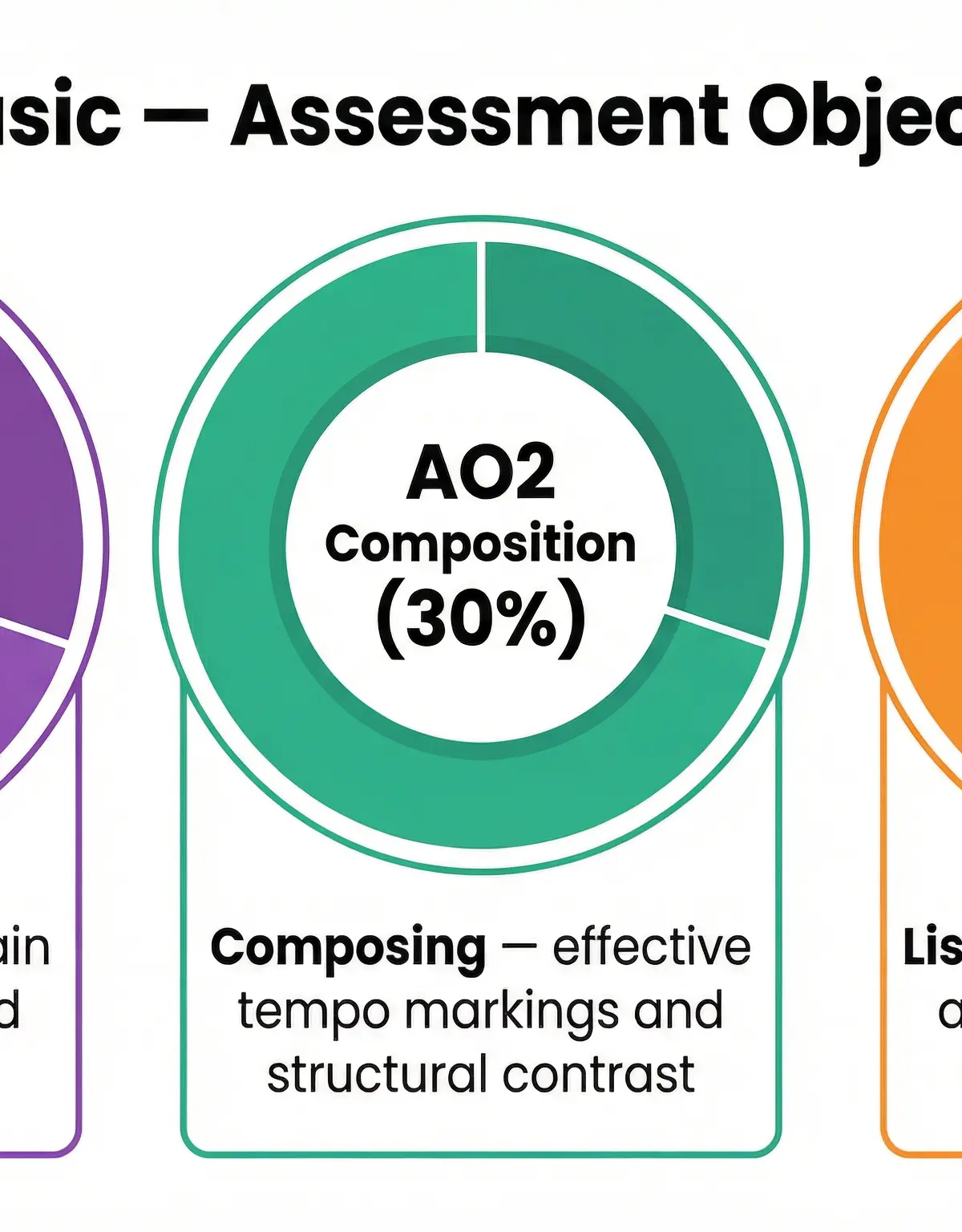
Examiners assess your understanding of tempo across your performance and composition coursework.
- AO1 (Performance - 30%): Credit is given for maintaining a consistent and appropriate tempo. Fluency and technical control are judged against the stability of the pulse. Unintentional speeding up or slowing down will be penalised.
- AO2 (Composition - 30%): Marks are awarded for selecting a tempo that is stylistically appropriate for your piece and for using tempo changes to create contrast and interest. Your score must be clearly marked.
Building a Strong Portfolio
- Performance Diary: Keep a log of your metronome practice. Note the tempos you are working at and any sections where you struggle to maintain pulse. This provides evidence of your development.
- Compositional Log: Annotate your score or a separate document explaining your tempo choices. Justify why you chose Allegro for your opening section. Explain the intended effect of the ritardando in the final bars. This commentary demonstrates your understanding to the examiner.
Exam Component
Written Exam Knowledge (AO3 - 40%)
The Listening and Appraising exam is where your theoretical knowledge of tempo is most directly tested. You will hear unfamiliar music from a range of styles and be expected to:
- Identify the correct Italian tempo marking.
- Describe how the tempo changes (e.g., "The music features an accelerando leading into the chorus").
- Analyse the effect of the tempo (e.g., "The Presto tempo creates a frantic and energetic mood, suitable for the virtuosic solo passage").
- Compare the tempos of different pieces or sections.
Practical Exam Preparation
While there is no "practical exam" for composition, the principle of working under timed conditions applies. When you receive a composition brief, spend time considering an appropriate tempo before you write a single note. Does the brief suggest energy, reflection, tension? Let the answer guide your initial tempo choice.
For performers, the practical exam is your final recorded performance. The key is to choose a tempo you can sustain under pressure. It is always better to perform a piece slightly under the professional recording speed with perfect control than to attempt a faster tempo and make mistakes. Choose a safe, manageable tempo that still reflects the composer's intentions.
"
Worked Examples
3 worked examples — open one to explore the question and available guidance.
Practice Questions
Test your understanding — click to reveal model answers
Define the term 'Pulse' and explain how it differs from 'Rhythm'. [4 marks]
Hint: Think about what you would tap your foot to versus the pattern of the words in a song.
Listen to an excerpt of music. Compare the tempo of the opening section with the closing section. You should refer to the correct Italian terminology and the overall effect. [6 marks]
Hint: Listen for a clear change in speed between the beginning and the end. Does it get faster or slower? By how much?
You are performing a piece that contains a long accelerando over 8 bars. How would you ensure this tempo change is smooth and controlled? [4 marks]
Hint: Think about how a metronome could help you practise this.
Evaluate the use of tempo in the final movement of Beethoven's Symphony No. 5. In your answer you should consider the main tempo, any changes, and the overall impact on the listener. [8 marks]
Hint: This is a synoptic question. You need to know the piece. Think about the triumphant character of the final movement and how tempo contributes to this.