OCR · GCSE · Music
Texture
This guide provides a comprehensive overview of musical texture for OCR GCSE Music students. It covers the core concepts, from monophony to polyphony, and provides essential exam techniques to help candidates secure top marks in their listening and appraising paper.
- 7 min read
- 3 worked examples
- 4 practice questions
- 7 key terms
Study Notes

Overview
Texture is one of the fundamental elements of music, alongside pitch, rhythm, and dynamics. For the OCR GCSE Music specification (J536), a secure understanding of texture is not just optional; it is essential for achieving high marks in the listening and appraising exam (Component 03). Texture refers to the number of layers or parts in a piece of music and how they interact with one another. Think of it as the fabric of sound. Is it a single, thin thread, or a rich, complex tapestry? Examiners will award significant credit to candidates who can accurately identify and describe different textures using precise terminology.
This guide will walk you through the four primary types of texture, introduce specific textural devices, and provide strategies for analysing music in an exam context. By mastering this topic, you will be able to describe what you hear with confidence and analytical depth, moving beyond vague descriptions like 'thick' or 'thin' to provide commentary that demonstrates genuine musical understanding.

Key Knowledge & Theory
Core Concepts
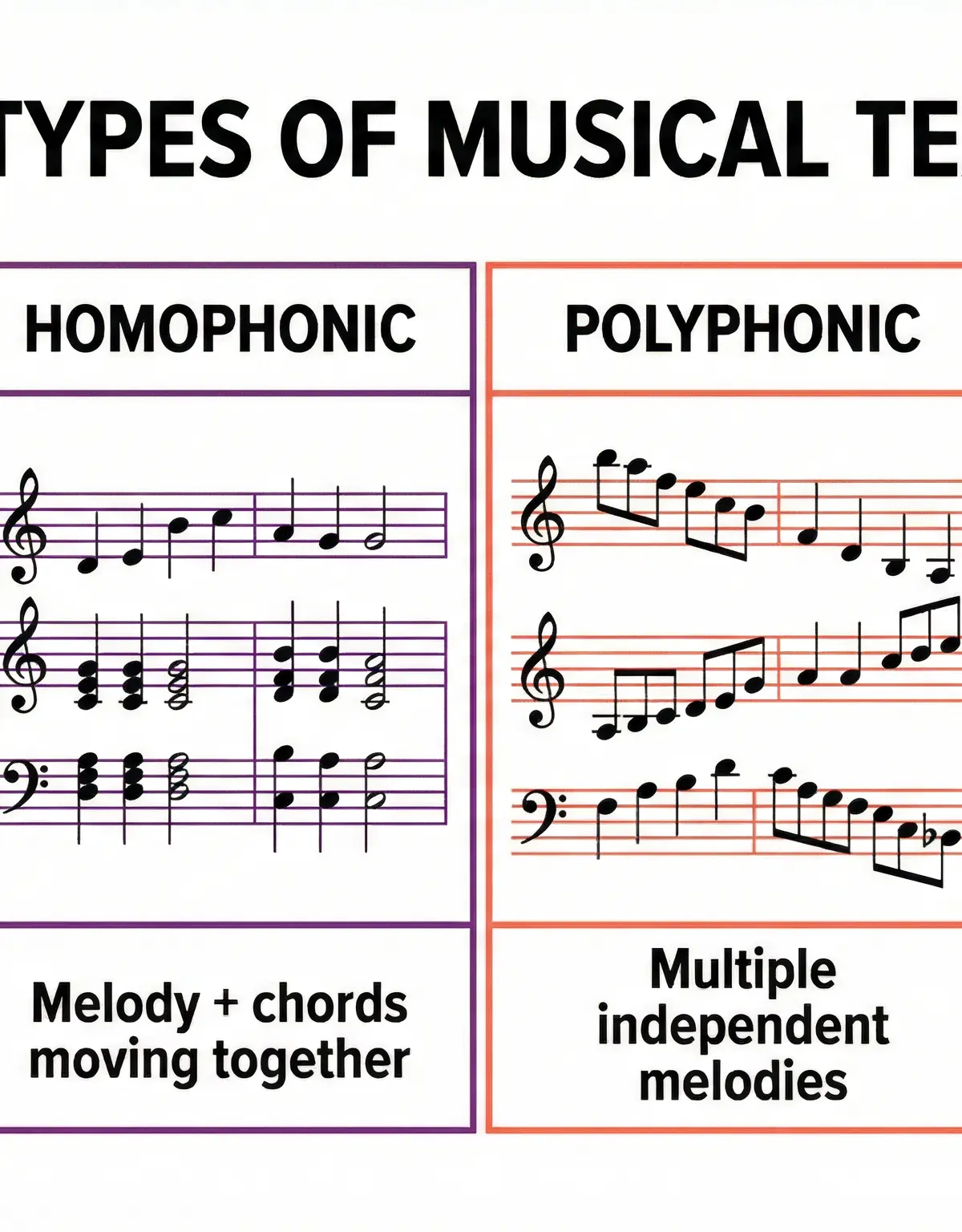
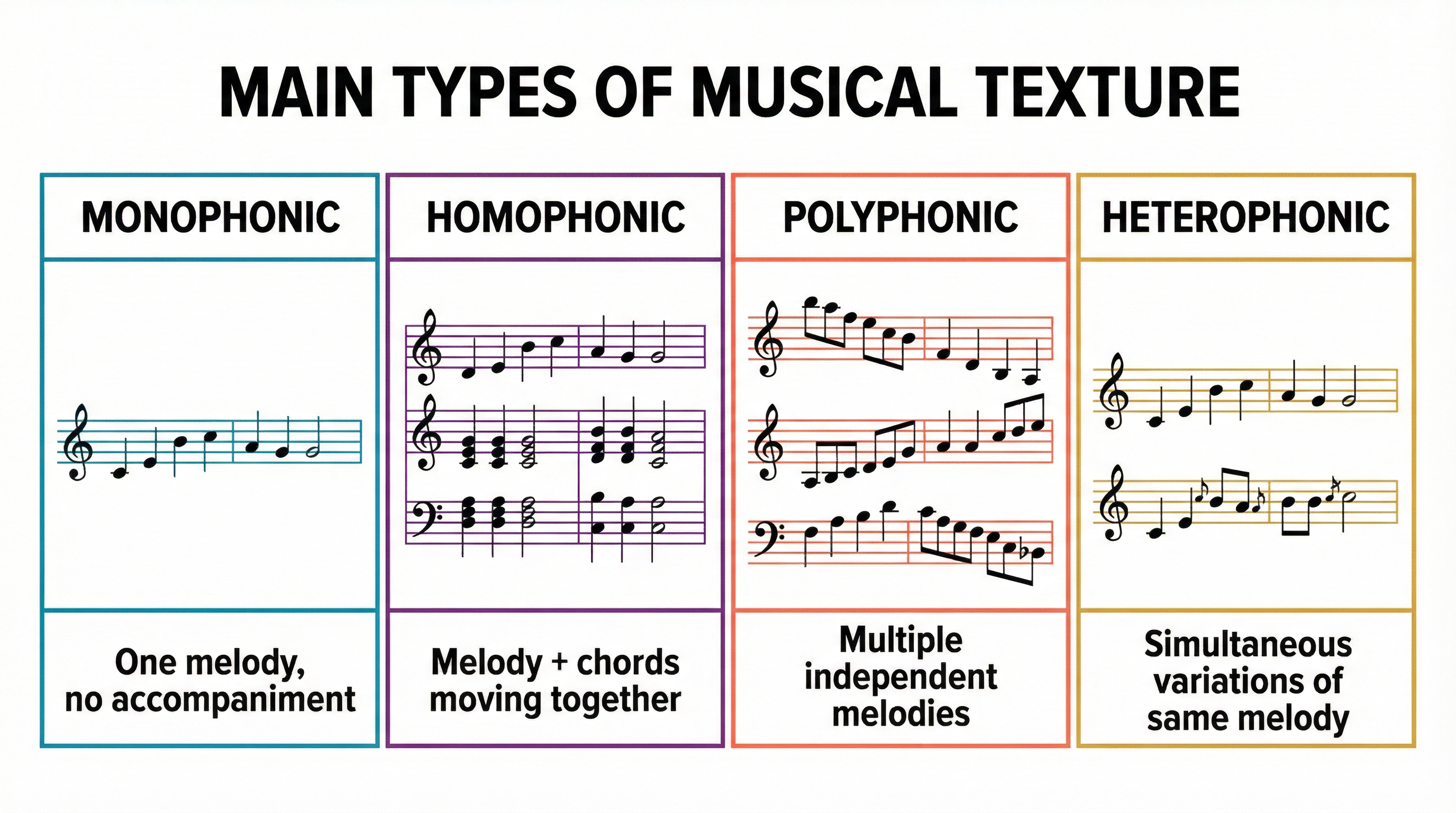
The foundation of textural analysis rests on four key categories. Candidates must be able to aurally distinguish between them in a wide range of musical styles, from Baroque concertos to contemporary pop and World Music.
1. Monophonic Texture:
- Definition: A single melodic line with absolutely no accompaniment. This is the simplest and thinnest of all textures.
- Examples: A solo singer, a lone flute melody, or a choir singing in unison (all singing the exact same notes at the same time). Even if there are multiple performers, if they are all performing the identical melodic line, the texture remains monophonic.
2. Homophonic Texture:
- Definition: The most common texture in Western music. It features a primary melody with a supporting harmonic accompaniment. The parts move together rhythmically, creating a chordal effect.
- Types:
- Melody and Accompaniment: The classic example. A singer's vocal line over guitar chords, or a violin melody supported by a piano accompaniment.
- Chordal: All parts move together with the same rhythm, forming a sequence of chords. Think of a traditional hymn or a brass fanfare.
3. Polyphonic Texture:
- Definition: Also known as counterpoint or contrapuntal texture. It involves two or more independent melodic lines weaving together. Each part is a melody in its own right.
- Examples: A fugue by J.S. Bach, a vocal round like 'Frère Jacques', or the interplay between instruments in a Dixieland jazz ensemble. A key device to listen for is imitation, where one part copies or echoes a melodic idea from another part.
4. Heterophonic Texture:
- Definition: A less common but vital texture, especially for Area of Study 3 (Rhythms of the World). It consists of a single melody being performed by multiple musicians simultaneously, but each musician adds their own slight variations or ornaments.
- Examples: Often found in Gamelan music from Indonesia, traditional Irish folk music, or Indian Classical music. It is a common error for candidates to mislabel this as 'out of tune' or simply 'polyphonic'. The key is that all parts are following the same basic melodic contour.
Key Practitioners/Artists/Composers
Understanding how composers use texture is key to contextual understanding.
| Name | Period/Style | Key Works | Relevance to Texture |
|---|---|---|---|
| J.S. Bach | Baroque | Brandenburg Concertos, The Well-Tempered Clavier | Master of polyphony and counterpoint. His fugues are the ultimate examples of interwoven melodic lines. |
| Queen | Rock | Bohemian Rhapsody | Demonstrates dramatic shifts in texture, from solo monophony to complex, multi-tracked homophonic and polyphonic vocal harmonies. |
| Steve Reich | Minimalism | Music for 18 Musicians, Electric Counterpoint | Explores texture through gradual processes, often using layered polyphony and phase-shifting to create complex, evolving soundscapes. |
| Gamelan Groups | World (Indonesian) | N/A | Prime examples of heterophonic texture, where multiple metallophones play variations of the same core melody (the balungan). |
Technical Vocabulary
Using the correct terminology is non-negotiable for high marks. Integrate these words into your analysis:
- Unison: Multiple parts playing the same melody at the same pitch.
- Octaves: Multiple parts playing the same melody an octave apart.
- Imitation: A melodic idea is copied from one part to another.
- Counterpoint: The art of combining two or more independent melodic lines (i.e., polyphony).
- Antiphony / Call and Response: A musical conversation between different groups of instruments or voices.
- Tutti: The full ensemble playing together, often creating a thick texture.
- Solo: A single performer, creating a thin texture.
- Continuo / Basso Continuo: A Baroque-era accompaniment, typically played by a harpsichord and a cello, providing the bass line and chords (a form of homophony).
Practical Skills
Techniques & Processes for Aural Analysis
- Focus on the Bass Line: Listen to the lowest part. Does it move rhythmically with the melody? If so, the texture is likely homophonic. Is it an independent melody of its own? Then you might be hearing polyphony.
- Count the Layers: Try to mentally separate the different musical lines you hear. Are there one, two, three, or more distinct layers? This helps distinguish between monophonic, simple homophonic, and complex polyphonic textures.
- Listen for Interaction: Do the parts move together like a team (homophony), or do they seem to be having separate conversations (polyphony)? Do they echo each other (imitation)? Do they alternate (antiphony)?
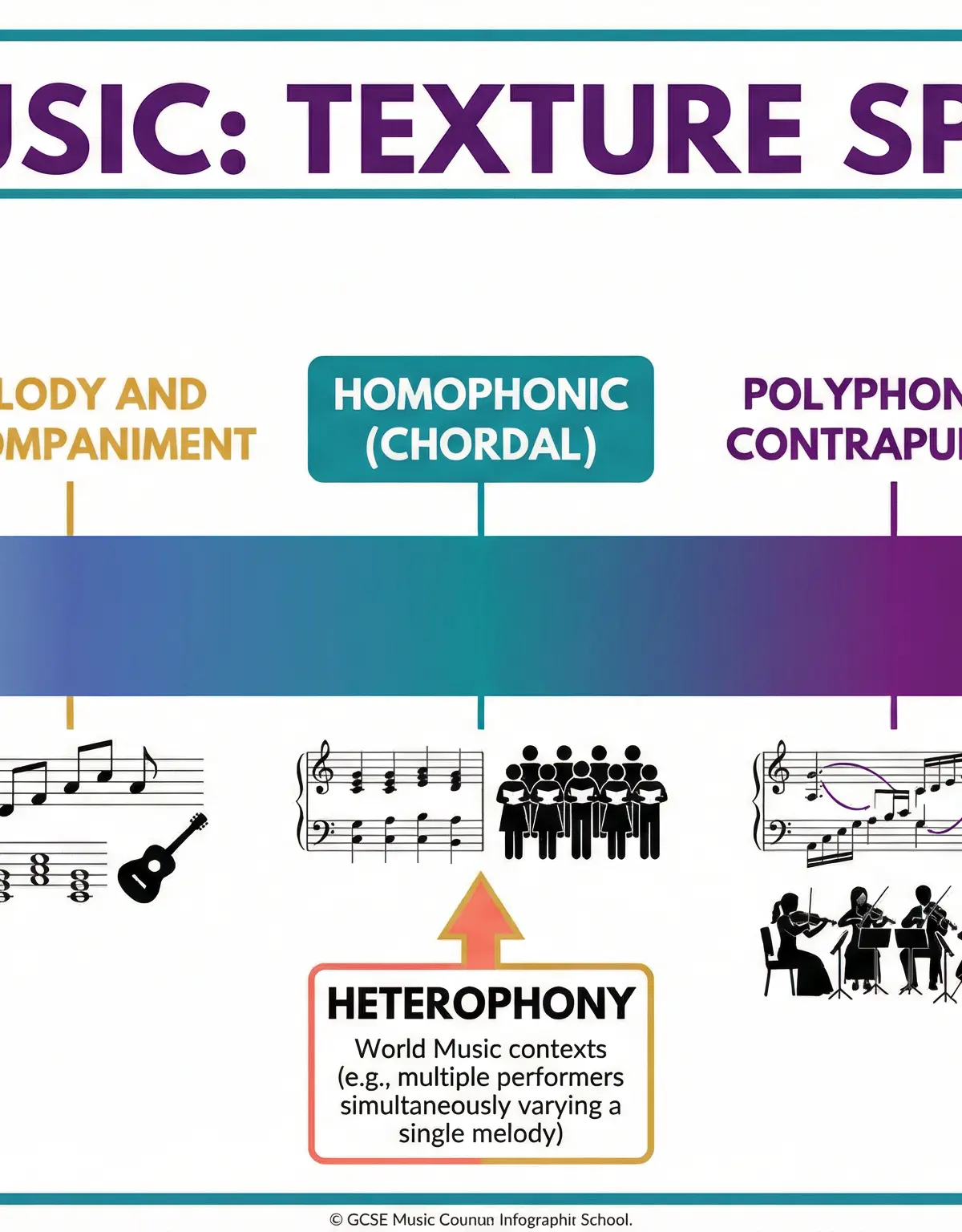
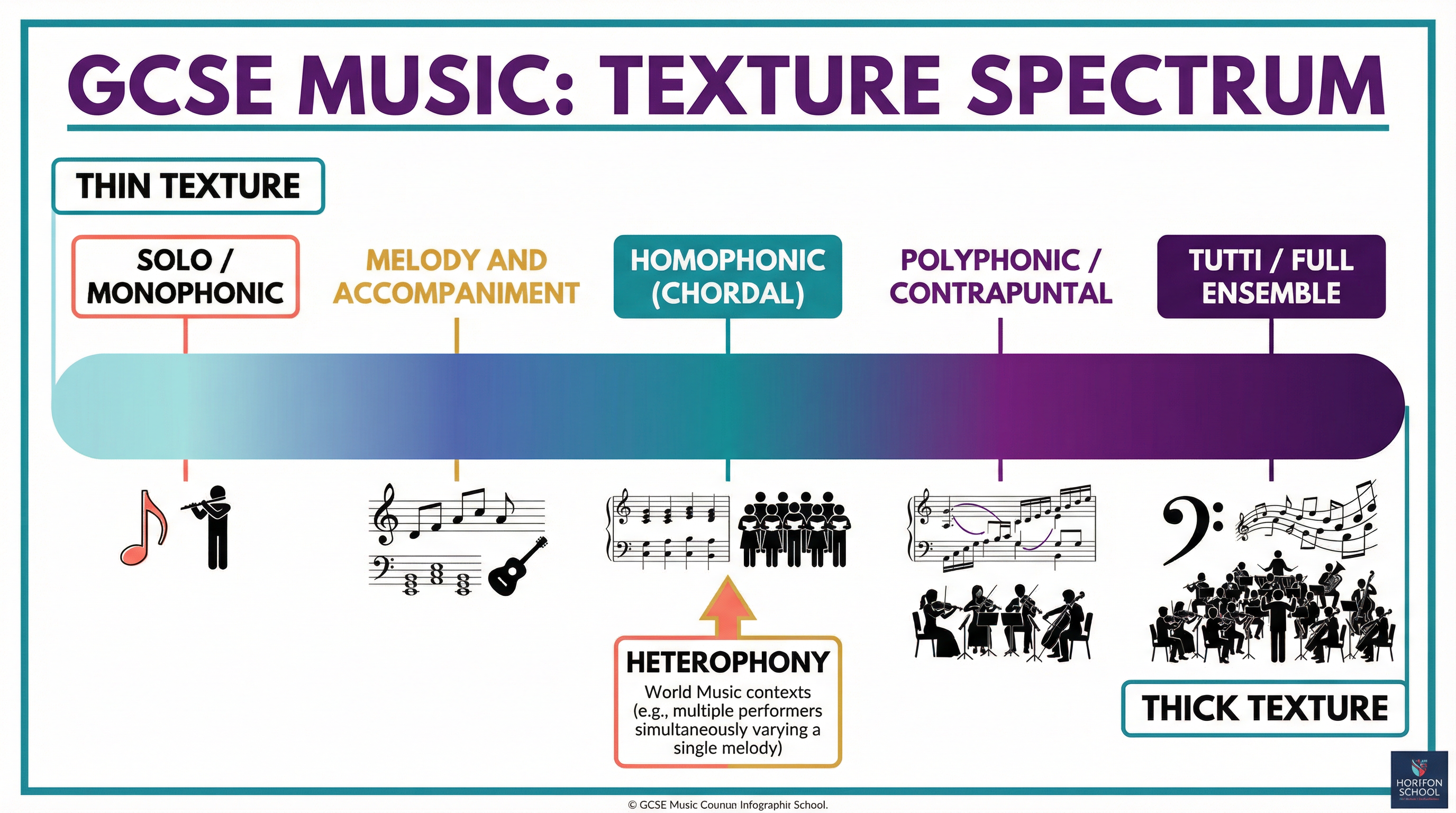
- Use a 'Texture Spectrum': Mentally place the music on a spectrum from thinnest to thickest. A solo flute is at one end; a full orchestra playing a complex fugue is at the other. This can help you qualify your descriptions.
Exam Component
Written Exam Knowledge (Component 03: Listening and Appraising)
In the listening exam, you will be asked to identify and describe texture in unfamiliar music from all Areas of Study. Questions can range from simple 1-mark identifications to longer 8-mark comparison questions.
- Section A: Questions on unfamiliar music from AoS 1 (My Music), AoS 2 (The Concerto Through Time), AoS 3 (Rhythms of the World), and AoS 4 (Film and Game Music).
- Section B: Questions based on the two set works you have studied.
Texture is a core concept in every Area of Study. You must be prepared to discuss the homophonic textures of a Classical concerto, the polyphonic interplay in a Baroque fugue, the heterophony of Gamelan, and the layered textures in a film score.
Portfolio/Coursework Guidance
While texture is primarily an analytical concept for the listening exam, it is also crucial for your own compositions (Component 01 & 02). A good composition will demonstrate a thoughtful use of texture and textural contrast.
Assessment Criteria
Examiners will credit compositions that:
- Use a variety of textures to create interest and contrast.
- Show an understanding of how texture can define a piece's structure (e.g., a thin texture in the verse, building to a thick texture in the chorus).
- Use textural devices like imitation or antiphony effectively.
- Demonstrate idiomatic writing for the chosen instruments, which includes creating effective and playable textures.
Visual Resources
2 diagrams and illustrations
Interactive Diagrams
1 interactive diagram to visualise key concepts
Conceptual Flow Outline
A decision-making flowchart for identifying musical texture during a listening exam.
Worked Examples
3 worked examples — open one to explore the question and available guidance.
Practice Questions
Test your understanding — click to reveal model answers
Identify the texture of a single, unaccompanied cello playing a melody. [1 mark]
Hint: Think about the number of melodic lines.
Describe the texture of a typical pop song with a lead singer and a backing band playing chords. [2 marks]
Hint: Is there a main melody? What are the other instruments doing in relation to it?
In a piece of music, you hear a trumpet play a short melody, which is then exactly copied by the trombone a bar later while the trumpet continues with a new idea. Analyse this textural device. [3 marks]
Hint: What is the term for musical copying? What is the overall texture when this happens?
A candidate describes a piece of Gamelan music as 'polyphonic because there are lots of instruments playing different things'. Explain why this description is unlikely to receive full credit and provide a more accurate analysis. [4 marks]
Hint: Consider the specific textures associated with Area of Study 3.