OCR · GCSE · Music
Timbre
This guide provides a comprehensive overview of Timbre (Sonority) for OCR GCSE Music, focusing on precise instrument identification, technical vocabulary, and analytical skills. It is designed to help candidates secure top marks in the Listening and Appraising exam by linking sonic qualities to musical effect.
- 7 min read
- 3 worked examples
- 4 practice questions
- 6 key terms
Study Notes

Overview
Timbre, also referred to as sonority or tone colour, is a fundamental element of music that describes the quality and character of a sound. For the OCR GCSE Music course, a sophisticated understanding of timbre is essential across all Areas of Study (AoS), from the Concertos of the Baroque period (AoS 2) to modern Pop Music (AoS 5). It is not enough to simply identify an instrument; examiners expect candidates to describe its sound quality with precision and explain why a composer has chosen a particular sonority to create a specific mood or atmosphere. This guide will equip you with the technical vocabulary and analytical framework needed to excel in questions related to this topic, which features heavily in the 40% weighted Listening and Appraising paper.

Key Knowledge & Theory
Core Concepts
Timbre is determined by a sound's harmonic series and its acoustic envelope (Attack-Decay-Sustain-Release). While you don't need to be a physicist, you do need to aurally distinguish these differences. The core task is to identify the sound source and describe its qualities.
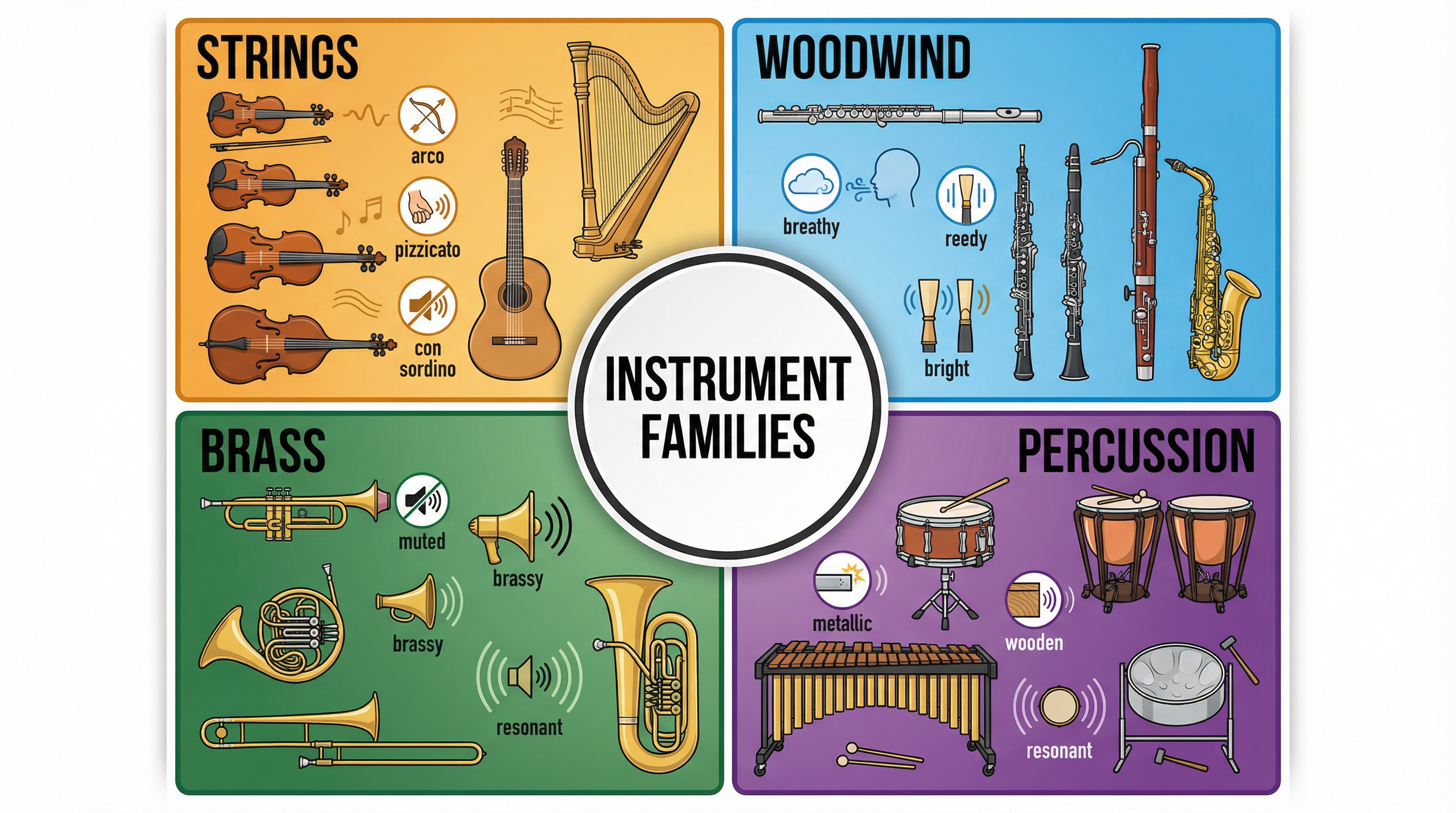
1. Instrument Families: A secure knowledge of the four main families is the foundation. Marks are awarded for specificity.
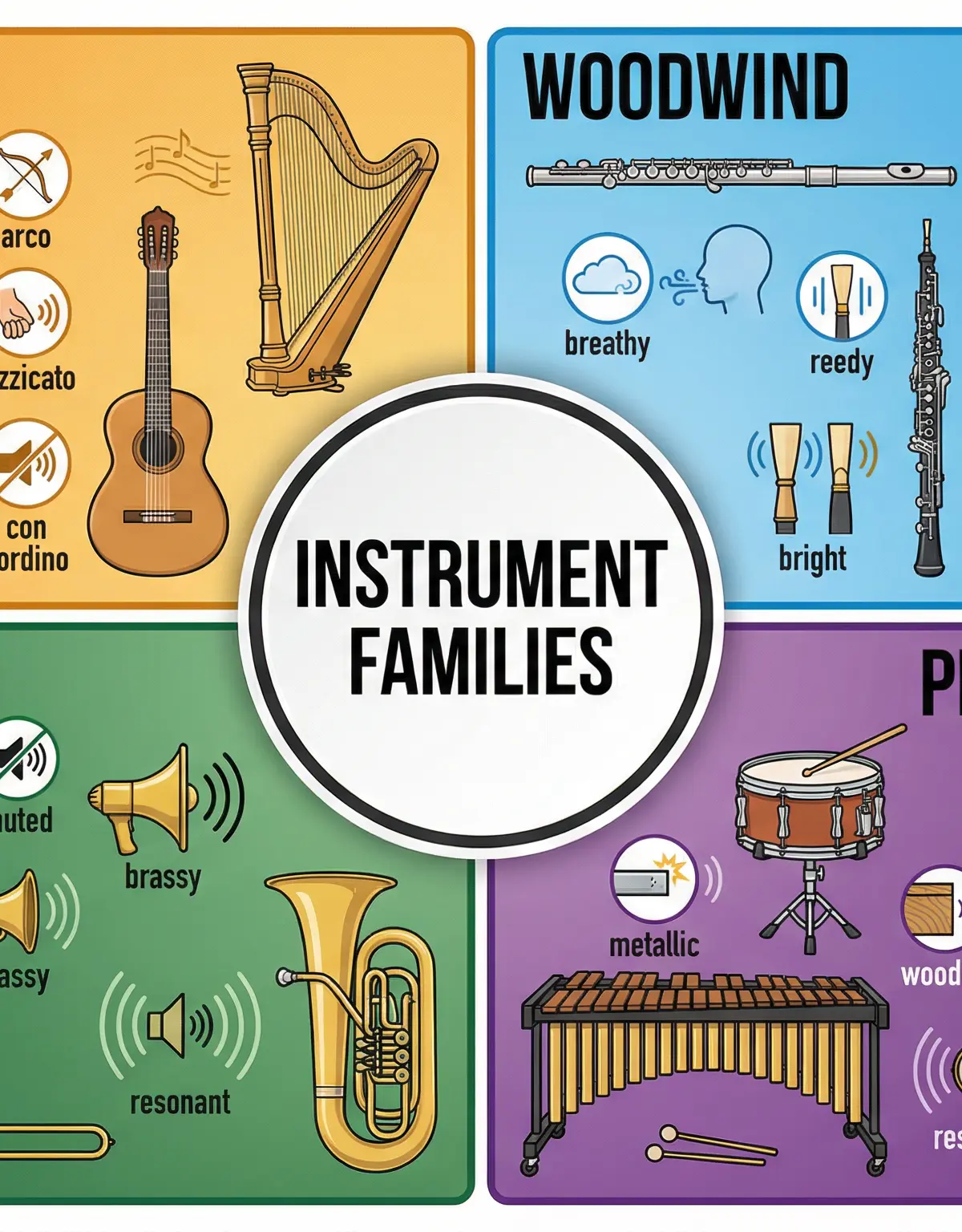
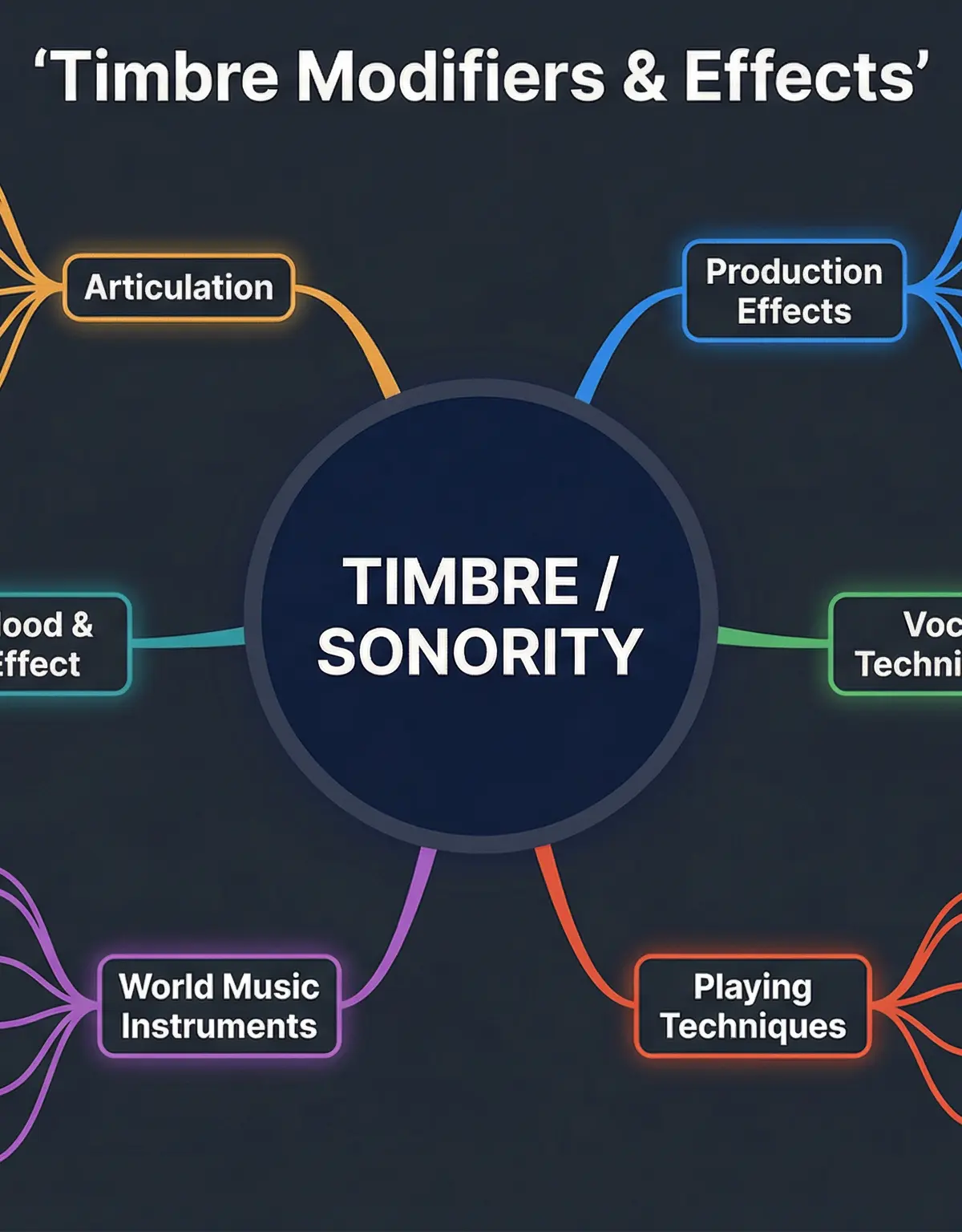
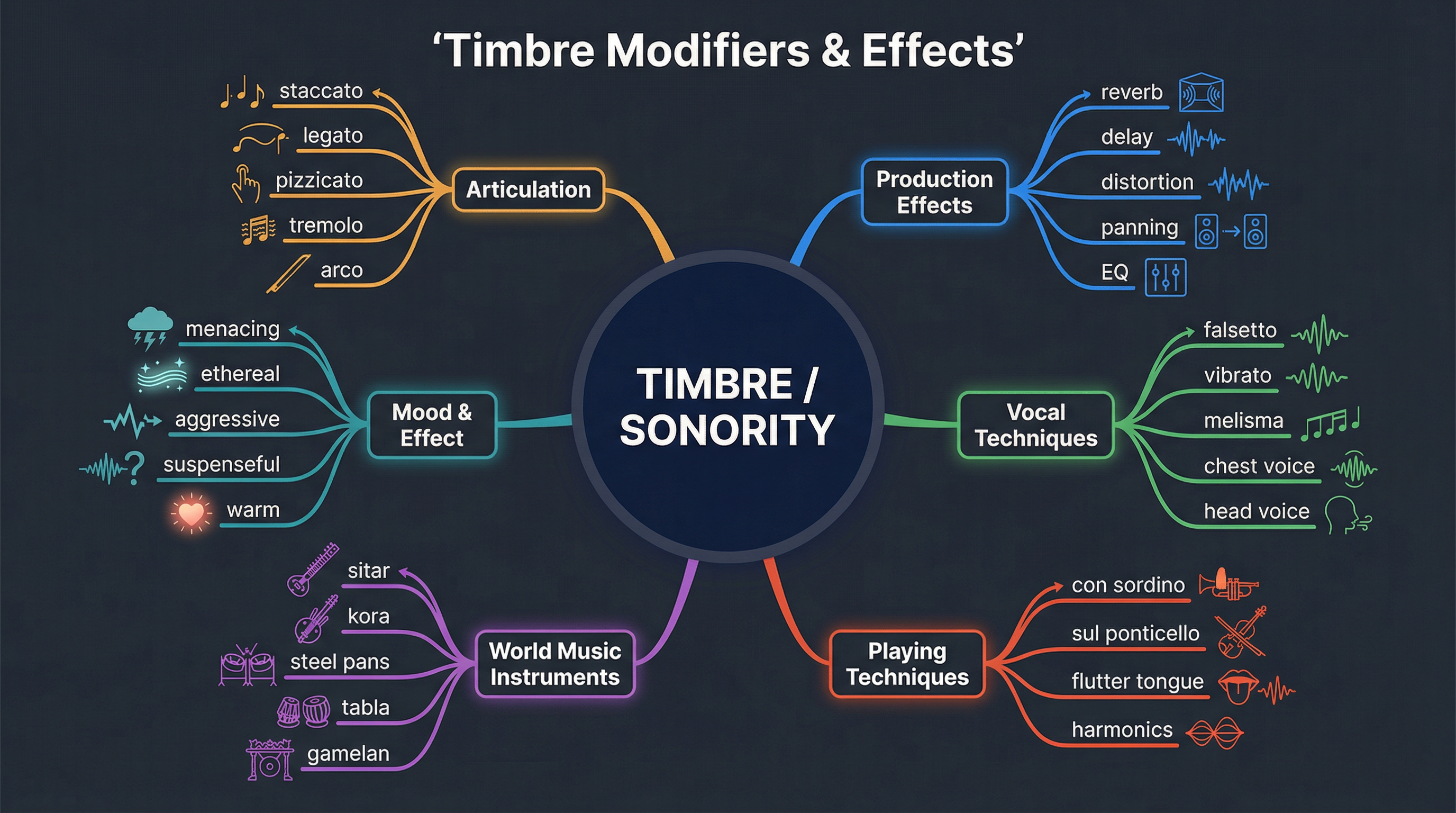
2. Playing Techniques (Articulation): How an instrument is played dramatically alters its timbre. These are primary timbre modifiers.
- Strings:
arco(bowed),pizzicato(plucked),tremolo(rapid bowing),con sordino(with a mute),sul ponticello(bowing near the bridge). - Woodwind/Brass:
flutter-tonguing, use ofmutes(e.g., cup, straight, plunger). - Guitar:
finger-picking,strumming,palm-muting.
3. Vocal Timbre: Voices are instruments too. Key terms include falsetto (a high, light male voice), vibrato (a slight, rapid pitch fluctuation), melisma (many notes on one syllable), chest voice (full, lower register), and head voice (lighter, higher register).
4. Production Effects (AoS 5): In popular and electronic music, timbre is heavily manipulated by technology.
Key Practitioners/Artists/Composers
| Name | Period/Style | Key Works | Relevance to Timbre |
|---|---|---|---|
| Hector Berlioz | Romantic | Symphonie fantastique | A master of orchestration. He pioneered new instrumental combinations and effects, like using the col legno (playing with the wood of the bow) technique in the strings to create a skeletal, macabre timbre in the finale. |
| Claude Debussy | Impressionist | Prélude à l'après-midi d'un faune | Used timbre to create texture and atmosphere. He often blended instrumental sounds, using muted strings, harp glissandi, and prominent flute solos to create a dreamlike, hazy sonority. |
| Jimi Hendrix | Rock | Purple Haze | Revolutionised the use of the electric guitar. He used distortion, feedback, and the wah-wah pedal not as noise, but as expressive tools to create a huge range of new, aggressive, and psychedelic timbres. |
| Kraftwerk | Electronic | The Man-Machine | Pioneers of electronic music. They used synthesisers, vocoders, and drum machines to create a deliberately artificial, robotic, and futuristic sound world, exploring purely electronic sonorities. |
Technical Vocabulary
Using precise, subject-specific language is non-negotiable. Avoid vague terms like 'nice' or 'rough'. Instead, use a rich vocabulary of descriptors:
- Bright: Clear, brilliant, high-frequency sound (e.g., trumpet, flute).
- Warm: Rich, resonant, with prominent lower-mid frequencies (e.g., cello, French horn).
- Reedy: A nasal, slightly buzzing quality characteristic of double-reed instruments (e.g., oboe, bassoon).
- Brassy: A sharp, brilliant, sometimes harsh sound from brass instruments played loudly.
- Mellow: A soft, smooth, rounded sound (e.g., clarinet in its low register).
- Distorted: A gritty, fuzzy, aggressive timbre created by overdriving an amplifier, common on electric guitars.
- Ethereal: A light, airy, otherworldly sound (e.g., high strings, falsetto voice with reverb).
- Resonant: A sound that sustains and vibrates, full of rich overtones (e.g., sitar, steel pans).
Practical Skills
Techniques & Processes
Aural Analysis (The I.D.E.A. Framework): This is the key practical skill for the listening exam.
- I - Identify: What instrument, voice, or effect do you hear? Be specific (e.g., 'Oboe', not 'Woodwind').
- D - Describe: What is its sound quality? Use technical vocabulary (e.g., 'a reedy, plaintive timbre').
- E - Explain: How is the sound produced? Mention any techniques (e.g., 'played with vibrato').
- A - Analyse: What is the effect? Link the timbre to the mood, character, or context of the music (e.g., 'creating a sense of melancholy and longing').
Portfolio/Coursework Guidance
Assessment Criteria
For your composition portfolio (AOs 1 & 2), your use of timbre is a key part of demonstrating musical understanding. Examiners look for:
- Appropriate Sonorities: Do your chosen instruments suit the style and intention of your piece?
- Idiomatic Writing: Are you writing for the instruments in a way that is practical and effective? (e.g., not writing impossibly high notes for a tuba).
- Development of Ideas: Do you vary the timbre to create contrast and interest? A piece that uses the same instrumentation throughout may be considered less developed.
Building a Strong Portfolio
- Experiment: Use your notation software (Sibelius, Musescore) to try out different instrument combinations. How does a melody sound on a clarinet versus a violin?
- Annotate Your Score: In your commentary, justify your timbral choices. Explain why you chose a muted trumpet for a specific section. This demonstrates your understanding to the examiner.
- Listen Widely: The more music you listen to, the broader your timbral palette will become. Listen to how film composers create suspense with high, muted strings, or how rock bands create power with distorted guitars.
Exam Component
Written Exam Knowledge
The Listening and Appraising exam will test your knowledge of timbre in several ways:
- Direct Questions: 'Identify the instrument playing the melody.' 'Describe the vocal technique used.'
- Comparative Questions: 'Compare the use of sonority in Extract A and Extract B.'
- Extended Response (8-mark questions): You will be expected to write about how timbre contributes to the overall character of a piece, often alongside other musical elements like melody, harmony, and rhythm.
Practical Exam Preparation
While there is no 'practical exam' for timbre itself, your listening skills are the practical application. Prepare by:
- Active Listening: Use online resources like the Philharmonia's Instrument Guides to train your ear to distinguish between instruments.
- Timed Practice: Complete past paper listening questions under timed conditions. This will improve your ability to identify and analyse timbre quickly and accurately.
- Glossary Creation: Create your own glossary of timbral terms and test yourself on their definitions and aural identification.
Interactive Diagrams
1 interactive diagram to visualise key concepts
Conceptual Flow Outline
The I.D.E.A. framework for analysing timbre in an exam context.
Worked Examples
3 worked examples — open one to explore the question and available guidance.
Practice Questions
Test your understanding — click to reveal model answers
Identify the solo woodwind instrument playing at the start of the extract.
Hint: Listen for a reedy, slightly nasal sound. It is not a flute or clarinet.
Describe the timbre of the electric guitar in this rock extract. [2 marks]
Hint: Think about the effects used in rock music. Is the sound clean or dirty?
Explain how the composer uses sonority to create a feeling of suspense in this piece of film music. [4 marks]
Hint: Listen to the string section in particular. Are they playing normally? What register are they in?
Analyse how the composer uses timbre and instrumentation to portray the character of the hero in this piece of video game music. [6 marks]
Hint: Think about which instrument families are associated with heroism. How are they used here? Are there any changes in instrumentation?