OCR · GCSE · Music
Use of Musical Elements
This guide provides a comprehensive overview of the Use of Musical Elements for OCR GCSE Music. It focuses on mastering the DR P SMITH mnemonic and applying this knowledge to achieve high marks in the Listening and Appraising exam."
- 9 min read
- 3 worked examples
- 4 practice questions
Study Notes
Overview
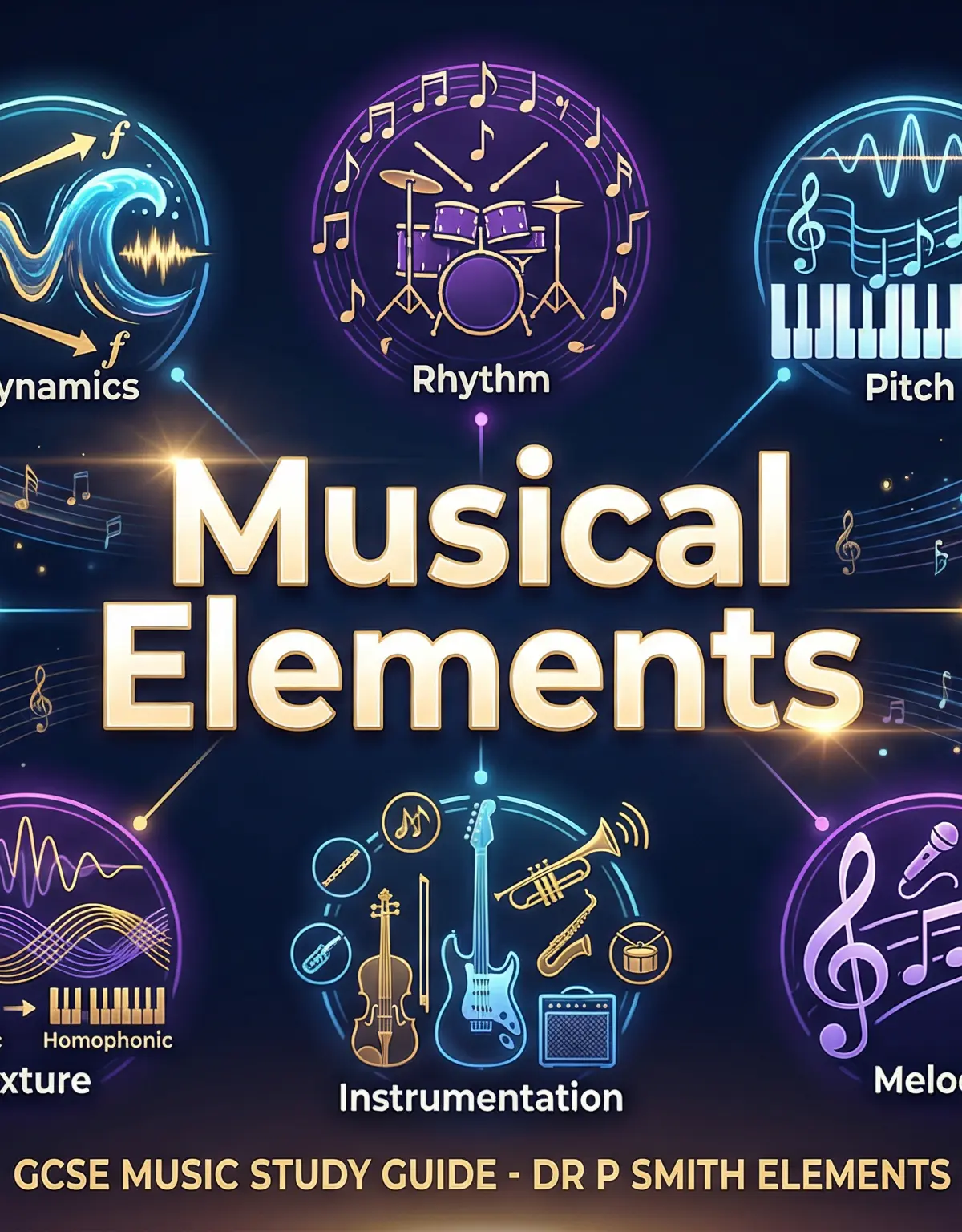
The 'Use of Musical Elements' is a cornerstone of the OCR GCSE Music specification, assessed primarily in the Listening and Appraising component. Candidates are required to demonstrate a sophisticated understanding of how music is constructed by identifying, describing, and analysing the eight core musical elements across a wide range of genres and historical periods. Mastery of this topic is not just about knowing definitions; it is about explaining the effect of these elements and how they interact to create mood, style, and structure. This skill is crucial for earning high marks and developing a mature musical ear.
Key Knowledge & Theory
Core Concepts
The fundamental framework for analysis is the DR P SMITH mnemonic. This is a powerful tool that ensures all analytical bases are covered when listening to an unfamiliar piece of music under exam conditions. Candidates must be fluent in the specific terminology associated with each element.
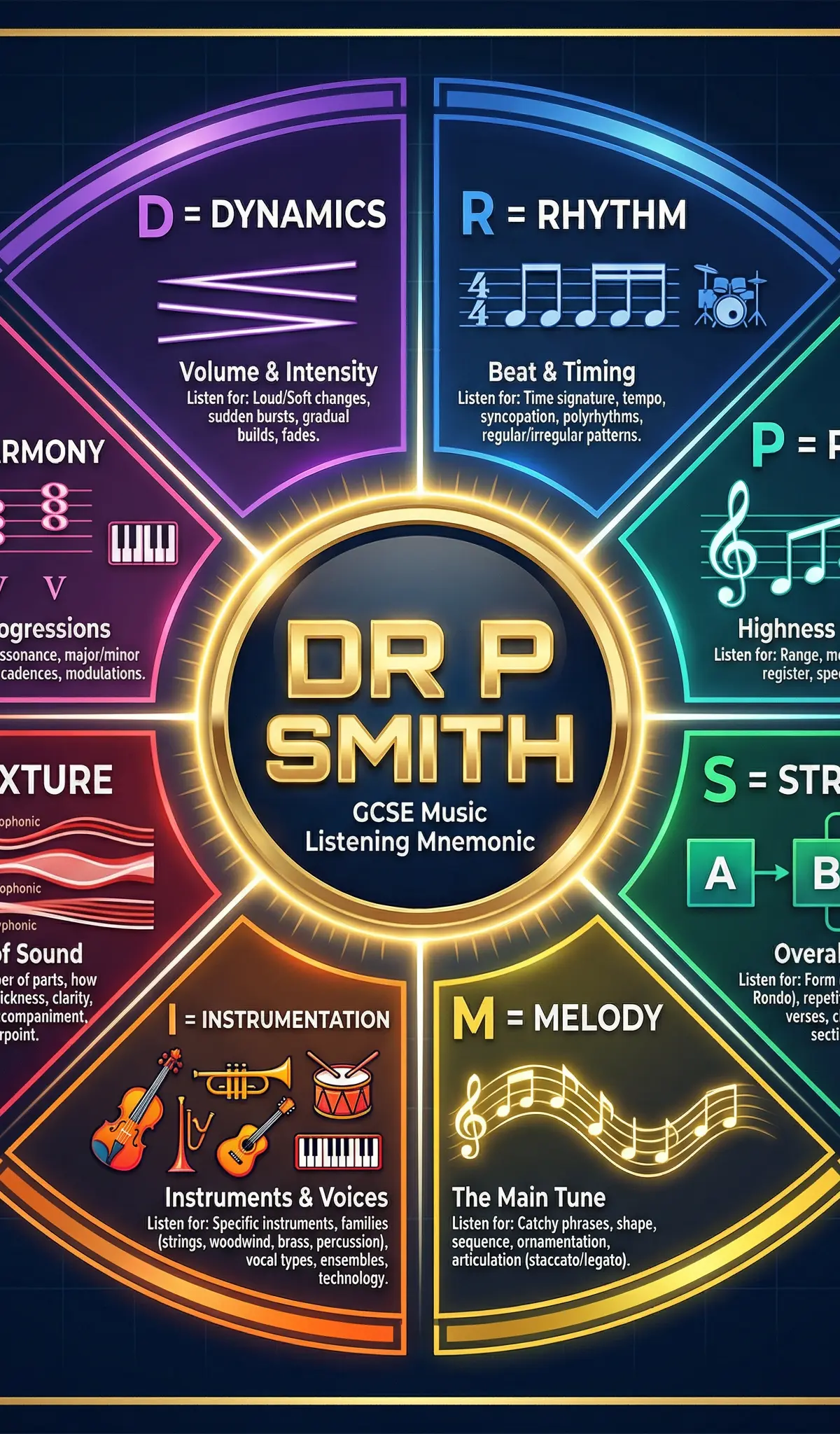
- Dynamics: The volume of the music and the way it changes. This includes sudden changes (subito forte) and gradual shifts (crescendo/diminuendo).
- Rhythm: The arrangement of sounds in time. This covers tempo, metre (time signature), duration of notes, and specific rhythmic features like syncopation and polyrhythms.
- Pitch: The highness or lowness of a sound. This includes the overall range, register, melodic contour (shape), and whether the melody is conjunct (stepwise) or disjunct (leaping).
- Structure: The overall plan or layout of a piece of music. Common forms include Binary (AB), Ternary (ABA), Rondo (ABACADA), and Verse-Chorus structure.
- Melody: The main tune. Analysis should focus on its shape, use of sequence, ornamentation, and its relationship to the harmony.
- Instrumentation: The specific instruments and voices used in a piece. Candidates should be as precise as possible (e.g., 'rhythm guitar with distortion' rather than just 'guitar'). This also includes timbre (the tone quality of an instrument).
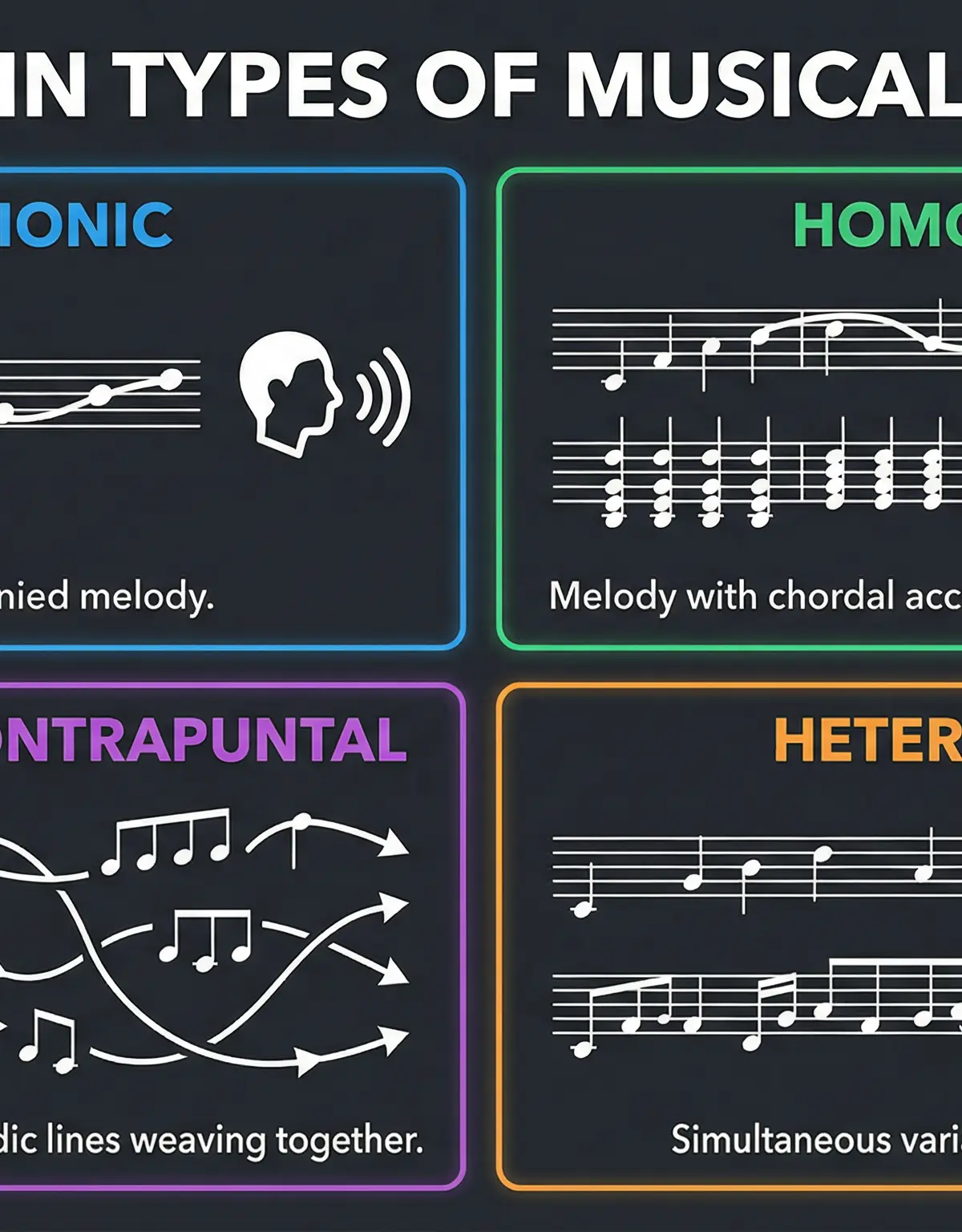
- Texture: How the different layers of sound are combined. The main types are Monophonic, Homophonic, Polyphonic, and Heterophonic.
- Harmony: The combination of simultaneously sounded musical notes to produce chords and chord progressions. This includes tonality (major/minor), the use of consonance and dissonance, and cadences.
Key Practitioners/Artists/Composers
Understanding how different composers manipulate the musical elements is key. While any composer can be studied, focusing on those who exemplify certain techniques is a useful strategy.
| Name | Period/Style | Key Works | Relevance |
|---|---|---|---|
| J.S. Bach | Baroque | Brandenburg Concertos, The Well-Tempered Clavier | Master of polyphonic texture (counterpoint). His fugues are the ultimate study in interwoven melodic lines. |
| Beethoven | Classical/Romantic | Symphony No. 5, Piano Sonata No. 8 | Revolutionary use of dynamics (extreme contrasts), structure (expanding traditional forms), and motivic development. |
| The Beatles | 1960s Pop/Rock | Sgt. Pepper's Lonely Hearts Club Band | Pioneers in studio production, experimenting with instrumentation (sitar, orchestral instruments), structure, and texture. |
| John Williams | Film Music (Modern) | Star Wars, Jaws, Harry Potter | Expert in using melody (leitmotifs) and instrumentation to create character, mood, and atmosphere. His scores are a masterclass in linking music to narrative. |
Technical Vocabulary
Using precise terminology is non-negotiable for high marks. Examiners credit the use of Italian terms and specific analytical language.
- Dynamics: piano, forte, crescendo, diminuendo, sforzando, fp (fortepiano)
- Rhythm: accelerando, ritardando, rubato, syncopation, polyrhythm, hemiola
- Pitch: conjunct, disjunct, scalic, arpeggio, chromaticism, diatonic
- Structure: binary, ternary, rondo, sonata form, strophic, through-composed
- Texture: monophonic, homophonic, polyphonic, heterophonic, counterpoint
- Harmony: consonance, dissonance, cadence (perfect, imperfect, plagal, interrupted), modulation, pedal note
Practical Skills
Techniques & Processes
For the composition component (AO2), candidates must demonstrate practical application of the musical elements. This is not just theoretical.
- Developing a Melody: Start with a simple motif. Develop it using techniques like sequence (repeating it at a higher/lower pitch), inversion (turning it upside down), or fragmentation (using small parts of it).
- Creating Harmonic Interest: Move beyond basic triads. Use seventh chords for richness, and plan a clear chord progression with effective cadences to define sections.
- Building Texture: Don't have everything playing all the time. Create contrast by varying the texture. Start with a monophonic line, build to a homophonic section, and perhaps include a polyphonic conversation between two instruments.
- Structuring Your Piece: Plan your structure from the outset. A simple Ternary (ABA) form is effective: introduce your main idea (A), develop a contrasting idea (B), then return to the main idea (A) to provide closure.
Materials & Equipment
Whether using notation software (Sibelius, Musescore) or a DAW (Logic, GarageBand, FL Studio), understanding the tools is vital.
- Notation Software: Excellent for understanding music theory, creating clear scores for performers, and focusing on harmony and structure.
- DAW (Digital Audio Workstation): Offers vast possibilities for manipulating instrumentation (virtual instruments), timbre (effects like reverb, EQ, distortion), and creating complex textures through layering.
- Safe Use: Regular breaks are important to avoid ear fatigue. When recording, ensure microphone levels are not clipping (distorting) to maintain audio quality.
Portfolio/Coursework Guidance
Assessment Criteria
Examiners assess compositions (AO2) based on three main criteria:
- Developing Musical Ideas: How imaginatively you take your initial motifs and develop them into a coherent piece.
- Compositional Technique: How well you control the musical elements (harmony, melody, structure, etc.).
- Composing with Technical Control: The fluency and accuracy of your notation or DAW production.
Building a Strong Portfolio
- Annotate Your Score/DAW Project: Create a written commentary explaining your compositional choices. Use the DR P SMITH vocabulary. For example: "In bar 17, I introduce a polyphonic texture between the flute and clarinet to create a sense of dialogue. This contrasts with the homophonic texture of the opening section."
- Show Development: Don't just submit the final piece. Show drafts, sketches, and mind maps. This evidences your creative process and experimentation.
- Refine and Edit: A good composition is refined. Check for parallel fifths (if writing in a classical style), ensure your melodies are singable, and check that your structure makes sense.
Exam Component

Written Exam Knowledge
The Listening and Appraising exam (AO3 & AO4) is where this theoretical knowledge is most directly tested. You will hear unfamiliar extracts and be asked to analyse them using the elements.
- Area of Study 2 (Pop Music): Focus on instrumentation (rhythm section, synths), structure (verse-chorus), and texture (often homophonic).
- Area of Study 3 (Traditional Music): Listen for specific instrumentation (e.g., steel pans, sitar), rhythmic features (e.g., polyrhythms in African drumming), and melodic devices (e.g., call and response).
- Area of Study 4 (Western Classical): Be prepared to identify the period (Baroque, Classical, Romantic) based on the use of elements like texture (polyphonic in Baroque), structure (sonata form in Classical), and dynamics (extreme range in Romantic).
- Area of Study 5 (Stage & Screen): The key here is linking the elements to the on-screen action or narrative. How does the music create tension, excitement, or sadness?
Practical Exam Preparation
While there isn't a 'practical exam' for this topic, the knowledge is practically applied in your own compositions and performances.
- For Composers: Before your timed composition, create a checklist based on DR P SMITH. Have I included dynamic contrast? Is my structure clear? Is the texture varied?
- For Performers: Your understanding of the elements informs your interpretation. Knowing a section is marked crescendo tells you to build the intensity. Understanding the harmony helps you shape your phrasing."
Worked Examples
3 worked examples — open one to explore the question and available guidance.
Practice Questions
Test your understanding — click to reveal model answers
Identify the tonality and describe the harmony of this extract. [4 marks]
Hint: Listen for whether the music sounds happy (major) or sad (minor). Are the chords simple or complex? Do they clash?
The piece begins with a solo flute. State the texture. [1 mark]
Hint: How many layers of sound can you hear?
Explain how the composer uses instrumentation to build excitement in this orchestral extract. [4 marks]
Hint: Think about which instruments are added and what they play. Consider changes in timbre and dynamics.
Analyse the composer's use of structure in this pop song. [6 marks]
Hint: Listen for repeating sections and contrasting sections. Map out the song's journey from beginning to end.