Vocal Music
This guide provides a comprehensive overview of Vocal Music for OCR GCSE Music, focusing on the essential terminology and analytical skills needed for the listening exam. It covers key vocal techniques, textures, and word-setting, directly targeting areas where candidates can earn maximum marks.
Study Notes

Overview
Welcome to your study guide for Vocal Music, a crucial topic for OCR GCSE Music, primarily assessed in Area of Study 5 (Conventions of Pop) and Area of Study 3 (Rhythms of the World). This guide will equip you with the precise language and analytical skills examiners are looking for. Mastering this topic is not just about knowing terms; it's about being able to hear a piece of music and accurately describe what the voices are doing and why it matters. Candidates who can confidently identify and explain vocal techniques, textures, and word-setting are consistently awarded higher marks.
This guide will break down the core concepts, provide you with the essential technical vocabulary, and show you how to apply this knowledge in an exam context. We will focus on aural recognition and the ability to articulate your understanding clearly and concisely.
Key Knowledge & Theory
Core Concepts
The study of vocal music in this context revolves around three main pillars: Word-Setting, Vocal Techniques, and Vocal Textures. You must be able to distinguish between these and use the correct terminology for each.
-
Word-Setting: This describes how the lyrics (words) are set to the melody (music).
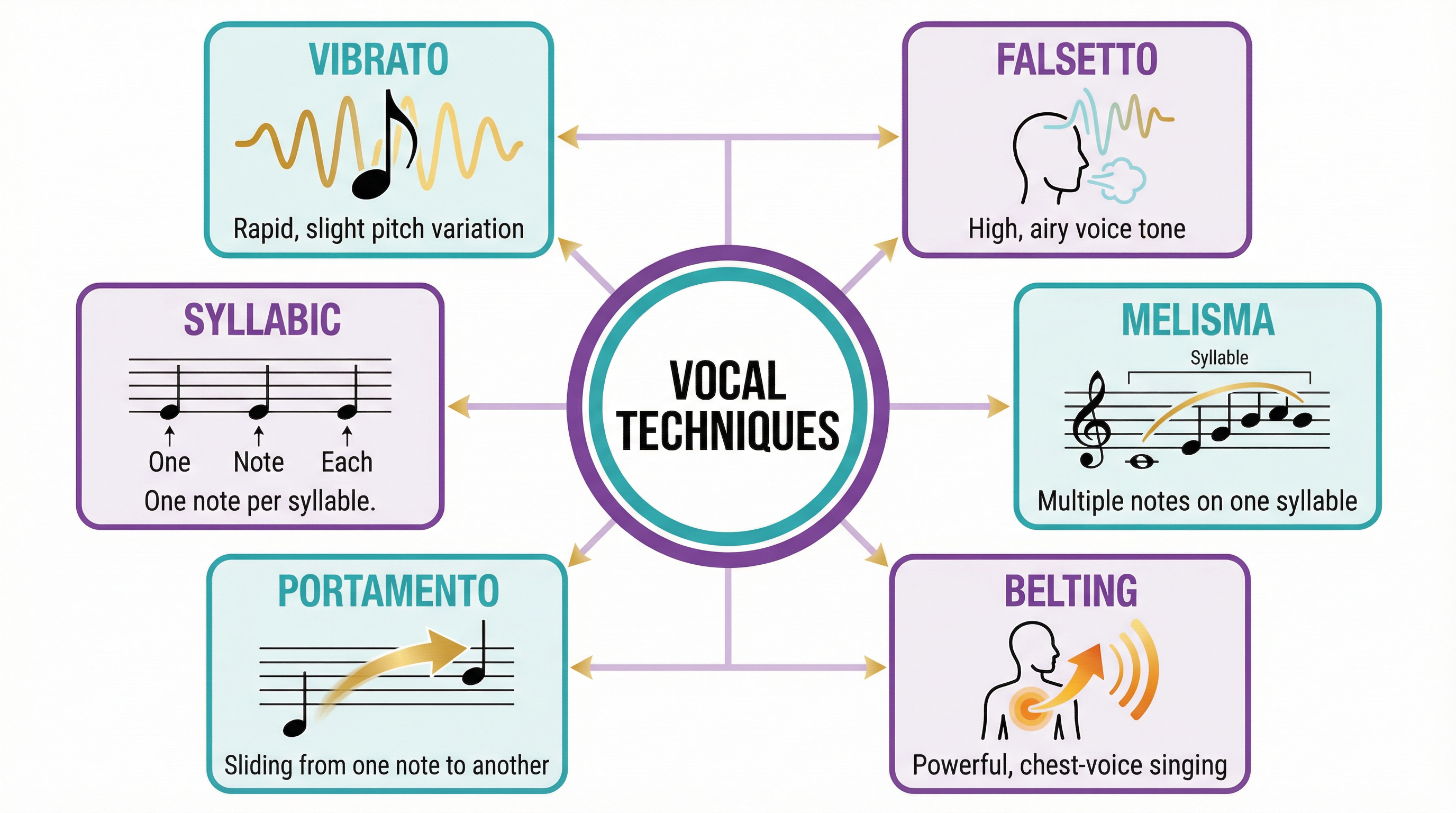
- Syllabic: One note is sung for each syllable of a word. This is the most common form of word-setting in pop music as it makes the lyrics clear and easy to follow. Think of most chart pop songs.
- Melismatic: Multiple (often many) notes are sung on a single syllable. This is used for emphasis and to create an expressive, virtuosic, or emotional effect. It is a key feature of Soul, Gospel, and R&B music.
-
Vocal Techniques: These are the specific methods singers use to create different sounds and effects with their voice.
- Falsetto: A technique used by male singers to sing in a high, airy register, far above their normal vocal range.
- Vibrato: A slight and rapid fluctuation in pitch on a sustained note. It adds warmth, richness, and expression.
- Portamento / Glide: A smooth, continuous slide in pitch from one note to another.
- Belting: A powerful, controlled, and sustained style of singing in the upper-middle range of the voice, often used in Musical Theatre and Power Ballads.
- Scat Singing: Improvised vocal lines using nonsense syllables, common in Jazz music. The voice is used like an instrument.
- Rapping: A rhythmic and rhyming speech-like delivery of lyrics, a cornerstone of Hip-Hop.
-
Vocal Textures: This refers to how the different vocal parts or layers are combined.
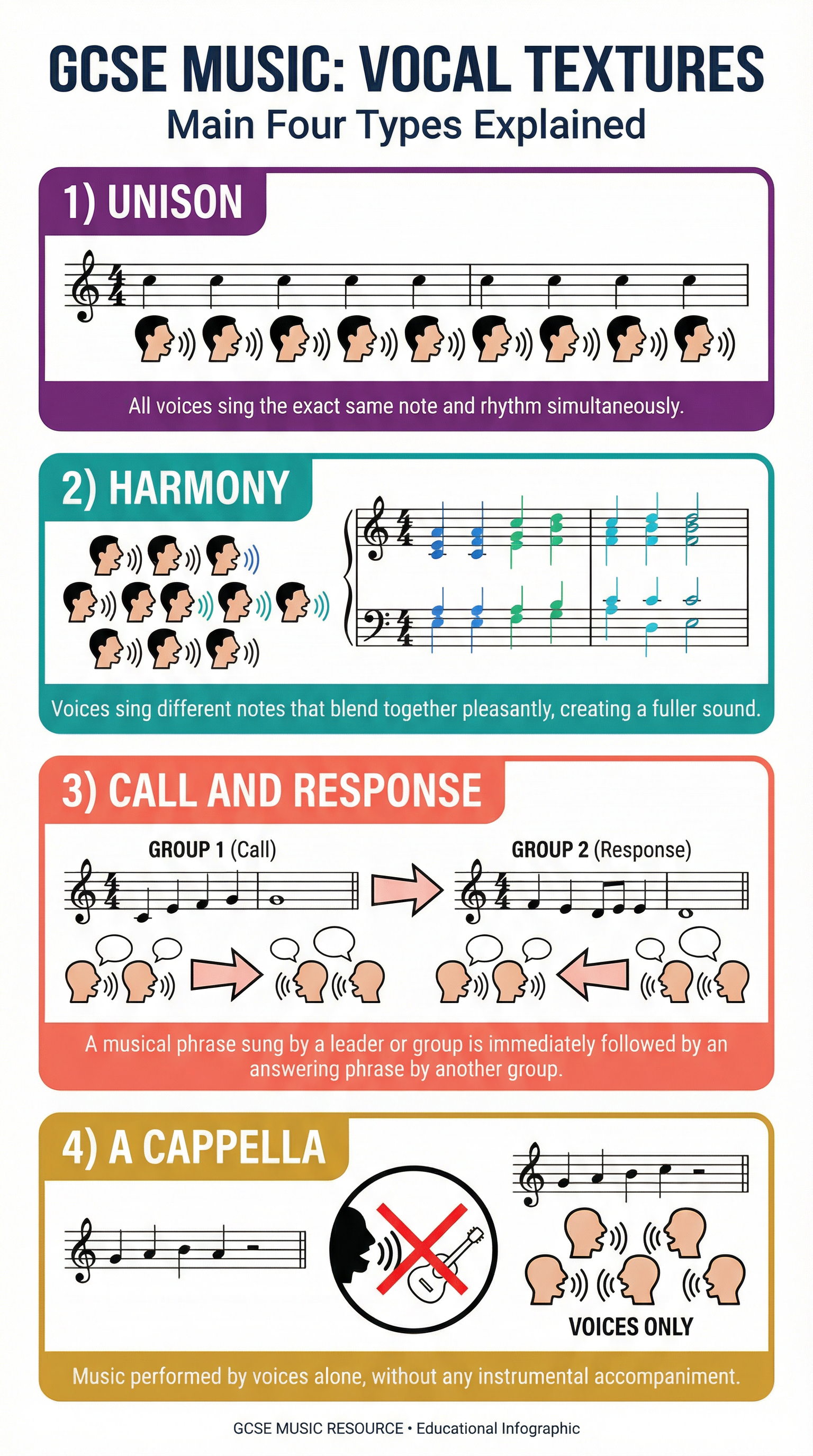
- Unison: All singers perform the exact same melody at the same pitch or in octaves.
- Harmony: Different singers perform different notes at the same time, creating chords and a richer sound. This is typical for backing vocals.
- Call and Response: A musical conversation where one voice or group (the 'call') is answered by another (the 'response'). This is a key feature of many African and Gospel music traditions.
- A Cappella: Vocal music performed without any instrumental accompaniment.
Key Practitioners/Artists/Composers
While you don't need to be an expert on every artist, having examples helps to contextualise the techniques.
| Name | Period/Style | Key Works (Examples) | Relevance |
|---|---|---|---|
| Queen | 1970s/80s Rock/Pop | 'Bohemian Rhapsody' | Exemplifies complex vocal harmonies, unison sections, and operatic style. |
| Aretha Franklin | 1960s/70s Soul | 'Respect', 'Natural Woman' | Master of melisma, belting, and call-and-response backing vocals. |
| Michael Jackson | 1980s Pop | 'Billie Jean' | Use of vocal hiccups, falsetto, and precise rhythmic delivery. |
| Beyoncé | 2000s-Present Pop/R&B | 'Listen', 'Halo' | Demonstrates powerful belting, wide vocal range, and intricate melisma. |
| Eminem | 1990s-Present Hip-Hop | 'Lose Yourself' | A prime example of complex rhythmic rapping and storytelling. |
Technical Vocabulary
Using the correct terminology is non-negotiable for high marks. Here is a list of essential terms you MUST know and use:
- A Cappella: Voices only, no instruments.
- Accompaniment: The instrumental backing for a singer.
- Backing Vocals: Singers who support the lead vocalist, often singing in harmony.
- Belting: Powerful chest-voice singing.
- Call and Response: A conversational texture between voices.
- Falsetto: High, airy male vocal technique.
- Harmony: Different notes sung together.
- Melisma: Many notes per syllable.
- Portamento: A slide between notes.
- Range: The distance from the lowest to the highest note a singer can produce.
- Reverb: An electronic effect that creates a sense of space (echo).
- Syllabic: One note per syllable.
- Timbre: The tone quality or 'colour' of a voice (e.g., raspy, smooth, breathy).
- Unison: All voices singing the same notes.
- Vibrato: A wobble on a sustained note.
Practical Skills
Techniques & Processes
For the listening exam, your practical skill is Aural Analysis. This is the process of listening critically and identifying musical features. You can practice this every day.
- Active Listening: When you listen to a song, don't just enjoy it. Ask yourself: What is the lead singer doing? Are there backing vocals? If so, are they in unison or harmony? Is the word-setting syllabic or melismatic? Try to name at least three distinct musical features in every song you hear.
- Isolate Layers: Use headphones. Try to focus only on the lead vocal. Then, listen again and focus only on the backing vocals. Then, focus on the bass, then the drums. This helps you to deconstruct the texture of the music.
- Vocalise the Techniques: Try singing a simple scale. Now try singing it with vibrato on the last note. Try sliding between two notes (portamento). Physically trying to replicate the sounds will help you to remember and identify them.
Exam Component
Written Exam Knowledge
The listening paper is where this knowledge is tested. Questions will be based on short, unfamiliar extracts of music from Pop (1950s-present) and World Music. You will be asked to:
- Identify specific features (e.g., 'Identify the vocal technique used at 0:45').
- Describe the music (e.g., 'Describe the use of vocals in this extract').
- Compare two extracts (e.g., 'Compare the use of vocals in Extract A and Extract B').
Practical Exam Preparation
Your performance and composition coursework can also demonstrate your understanding of vocal music.
- Performance: If you are a singer, choose a piece that showcases a range of techniques you can execute well. In your programme notes, you can describe the vocal challenges of the piece using the correct terminology.
- Composition: If you are composing a song, think carefully about your word-setting. Will it be syllabic for clarity, or will you add melisma for expression? How will you use backing vocals? Your composition log should document these decisions, explaining why you made them. This is a chance to show the examiner your deep understanding of vocal writing.
Visual Resources
2 diagrams and illustrations
Interactive Diagrams
1 interactive diagram to visualise key concepts
Conceptual Flow Outline
A flowchart for approaching a listening exam question on vocals.
Worked Examples
3 detailed examples with solutions and examiner commentary
Practice Questions
Test your understanding — click to reveal model answers
Listen to an extract from a 1960s soul track. Identify two vocal techniques used by the lead singer. [2 marks]
Hint: Listen for expressive devices on long-held notes and how the singer moves between pitches.
Describe the texture of the vocals in this extract from a piece of world music. [4 marks]
Hint: Listen for how the different vocal parts interact. Is there a leader? Are they singing the same thing or different things?
Explain how the vocalist creates a sense of power and emotion in the chorus of this power ballad. [4 marks]
Hint: Think about the specific techniques used to convey strong emotion. Use the correct terminology.
Analyse the use of vocals in this extract from a 1990s R&B track, commenting on at least three different musical elements. [6 marks]
Hint: Use the S.M.A.R.T. acronym: Syllabic/Melismatic, Melody, Articulation, Range, Texture. Cover at least three of these.