OCR · GCSE · Music
Writing to a Brief
This guide provides a comprehensive overview of the OCR GCSE Music component 'Writing to a Brief' (2.8). It covers the essential skills of creating, developing, and structuring musical ideas in response to a set stimulus, which is a crucial part of the practical coursework."
- 10 min read
- 3 worked examples
- 4 practice questions
Study Notes

Overview
Welcome to the definitive guide for OCR GCSE Music, Component 03: the Practical Component, focusing on Writing to a Brief. This component is your opportunity to showcase your creativity and technical skill as a composer. It accounts for a significant portion of your final grade and is assessed entirely under Assessment Objective 2 (AO2), which is defined as the ability to 'create, develop and structure musical ideas, with technical control and coherence.' Unlike other components, there are no listening or performance marks here; it is a pure test of your compositional craft.
Candidates are required to compose a piece of music in response to one of several Board-set briefs. These briefs provide a stimulus—it could be a line of text, an image, a specific musical style, or a functional purpose (e.g., music for a film scene). Your task is to interpret this stimulus and create a coherent, well-structured, and musically engaging piece that meets the brief's constraints.

Key Knowledge & Theory
Core Concepts
To excel in this component, a firm grasp of core musical concepts is non-negotiable. Examiners will be looking for how effectively you manipulate these elements to create a convincing piece of music.
- Melody: The 'tune' of your piece. A strong melody is memorable, has a clear contour (shape), and is suitable for the instrument playing it. It should be more than just a random string of notes; it needs direction and purpose.
- Harmony: The chords that support the melody. Your choice of harmony dictates the mood and emotional feel of the music. You must demonstrate an understanding of chord progressions, cadences (e.g., perfect, plagal, imperfect, interrupted), and how to use dissonance and consonance effectively.
- Rhythm: The arrangement of sounds in time. This includes the duration of notes, the metre (time signature), and the use of rhythmic devices like syncopation, ostinatos (riffs), and polyrhythms. Your rhythmic choices are fundamental to establishing the style and energy of your composition.
- Structure/Form: The overall plan or architecture of your piece. Simply repeating a loop is not enough. You need to create a journey for the listener. Common structures include Binary (AB), Ternary (ABA), Rondo (ABACA), and Theme and Variations. For popular styles, a Verse-Chorus structure is appropriate. Your structure must be clear and help the music to develop logically.
- Texture: The number of layers in the music and how they interact. This could be monophonic (a single melodic line), homophonic (melody with chordal accompaniment), or polyphonic (multiple independent melodic lines). Varying the texture is a key way to maintain interest.
- Timbre & Instrumentation: The specific sound quality of the instruments or voices you choose. You must write idiomatically for your chosen instruments, meaning you understand their capabilities, ranges, and common techniques. For example, don't write complex chords for a flute, but do explore techniques like pizzicato or arco for strings.
Key Practitioners/Artists/Composers
Studying the work of established composers is essential for understanding different styles. The brief you choose will dictate which composers are most relevant.
| Name | Period/Style | Key Works | Relevance |
|---|---|---|---|
| John Williams | Film Music (20th/21st C.) | Star Wars, Jurassic Park, Harry Potter | Master of the leitmotif, orchestral colour, and creating atmosphere. Essential listening for any film music brief. |
| Steve Reich | Minimalism (20th C.) | Music for 18 Musicians, Clapping Music | Pioneer of phasing, ostinatos, and gradual process music. Key for briefs involving minimalist techniques. |
| Max Martin | Pop Music (21st C.) | Countless hits for Taylor Swift, Britney Spears | Expert in crafting memorable hooks, strong verse-chorus structures, and polished production. |
| Hans Zimmer | Film Music (21st C.) | Inception, The Dark Knight, Gladiator | Known for blending orchestral and electronic sounds, creating powerful textures and driving rhythmic patterns. |
Technical Vocabulary
Using precise musical language in your annotations and any accompanying commentary is vital. It shows the examiner you are thinking like a musician.
- Motif: A short, recurring musical idea.
- Sequence: The immediate repetition of a motif at a higher or lower pitch.
- Inversion: Turning a melody 'upside down'.
- Retrograde: Playing a melody backwards.
- Augmentation: Lengthening the rhythmic values of a motif (usually doubling them).
- Diminution: Shortening the rhythmic values of amotif (usually halving them).
- Ostinato: A persistently repeated rhythmic or melodic pattern.
- Idiomatic Writing: Writing music that is well-suited to the capabilities of the chosen instrument.
- DAW: Digital Audio Workstation (e.g., Logic Pro, GarageBand, Ableton Live).
Practical Skills
Techniques & Processes
This is where theory meets practice. A successful composition follows a clear process from initial idea to final product.
-
Deconstruct the Brief: Before you write a single note, analyse every word of the brief. What is the required mood? What are the stylistic constraints? Who is the intended audience? Annotate the brief and highlight the key instructions.
-
Brainstorm Core Ideas: Based on the brief, create several short motifs or chord progressions. Don't settle on your first idea. Experiment. Try writing a memorable melody, a driving rhythmic pattern, or a unique harmonic colour.
-
Select and Develop: Choose your strongest core idea and begin to develop it. This is the most important stage for scoring high marks. Use the compositional techniques listed above to transform your material. Avoid simple repetition. Ask yourself, 'How can I vary this idea?'

-
Structure Your Piece: Plan the overall form. Where will the climax be? How will you build tension and release it? Sketch out a timeline for your composition, marking where each section begins and ends and what developmental techniques you will use.
-
Refine and Polish: This involves checking your orchestration, refining your harmony, and adding performance details. Pay close attention to dynamics, articulation, and tempo. If using a DAW, this is the mixing and mastering stage, where you balance levels and add effects.
Materials & Equipment
Your choice of tools will significantly impact your workflow and the final sound of your piece.
- Notation Software (e.g., Sibelius, Musescore, Dorico):
- Pros: Excellent for creating professional, legible scores. Essential for writing for acoustic instruments and ensembles. Automatically handles transposition and part extraction.
- Cons: Playback can be robotic and unmusical. Can be less intuitive for styles that are not traditionally notated, like electronic music.
- Digital Audio Workstation (DAW) (e.g., Logic Pro, Ableton Live, GarageBand):
- Pros: Offers infinite sonic possibilities through virtual instruments and effects. The best choice for electronic music, pop, and film scoring. Allows for high-quality audio recording and production.
- Cons: Can encourage reliance on pre-made loops. Creating a clear, detailed score or lead sheet from a DAW project requires an extra step and careful attention to detail.
Regardless of your choice, you must submit both a recording and a score/lead sheet. The score provides evidence of your technical control and compositional intent.
Portfolio/Coursework Guidance
Assessment Criteria
Your work is marked against four key criteria, all falling under AO2. Understanding these is the key to a top grade.
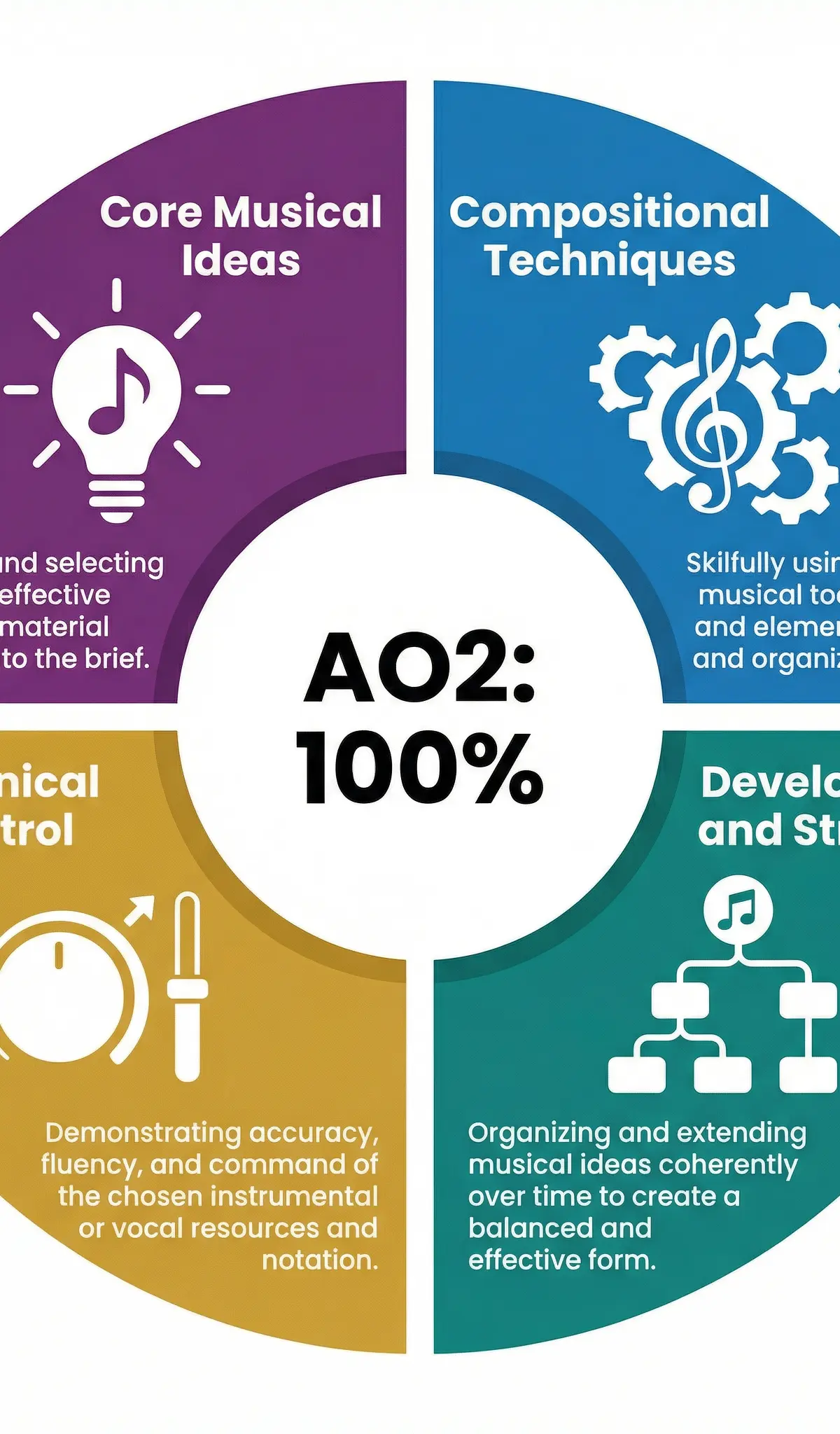
- Core Musical Ideas: The quality and potential of your initial motifs. Are they musical, engaging, and appropriate for the brief?
- Compositional Techniques: Your use of melody, harmony, rhythm, and texture. Is the writing idiomatic? Do you use a range of devices effectively?
- Development and Structure: How you manipulate your ideas and organize them into a coherent form. Is there a sense of journey? Is development more than just repetition?
- Technical Control: The accuracy of your score and/or programming. Is the notation correct? Are performance directions clear? Does the audio match the score?
Building a Strong Portfolio
Your submission is the only thing the examiner sees. It must be clear, professional, and complete.
- Document Your Process: While not always a requirement for the final submission, keeping a log of your ideas, experiments, and decisions can be invaluable. This helps you write the commentary if one is required and demonstrates your creative journey.
- The Score is King: Your score must be immaculate. Use a consistent layout. Ensure all parts are clearly labelled. Add dynamics, articulation (staccato, legato, accents), and tempo markings. These are not optional extras; they are essential for demonstrating technical control.
- High-Quality Recording: Your audio recording should be as good as you can make it. If using a DAW, spend time on the mix to ensure all parts are audible and balanced. If recording live instruments, find a quiet space and use the best microphone available.
- The Final Check: Before submitting, listen to your recording while following the score. Does what you hear match what you've written? This is a critical final step that many candidates miss.
Exam Component
Written Exam Knowledge
While Component 03 is practical, the knowledge you gain is directly relevant to the Component 01: Listening and Appraising paper. In that exam, you will be asked to analyse unfamiliar music, often using the very same vocabulary you use to describe your own compositions. Understanding concepts like structure, texture, and compositional devices from a creator's perspective will give you a huge advantage when you have to identify them as a listener.
Practical Exam Preparation
This component is a marathon, not a sprint. Effective preparation is key.
- Know Your Strengths: As soon as the briefs are released, read them all and honestly assess which one best suits your skills and interests. Don't pick the 'coolest' brief if you don't have the technical ability to pull it off.
- Time Management: Create a schedule. Allocate time for brainstorming, developing, structuring, and refining. Leave plenty of time at the end for creating the final score and recording. Rushing at the end is where mistakes happen.
- Seek Feedback: Play your work-in-progress to your teacher and peers. A fresh pair of ears can often spot issues you've missed. Be prepared to revise your work based on constructive criticism."
Worked Examples
3 worked examples — open one to explore the question and available guidance.
Practice Questions
Test your understanding — click to reveal model answers
You are composing a piece for a string quartet. The brief asks for a 'tense and dramatic' mood. Describe two ways you could use harmony and texture to achieve this effect.
Hint: Think about consonance vs. dissonance, and how many layers of sound you are using.
What does 'idiomatic writing' mean? Give one example of idiomatic writing for piano and one example of non-idiomatic writing for a trumpet.
Hint: Think about what each instrument is designed to do well.
Analyse how a composer like Hans Zimmer might use timbre and rhythm to score a high-action chase scene in a film.
Hint: Think about the combination of electronic and orchestral sounds, and the use of repeating rhythmic patterns.
You have written a 4-bar melody. The examiner's feedback says it needs 'more development'. Describe three distinct things you could do to develop this melody.
Hint: Use the DSRIAV mnemonic!