Pearson Edexcel · GCSE · Music
Course version: 1MU0 · Version from Sept 2016
Musical vocabulary - Dynamics and performance matters: Notes may be given…
Full specification wording
Appendix 3: Musical vocabulary - Dynamics and performance matters: Notes may be given special prominence by the addition of accent marks
Accent marks are articulation and performance markings placed on or near individual notes to give them special prominence.
- Point 2 of 25
- 4 key terms
Study notes
From the teaching notes for this specification point.
The idea
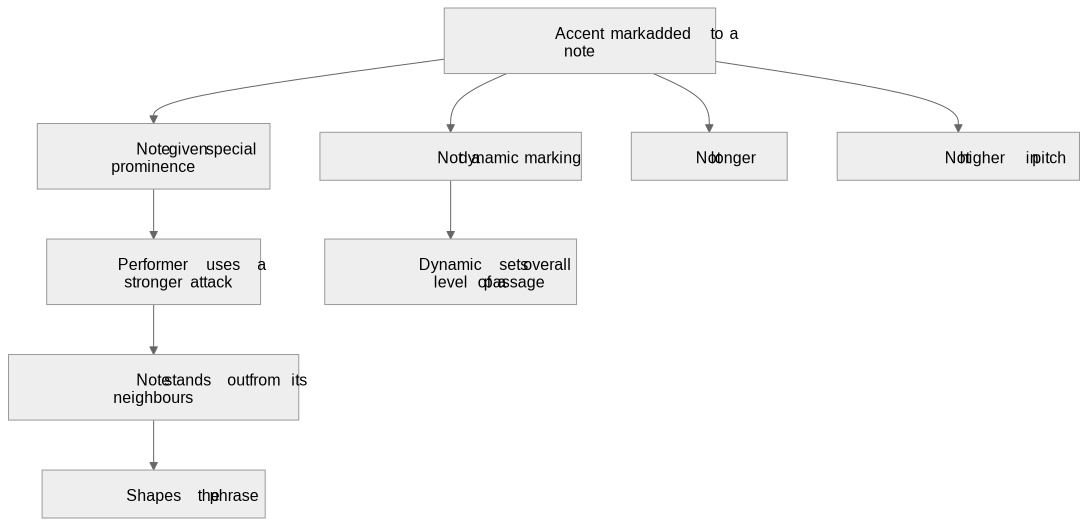
Accent marks are articulation and performance markings placed on or near individual notes to give them special prominence. The player or singer responds by attacking that note more strongly than its neighbours, so it stands out from the surrounding texture or melodic line. Prominence is created by extra force at the start of the note, not by making the note longer or higher. In a listening or score-reading question, identify the accent symbol and explain that it directs a stronger, emphasised attack on the marked note. Distinguish accents from dynamic markings: a dynamic such as forte sets the overall level of a passage, whereas an accent singles out one note within that level. A useful method is to locate the marked note, describe the louder attack, then say how this shapes the phrase.
What earns the marks
- Identifies an accent mark as a marking applied to an individual note to give it special prominence.
- Explains that the performer produces prominence through a stronger attack or emphasis on the marked note.
- Distinguishes accent marks from general dynamic markings, which set the overall loudness of a passage rather than singling out one note.
- Describes the musical effect, such as a note standing out from its neighbours or shaping the phrase.
- Applies the term correctly when reading a score or responding to a listening excerpt.
Common mistakes and how to put them right
Confusing an accent with a dynamic marking.
Put it right: An accent emphasises a single note, whereas a dynamic sets the general level of a passage.
Assuming an accent makes the note longer.
Put it right: The prominence comes from a stronger attack, not added duration.
Thinking an accent raises the pitch.
Put it right: The note keeps its pitch and gains emphasis only.
Exam tips
- Name the symbol precisely as an accent before explaining its effect.
- Link the accent to a specific note or moment in the excerpt rather than describing it in the abstract.
- Contrast the accent with the surrounding dynamic to show you understand the difference.
Try the lesson
The start of the Appendix 3: Musical vocabulary - Dynamics and performance matters: Notes may be given special prominence by the addition of accent marks lesson, made from teaching notes for this specification point.
Have a go first
In music notation, what is the primary function of an accent mark placed above or below a note?
Listen
Accent marks are articulation and performance markings placed on or near individual notes to give them special prominence. The player or singer responds by attacking that note more strongly than its neighbours, so it stands out from the surrounding texture or melodic line. Prominence is created by extra force at the start of the note, not by making the note longer or higher. In a listening or score-reading question, identify the accent symbol and explain that it directs a stronger, emphasised attack on the marked note. Distinguish accents from dynamic markings: a dynamic such as forte sets the overall level of a passage, whereas an accent singles out one note within that level. A useful method is to locate the marked note, describe the louder attack, then say how this shapes the phrase. A strong answer earns marks for these points. Identifies an accent mark as a marking applied to an individual note to give it special prominence. Explains that the performer produces prominence through a stronger attack or emphasis on the marked note. Distinguishes accent marks from general dynamic markings, which set the overall loudness of a passage rather than singling out one note. Describes the musical effect, such as a note standing out from its neighbours or shaping the phrase. Exam tip: Name the symbol precisely as an accent before explaining its effect.
See it
Key words
Say what each word means before you turn the card.
Accent mark
Try answering aloud or in your head before turning the card.
Emphasis and attack
Try answering aloud or in your head before turning the card.
Special prominence of individual notes
Try answering aloud or in your head before turning the card.
Distinction between accents and dynamics
Try answering aloud or in your head before turning the card.
See every definition
- Accent mark
- An articulation and performance marking placed on or near an individual note to give it special prominence.
- Emphasis and attack
- The performer produces prominence through a stronger attack or emphasis on the marked note, standing out from its neighbours.
- Special prominence of individual notes
- Prominence is created by extra force at the start of the note, not by making the note longer or higher.
- Distinction between accents and dynamics
- A dynamic such as forte sets the overall level of a passage, whereas an accent singles out one note within that level.
Label the diagram
Some boxes have lost their names. Pick the right name for each number.
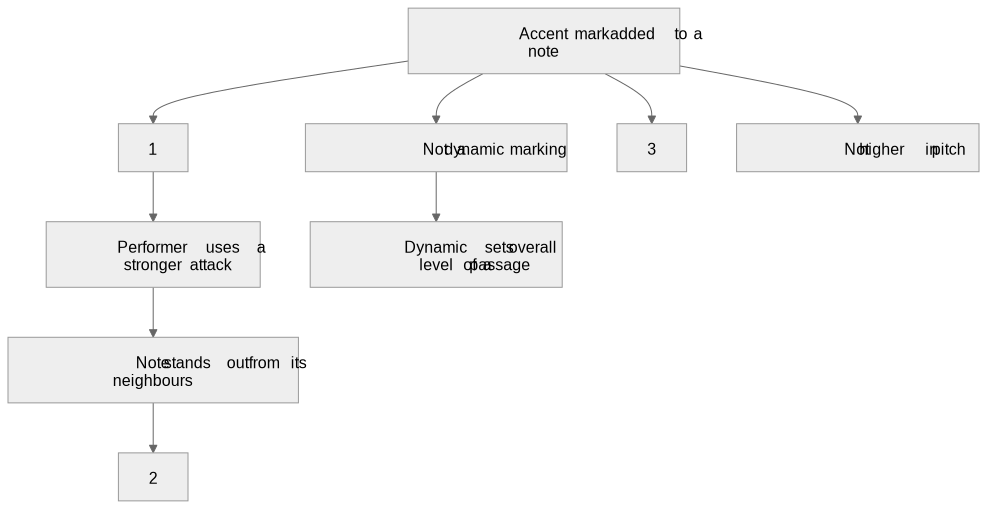
1Box 1
2Box 2
3Box 3
There is more to this lesson
The full lesson goes on to check your understanding and help you earn the marks. Create a free account to carry on, with your progress saved.
A week of Premium from your first lesson · Then the free plan continues · No card, no charge
Test your understanding of Appendix 3: Musical vocabulary - Dynamics and performance matters: Notes may be given special prominence by the addition of accent marks
Active recall beats re-reading. Take an instant quiz now to test what you’ve learned and lock it into long-term memory.
A week of Premium from your first lesson · Then the free plan continues · No card, no charge