Pearson Edexcel · GCSE · Music
Course version: 1MU0 · Version from Sept 2016
Musical vocabulary - Dynamics and performance matters: The volume of…
Full specification wording
Appendix 3: Musical vocabulary - Dynamics and performance matters: The volume of musical sound(s), and also the symbols used in a score to indicate volume (e.g. f and p)
Dynamics has two linked meanings.
- Point 1 of 25
- 4 key terms
Study notes
From the teaching notes for this specification point.
The idea
Dynamics has two linked meanings. First, it refers to the volume of musical sound or sounds — how loud or soft the music is at any moment. Second, it refers to the symbols written in a score that tell performers what volume to produce. Common symbols include f for forte (loud) and p for piano (soft). Performers respond to these markings by changing how much force or breath they use, so the actual volume heard matches the symbol. Dynamics can change gradually or suddenly, and a single piece may move between loud and soft passages. When answering, be ready to name a dynamic symbol, say what volume it indicates, and explain that dynamics describes both the heard volume and the notation used to indicate it.
What earns the marks
- Dynamics refers to the volume of musical sound or sounds.
- Dynamics also refers to the symbols in a score that indicate volume.
- f stands for forte and indicates loud.
- p stands for piano and indicates soft.
- Performers change their force or breath to realise dynamic markings.
- Dynamics may change gradually or suddenly within a piece.
Common mistakes and how to put them right
Treating dynamics as tempo.
Put it right: Dynamics concerns volume, while tempo concerns speed.
Thinking f means soft.
Put it right: f (forte) means loud, and p (piano) means soft.
Assuming dynamics only means the printed symbols.
Put it right: It also means the actual volume of the sounds heard.
Believing dynamic level stays fixed throughout a piece.
Put it right: Dynamics can change gradually or suddenly.
Exam tips
- Link each symbol to its Italian term and its meaning, for example f = forte = loud.
- When describing a passage, state the dynamic level and whether it changes gradually or suddenly.
- Remember to mention both the heard volume and the notation when defining dynamics.
Try the lesson
The start of the Appendix 3: Musical vocabulary - Dynamics and performance matters: The volume of musical sound(s), and also the symbols used in a score to indicate volume (e.g. f and p) lesson, made from teaching notes for this specification point.
Have a go first
Which dynamic marking would you expect to see in a score to indicate a gradual increase in volume?
Listen
Dynamics has two linked meanings. First, it refers to the volume of musical sound or sounds — how loud or soft the music is at any moment. Second, it refers to the symbols written in a score that tell performers what volume to produce. Common symbols include f for forte (loud) and p for piano (soft). Performers respond to these markings by changing how much force or breath they use, so the actual volume heard matches the symbol. Dynamics can change gradually or suddenly, and a single piece may move between loud and soft passages. When answering, be ready to name a dynamic symbol, say what volume it indicates, and explain that dynamics describes both the heard volume and the notation used to indicate it. A strong answer earns marks for these points. Dynamics refers to the volume of musical sound or sounds. Dynamics also refers to the symbols in a score that indicate volume. f stands for forte and indicates loud. p stands for piano and indicates soft. A common slip: Treating dynamics as tempo. Instead, dynamics concerns volume, while tempo concerns speed. Exam tip: Link each symbol to its Italian term and its meaning, for example f = forte = loud.
See it
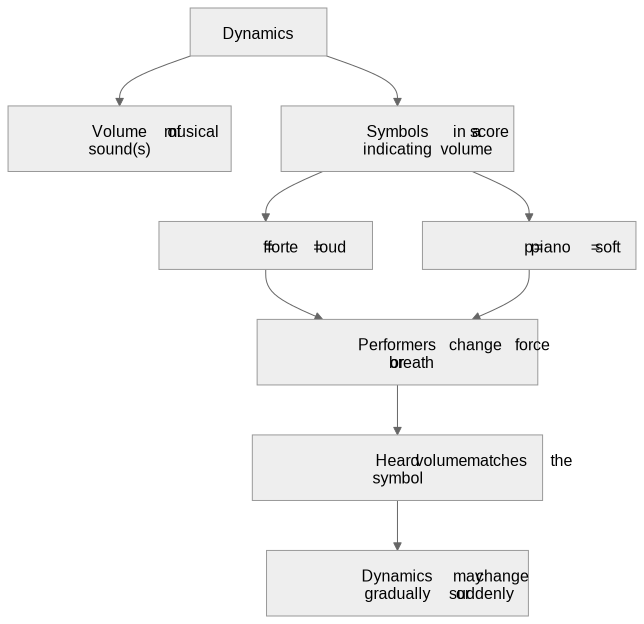
Key words
Say what each word means before you turn the card.
Volume in music
Try answering aloud or in your head before turning the card.
Dynamic symbols and Italian terms
Try answering aloud or in your head before turning the card.
Performing dynamic markings
Try answering aloud or in your head before turning the card.
Changes of dynamics within a piece
Try answering aloud or in your head before turning the card.
See every definition
- Volume in music
- The loudness or softness of musical sound or sounds at any moment.
- Dynamic symbols and Italian terms
- Symbols written in a score to indicate volume, such as f for forte (loud) and p for piano (soft).
- Performing dynamic markings
- Performers change how much force or breath they use so the volume heard matches the symbol.
- Changes of dynamics within a piece
- Dynamics may change gradually or suddenly, and a single piece may move between loud and soft passages.
Label the diagram
Some boxes have lost their names. Pick the right name for each number.
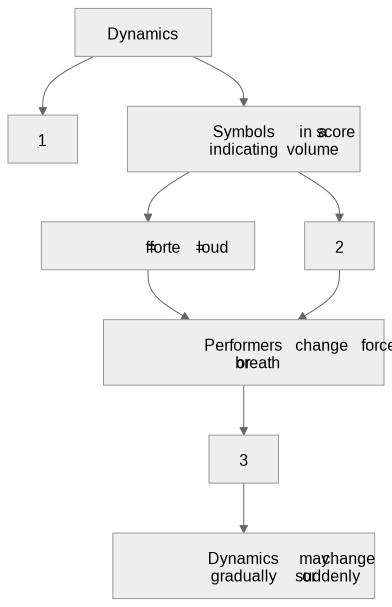
1Box 1
2Box 2
3Box 3
There is more to this lesson
The full lesson goes on to check your understanding and help you earn the marks. Create a free account to carry on, with your progress saved.
A week of Premium from your first lesson · Then the free plan continues · No card, no charge
Test your understanding of Appendix 3: Musical vocabulary - Dynamics and performance matters: The volume of musical sound(s), and also the symbols used in a score to indicate volume (e.g. f and p)
Active recall beats re-reading. Take an instant quiz now to test what you’ve learned and lock it into long-term memory.
A week of Premium from your first lesson · Then the free plan continues · No card, no charge