Pearson Edexcel · GCSE · Music
Course version: 1MU0 · Version from Sept 2016
Musical vocabulary - Dynamics and performance matters: Rapid repetition of…
Full specification wording
Appendix 3: Musical vocabulary - Dynamics and performance matters: Rapid repetition of a single note or of notes a 3rd or more apart
This vocabulary item names a performance device: the rapid repetition of one note, or of two notes at least a 3rd apart, usually alternating quickly between them.
- Point 22 of 25
- 4 key terms
Study notes
From the teaching notes for this specification point.
The idea
This vocabulary item names a performance device: the rapid repetition of one note, or of two notes at least a 3rd apart, usually alternating quickly between them. The term for it is tremolo. On a string instrument a bowed tremolo repeats a single pitch very fast; on a keyboard or in an orchestral score the same word covers the fast alternation of two notes a 3rd or more apart, which is why the definition mentions both cases. To identify it in listening, track a single pitch or a pair of pitches and judge whether the repetition is fast enough to blur into a shimmering or throbbing texture rather than a measured, countable rhythm. Distinguish it from a trill, which alternates two adjacent notes (a 2nd apart), and from an ordinary repeated-note rhythm, which is slower and metrically regular.
What earns the marks
- Names the device as tremolo.
- Recognises the single-note form: one pitch repeated rapidly.
- Recognises the two-note form: rapid alternation of notes a 3rd or more apart.
- Distinguishes tremolo from a trill, which uses adjacent notes a 2nd apart.
- Distinguishes tremolo from a measured repeated-note rhythm by its speed and blurred effect.
Common mistakes and how to put them right
Confusing tremolo with trill.
Put it right: A trill alternates two adjacent notes (a 2nd apart), whereas the two-note tremolo uses notes a 3rd or more apart.
Assuming tremolo only means fast repetition of one note.
Put it right: The definition also covers rapid alternation of two notes a 3rd or more apart.
Calling any repeated-note rhythm a tremolo.
Put it right: The repetition must be rapid, not a measured, countable pattern.
Exam tips
- Learn the definition as two cases: one note repeated rapidly, or two notes a 3rd or more apart alternating rapidly.
- When listening, count the interval between the alternating notes; a 3rd or wider points to tremolo rather than trill.
- Link the term to the effect you hear (shimmering, throbbing, tense) so you can justify your answer.
Try the lesson
The start of the Appendix 3: Musical vocabulary - Dynamics and performance matters: Rapid repetition of a single note or of notes a 3rd or more apart lesson, made from teaching notes for this specification point.
Have a go first
In music, which term describes the rapid repetition of a single note, or of notes a 3rd or more apart, typically performed on string instruments by rapid bow movements?
Listen
This vocabulary item names a performance device: the rapid repetition of one note, or of two notes at least a 3rd apart, usually alternating quickly between them. The term for it is tremolo. On a string instrument a bowed tremolo repeats a single pitch very fast; on a keyboard or in an orchestral score the same word covers the fast alternation of two notes a 3rd or more apart, which is why the definition mentions both cases. To identify it in listening, track a single pitch or a pair of pitches and judge whether the repetition is fast enough to blur into a shimmering or throbbing texture rather than a measured, countable rhythm. Distinguish it from a trill, which alternates two adjacent notes (a 2nd apart), and from an ordinary repeated-note rhythm, which is slower and metrically regular. A strong answer earns marks for these points. Names the device as tremolo. Recognises the single-note form: one pitch repeated rapidly. Recognises the two-note form: rapid alternation of notes a 3rd or more apart. Distinguishes tremolo from a trill, which uses adjacent notes a 2nd apart. Exam tip: Learn the definition as two cases: one note repeated rapidly, or two notes a 3rd or more apart alternating rapidly.
See it
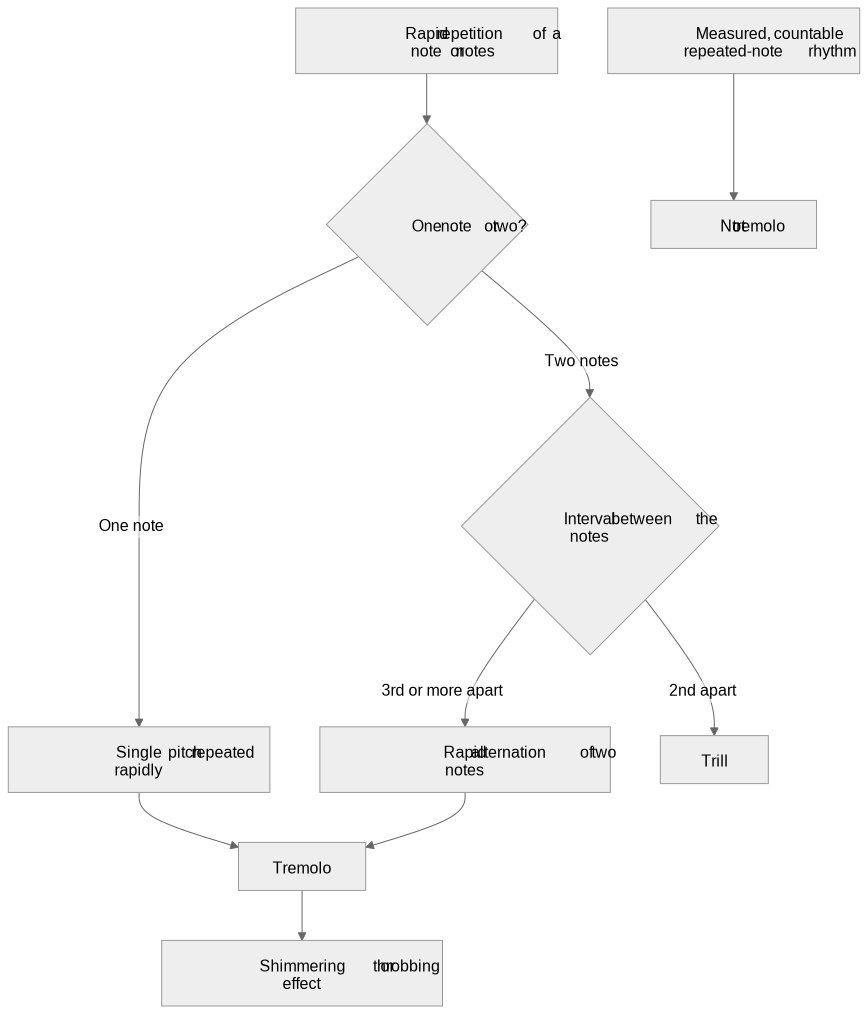
Key words
Say what each word means before you turn the card.
Tremolo
Try answering aloud or in your head before turning the card.
Trill
Try answering aloud or in your head before turning the card.
Measured repeated-note rhythm
Try answering aloud or in your head before turning the card.
Bowed tremolo
Try answering aloud or in your head before turning the card.
See every definition
- Tremolo
- The rapid repetition of a single note, or of notes a 3rd or more apart, usually alternating quickly between them.
- Trill
- Alternates two adjacent notes, a 2nd apart, and is distinguished from a two-note tremolo.
- Measured repeated-note rhythm
- A slower, metrically regular repetition, distinguished from a tremolo by its speed and blurred effect.
- Bowed tremolo
- On a string instrument, repeats a single pitch very fast.
There is more to this lesson
The full lesson goes on to check your understanding and help you earn the marks. Create a free account to carry on, with your progress saved.
A week of Premium from your first lesson · Then the free plan continues · No card, no charge
Test your understanding of Appendix 3: Musical vocabulary - Dynamics and performance matters: Rapid repetition of a single note or of notes a 3rd or more apart
Active recall beats re-reading. Take an instant quiz now to test what you’ve learned and lock it into long-term memory.
A week of Premium from your first lesson · Then the free plan continues · No card, no charge