Pearson Edexcel · GCSE · Music
Course version: 1MU0 · Version from Sept 2016
Musical vocabulary - Dynamics and performance matters: Words to which a…
Full specification wording
Appendix 3: Musical vocabulary - Dynamics and performance matters: Words to which a song is set (applies to music in popular styles)
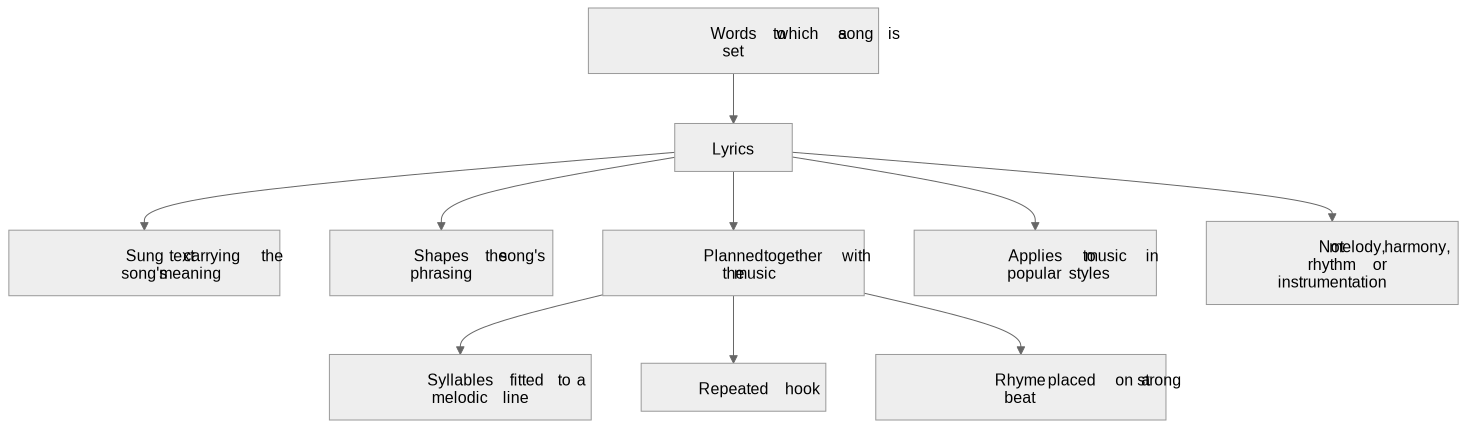
In popular styles, the words a song is set to are its lyrics: the sung text that carries the song's meaning and shapes its phrasing.
- Point 23 of 25
- 4 key terms
Study notes
From the teaching notes for this specification point.
The idea
In popular styles, the words a song is set to are its lyrics: the sung text that carries the song's meaning and shapes its phrasing. Lyrics are not the same as the melody, harmony or rhythm, though they interact with all three. A songwriter may fit syllables to a melodic line, repeat a hook, or place a rhyme on a strong beat, so the words and the music are planned together. When you meet a listening question, identify the term by asking what the words themselves are called, not what the voice is doing. For example, a verse sung over a chord pattern has lyrics; the chord pattern is harmony. Learn the term as vocabulary, then apply it when describing a popular song you hear.
What earns the marks
- Identifies the words to which a song is set as the lyrics.
- Distinguishes lyrics from melody, harmony, rhythm and instrumentation.
- Recognises that the definition applies to music in popular styles.
- Applies the term correctly when describing a song heard or studied.
Common mistakes and how to put them right
Confusing lyrics with the melody.
Put it right: The melody is the tune, while the lyrics are the words sung to it.
Calling the words 'the vocal' or 'the singing'.
Put it right: The voice is the performing medium, but the words themselves are the lyrics.
Exam tips
- Read the question stem to see whether it asks about the words or about the music, then choose the matching term.
- Eliminate options that name musical elements such as harmony or rhythm rather than the text.
- When describing a song, use 'lyrics' precisely so your answer shows secure vocabulary.
Try the lesson
The start of the Appendix 3: Musical vocabulary - Dynamics and performance matters: Words to which a song is set (applies to music in popular styles) lesson, made from teaching notes for this specification point.
Listen
In popular styles, the words a song is set to are its lyrics: the sung text that carries the song's meaning and shapes its phrasing. Lyrics are not the same as the melody, harmony or rhythm, though they interact with all three. A songwriter may fit syllables to a melodic line, repeat a hook, or place a rhyme on a strong beat, so the words and the music are planned together. When you meet a listening question, identify the term by asking what the words themselves are called, not what the voice is doing. For example, a verse sung over a chord pattern has lyrics; the chord pattern is harmony. Learn the term as vocabulary, then apply it when describing a popular song you hear. A strong answer earns marks for these points. Identifies the words to which a song is set as the lyrics. Distinguishes lyrics from melody, harmony, rhythm and instrumentation. Recognises that the definition applies to music in popular styles. Applies the term correctly when describing a song heard or studied. Exam tip: Read the question stem to see whether it asks about the words or about the music, then choose the matching term.
See it
Key words
Say what each word means before you turn the card.
Lyrics
Try answering aloud or in your head before turning the card.
Melody
Try answering aloud or in your head before turning the card.
Harmony
Try answering aloud or in your head before turning the card.
Rhythm
Try answering aloud or in your head before turning the card.
See every definition
- Lyrics
- The words to which a song is set, applying to music in popular styles.
- Melody
- The tune, which is distinct from the words sung to it.
- Harmony
- A musical element distinct from the lyrics, such as a chord pattern.
- Rhythm
- A musical element distinct from the lyrics, named alongside melody, harmony and instrumentation.
Label the diagram
Some boxes have lost their names. Pick the right name for each number.
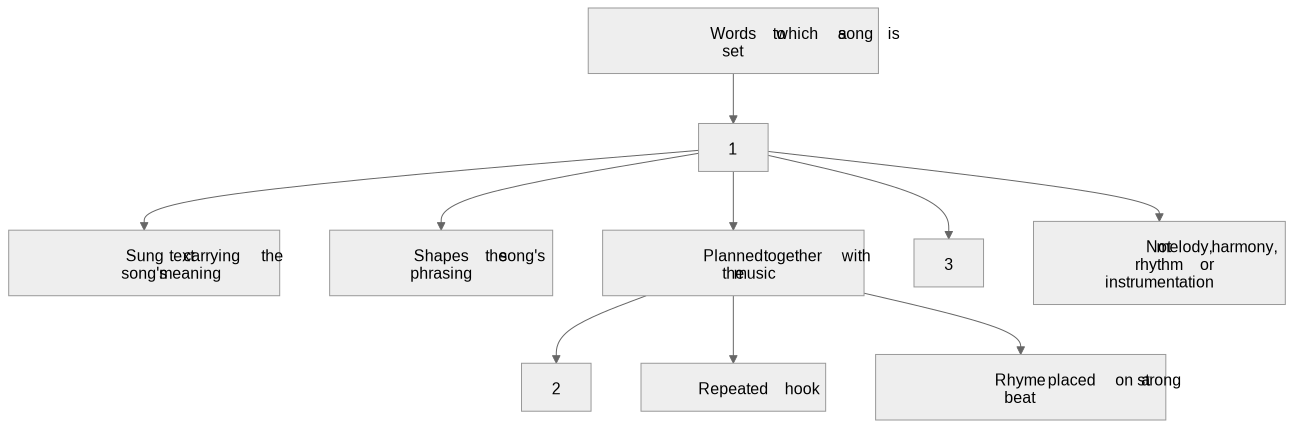
1Box 1
2Box 2
3Box 3
There is more to this lesson
The full lesson goes on to check your understanding and help you earn the marks. Create a free account to carry on, with your progress saved.
A week of Premium from your first lesson · Then the free plan continues · No card, no charge
Test your understanding of Appendix 3: Musical vocabulary - Dynamics and performance matters: Words to which a song is set (applies to music in popular styles)
Active recall beats re-reading. Take an instant quiz now to test what you’ve learned and lock it into long-term memory.
A week of Premium from your first lesson · Then the free plan continues · No card, no charge