Pearson Edexcel · GCSE · Music
Course version: 1MU0 · Version from Sept 2016
Musical vocabulary - Dynamics and performance matters: The instrument(s)…
Full specification wording
Appendix 3: Musical vocabulary - Dynamics and performance matters: The instrument(s) and/or voice(s) that perform the music
This vocabulary item covers instrumentation and voices: identifying which instruments and which voices actually perform a piece.
- Point 5 of 25
- 4 key terms
Study notes
From the teaching notes for this specification point.
The idea
This vocabulary item covers instrumentation and voices: identifying which instruments and which voices actually perform a piece. It is about naming what you hear, not the genre or the mood. A learner should be able to pick out individual instruments by their sound, recognise families such as strings, woodwind, brass and percussion, and identify voice types such as soprano, alto, tenor and bass, including choirs and solo voices. Ensembles may combine instruments and voices, so the answer may name more than one performer. When answering, listen for the distinctive timbre of each part and match it to the correct instrument or voice rather than guessing from the style of the music.
What earns the marks
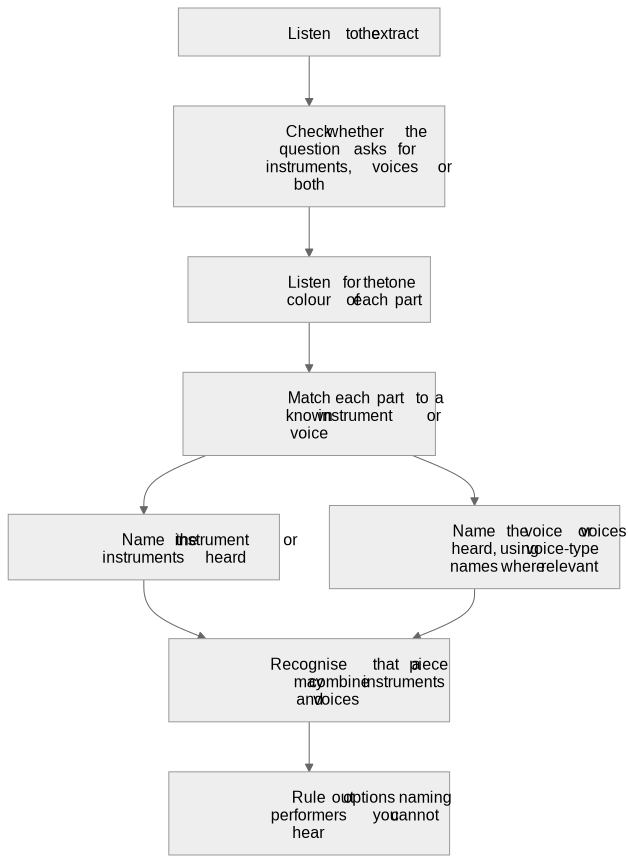
- Identifies the instrument or instruments performing, using recognised instrument names.
- Identifies the voice or voices performing, using recognised voice-type names where relevant.
- Recognises that a piece may combine instruments and voices, so more than one answer may apply.
- Uses the distinctive sound (timbre) of each part as evidence for identifying the performer.
Common mistakes and how to put them right
Naming the genre or style instead of the performers.
Put it right: The question asks which instruments or voices are heard.
Confusing similar-sounding instruments, such as a violin with a viola.
Put it right: Listen for register and tone colour.
Assuming a solo voice piece has no accompaniment.
Put it right: Listen for accompanying instruments before deciding.
Exam tips
- Listen for the tone colour of each part and match it to a known instrument or voice.
- Check whether the question asks for instruments, voices or both before selecting.
- Rule out options naming performers you cannot hear in the extract.
Try the lesson
The start of the Appendix 3: Musical vocabulary - Dynamics and performance matters: The instrument(s) and/or voice(s) that perform the music lesson, made from teaching notes for this specification point.
Have a go first
In Area of Study 2 (Vocal Music), an exam question plays an excerpt featuring a high female solo voice accompanied by a piano and an acoustic guitar. Which term describes these combined instruments and voices?
Listen
This vocabulary item covers instrumentation and voices: identifying which instruments and which voices actually perform a piece. It is about naming what you hear, not the genre or the mood. A learner should be able to pick out individual instruments by their sound, recognise families such as strings, woodwind, brass and percussion, and identify voice types such as soprano, alto, tenor and bass, including choirs and solo voices. Ensembles may combine instruments and voices, so the answer may name more than one performer. When answering, listen for the distinctive timbre of each part and match it to the correct instrument or voice rather than guessing from the style of the music. A strong answer earns marks for these points. Identifies the instrument or instruments performing, using recognised instrument names. Identifies the voice or voices performing, using recognised voice-type names where relevant. Recognises that a piece may combine instruments and voices, so more than one answer may apply. Uses the distinctive sound (timbre) of each part as evidence for identifying the performer. A common slip: Naming the genre or style instead of the performers. Instead, the question asks which instruments or voices are heard. Exam tip: Listen for the tone colour of each part and match it to a known instrument or voice.
See it
Key words
Say what each word means before you turn the card.
Instrumentation
Try answering aloud or in your head before turning the card.
Voice types
Try answering aloud or in your head before turning the card.
Ensembles combining instruments and voices
Try answering aloud or in your head before turning the card.
Identifying performers by timbre
Try answering aloud or in your head before turning the card.
See every definition
- Instrumentation
- The instrument(s) and/or voice(s) that perform the music, named using recognised instrument and voice names.
- Voice types
- Names such as soprano, alto, tenor and bass, used to identify the voices performing, including choirs and solo voices.
- Ensembles combining instruments and voices
- Performers may be combined, so the answer may name more than one performer.
- Identifying performers by timbre
- Listening for the distinctive sound of each part and matching it to the correct instrument or voice rather than guessing from the style of the music.
Label the diagram
Some boxes have lost their names. Pick the right name for each number.
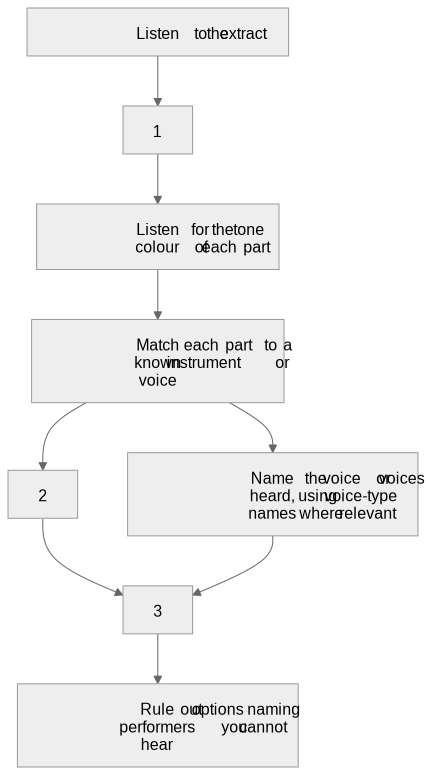
1Box 1
2Box 2
3Box 3
There is more to this lesson
The full lesson goes on to check your understanding and help you earn the marks. Create a free account to carry on, with your progress saved.
A week of Premium from your first lesson · Then the free plan continues · No card, no charge
Test your understanding of Appendix 3: Musical vocabulary - Dynamics and performance matters: The instrument(s) and/or voice(s) that perform the music
Active recall beats re-reading. Take an instant quiz now to test what you’ve learned and lock it into long-term memory.
A week of Premium from your first lesson · Then the free plan continues · No card, no charge