Pearson Edexcel · GCSE · Music
Course version: 1MU0 · Version from Sept 2016
Musical vocabulary - Dynamics and performance matters: Doubling occurs…
Full specification wording
Appendix 3: Musical vocabulary - Dynamics and performance matters: Doubling occurs where one performer consistently plays or sings the same notes as another – strictly speaking at the same octave, but duplication at the octave may be involved
Doubling describes two performers producing the same musical line at once.
- Point 6 of 25
- 4 key terms
Study notes
From the teaching notes for this specification point.
The idea
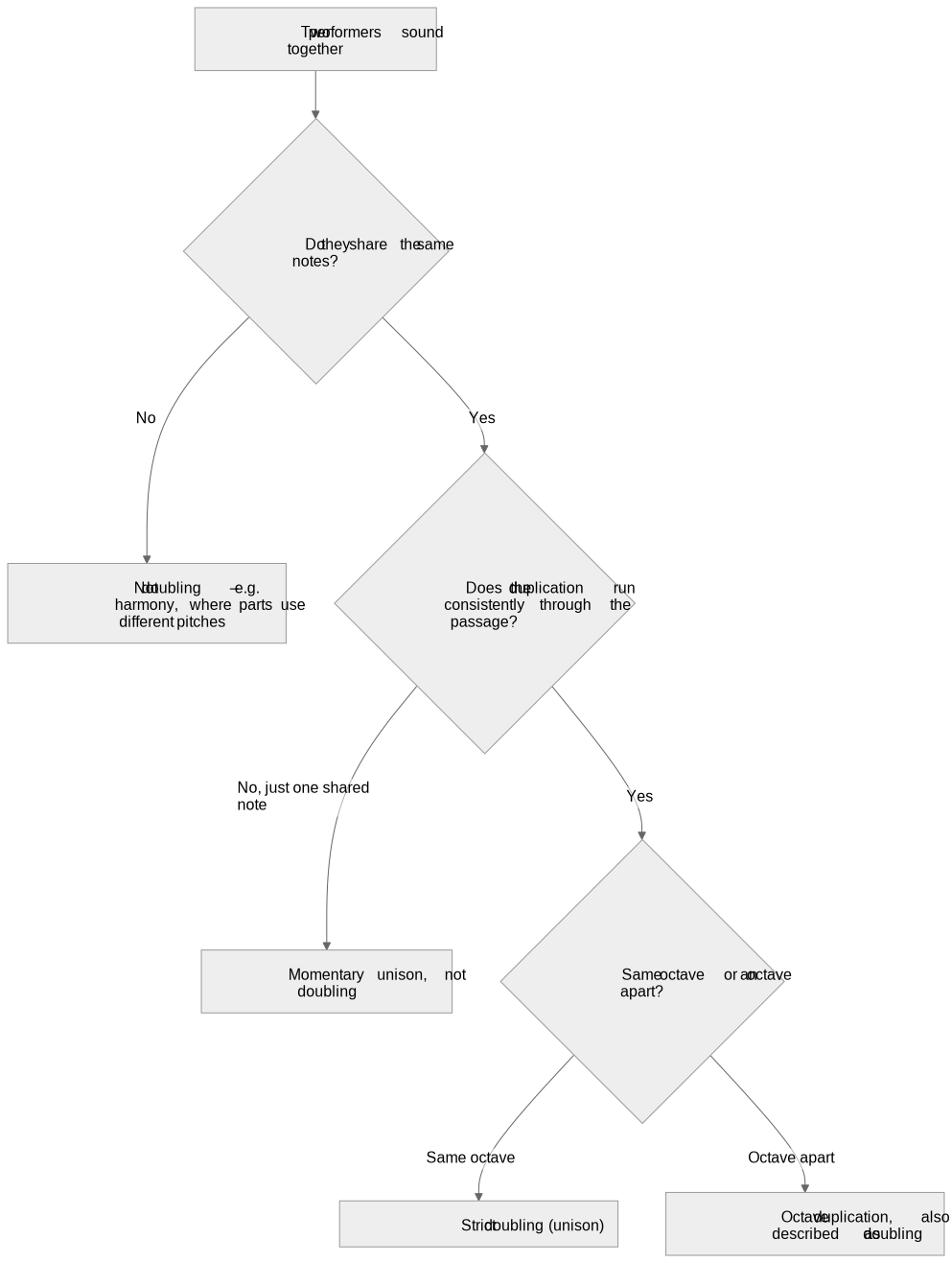
Doubling describes two performers producing the same musical line at once. The strict definition is that one performer consistently plays or sings the same notes as another at the same octave, so the two parts move in unison and sound as one line. In practice, duplication at the octave is also called doubling: a flute and a violin sharing a melody an octave apart, or a tenor and a soprano singing the same tune in different octaves. The key ideas are consistency (the duplication runs through the passage, not a single shared note) and pitch relationship (same pitch, or the same pitch class displaced by an octave). To identify doubling, compare the two parts bar by bar: if they trace the same contour and rhythm with matching note names, they are doubled. Distinguish this from harmony, where parts move in different intervals, and from momentary unison on one note.
What earns the marks
- Defines doubling as one performer consistently playing or singing the same notes as another.
- States that the strict form is duplication at the same octave (unison).
- Recognises that duplication at the octave is also described as doubling.
- Emphasises consistency across a passage rather than a single shared note.
- Distinguishes doubling from harmony or from a one-off unison note.
Common mistakes and how to put them right
Treating any two instruments playing together as doubling.
Put it right: Doubling requires them to share the same notes, not merely sound simultaneously.
Assuming doubling must always be exactly the same octave.
Put it right: Octave duplication is also accepted as doubling.
Calling a single shared note doubling.
Put it right: The duplication must be consistent through the passage.
Confusing doubling with harmonisation.
Put it right: Harmony uses different pitches, doubling repeats the same line.
Exam tips
- Compare the two parts bar by bar, checking note names and contour before deciding.
- Note whether the shared line is at the same octave or an octave apart, and say which.
- Check the duplication lasts through the passage, not just one chord.
Try the lesson
The start of the Appendix 3: Musical vocabulary - Dynamics and performance matters: Doubling occurs where one performer consistently plays or sings the same notes as another – strictly speaking at the same octave, but duplication at the octave may be involved lesson, made from teaching notes for this specification point.
Have a go first
In a choir, the soprano and alto sections often sing the same melodic line but an octave apart. Which term best describes this texture?
Listen
Doubling describes two performers producing the same musical line at once. The strict definition is that one performer consistently plays or sings the same notes as another at the same octave, so the two parts move in unison and sound as one line. In practice, duplication at the octave is also called doubling: a flute and a violin sharing a melody an octave apart, or a tenor and a soprano singing the same tune in different octaves. The key ideas are consistency (the duplication runs through the passage, not a single shared note) and pitch relationship (same pitch, or the same pitch class displaced by an octave). To identify doubling, compare the two parts bar by bar: if they trace the same contour and rhythm with matching note names, they are doubled. Distinguish this from harmony, where parts move in different intervals, and from momentary unison on one note. A strong answer earns marks for these points. Defines doubling as one performer consistently playing or singing the same notes as another. States that the strict form is duplication at the same octave (unison). Recognises that duplication at the octave is also described as doubling. Emphasises consistency across a passage rather than a single shared note. A common slip: Treating any two instruments playing together as doubling. Instead, doubling requires them to share the same notes, not merely sound simultaneously. Exam tip: Compare the two parts bar by bar, checking note names and contour before deciding.
See it
Key words
Say what each word means before you turn the card.
Doubling
Try answering aloud or in your head before turning the card.
Unison and octave relationships
Try answering aloud or in your head before turning the card.
Consistency of a shared line
Try answering aloud or in your head before turning the card.
Distinguishing doubling from harmony
Try answering aloud or in your head before turning the card.
See every definition
- Doubling
- One performer consistently plays or sings the same notes as another, strictly speaking at the same octave, though duplication at the octave may be involved.
- Unison and octave relationships
- The two parts move in unison and sound as one line, or the same pitch class is displaced by an octave.
- Consistency of a shared line
- The duplication runs through the passage rather than being a single shared note.
- Distinguishing doubling from harmony
- Harmony uses parts moving in different intervals, whereas doubling repeats the same line, and momentary unison on one note is not doubling.
There is more to this lesson
The full lesson goes on to check your understanding and help you earn the marks. Create a free account to carry on, with your progress saved.
A week of Premium from your first lesson · Then the free plan continues · No card, no charge
Test your understanding of Appendix 3: Musical vocabulary - Dynamics and performance matters: Doubling occurs where one performer consistently plays or sings the same notes as another – strictly speaking at the same octave, but duplication at the octave may be involved
Active recall beats re-reading. Take an instant quiz now to test what you’ve learned and lock it into long-term memory.
A week of Premium from your first lesson · Then the free plan continues · No card, no charge