Pearson Edexcel · GCSE · Music
Course version: 1MU0 · Version from Sept 2016
Musical vocabulary - Dynamics and performance matters: Where the string(s)…
Full specification wording
Appendix 3: Musical vocabulary - Dynamics and performance matters: Where the string(s) of a stringed instrument are plucked rather than bowed. The direction ‘pizzicato’ in the score is cancelled by ‘arco’, meaning ‘[with] the bow’
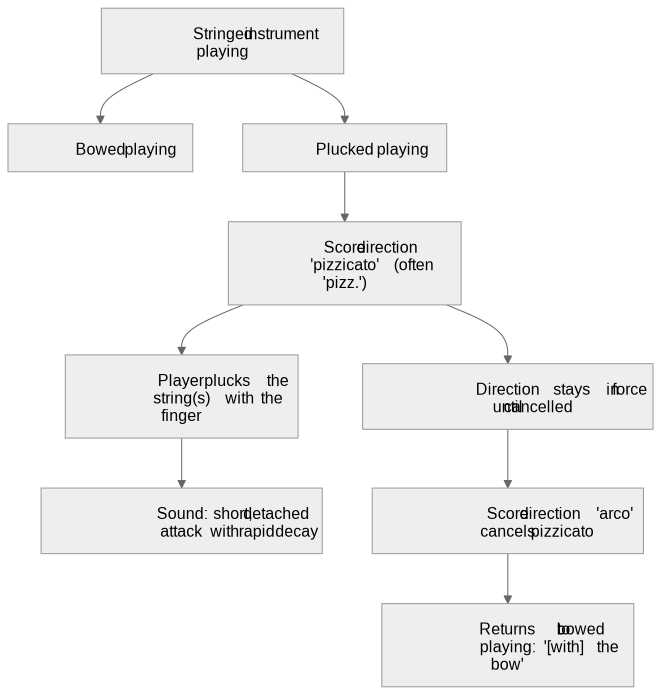
Pizzicato is a performance direction telling a string player to pluck the string with the finger rather than draw the bow across it.
- Point 18 of 25
- 4 key terms
Study notes
From the teaching notes for this specification point.
The idea
Pizzicato is a performance direction telling a string player to pluck the string with the finger rather than draw the bow across it. It appears in the score as the word 'pizzicato' (often abbreviated 'pizz.') above or below the staff, and it changes the sound from a sustained, singing tone to a short, percussive attack with quick decay. The direction stays in force until it is cancelled. The cancelling direction is 'arco', meaning '[with] the bow', which returns the player to normal bowed playing. So the pair works as a switch: 'pizzicato' turns plucking on, 'arco' turns it off. In a listening question, identify the plucked articulation by its detached, dry attack and lack of sustained resonance, and link it to the score direction that caused it.
What earns the marks
- Identifies pizzicato as plucking the string(s) with the finger rather than bowing.
- Recognises that the score direction 'pizzicato' (often 'pizz.') instructs the player to pluck.
- States that 'arco' cancels pizzicato and means '[with] the bow'.
- Describes the resulting sound: short, detached attack with rapid decay rather than sustained bowed tone.
- Locates the direction in the score as a performance instruction applying to the string part until cancelled.
Common mistakes and how to put them right
Confusing pizzicato with a dynamic marking.
Put it right by stressing it is an articulation/performance direction about how the string is sounded, not how loud.
Believing 'arco' means pluck harder or mute the string.
Put it right by stating arco means '[with] the bow' and restores bowed playing.
Assuming pizzicato applies only to one note and then stops automatically.
Put it right by explaining it continues until 'arco' cancels it.
Exam tips
- Link the heard articulation (short, dry attack) directly to the score direction that produces it.
- Quote the exact terms 'pizzicato' and 'arco' and give the meaning of each.
- If asked which direction cancels pizzicato, answer 'arco' and add '[with] the bow' to secure the mark.
Try the lesson
The start of the Appendix 3: Musical vocabulary - Dynamics and performance matters: Where the string(s) of a stringed instrument are plucked rather than bowed. The direction ‘pizzicato’ in the score is cancelled by ‘arco’, meaning ‘[with] the bow’ lesson, made from teaching notes for this specification point.
Have a go first
Which of the following statements about 'pizzicato' and 'arco' is correct?
Listen
Pizzicato is a performance direction telling a string player to pluck the string with the finger rather than draw the bow across it. It appears in the score as the word 'pizzicato' (often abbreviated 'pizz.') above or below the staff, and it changes the sound from a sustained, singing tone to a short, percussive attack with quick decay. The direction stays in force until it is cancelled. The cancelling direction is 'arco', meaning '[with] the bow', which returns the player to normal bowed playing. So the pair works as a switch: 'pizzicato' turns plucking on, 'arco' turns it off. In a listening question, identify the plucked articulation by its detached, dry attack and lack of sustained resonance, and link it to the score direction that caused it. A strong answer earns marks for these points. Identifies pizzicato as plucking the string(s) with the finger rather than bowing. Recognises that the score direction 'pizzicato' (often 'pizz.') instructs the player to pluck. States that 'arco' cancels pizzicato and means '[with] the bow'. Describes the resulting sound: short, detached attack with rapid decay rather than sustained bowed tone. A common slip: Confusing pizzicato with a dynamic marking. Instead, stressing it is an articulation/performance direction about how the string is sounded, not how loud. Exam tip: Link the heard articulation (short, dry attack) directly to the score direction that produces it.
See it
Key words
Say what each word means before you turn the card.
Performance directions
Try answering aloud or in your head before turning the card.
String articulation
Try answering aloud or in your head before turning the card.
Plucked versus bowed tone
Try answering aloud or in your head before turning the card.
Score reading and cancellation of directions
Try answering aloud or in your head before turning the card.
See every definition
- Performance directions
- Instructions in the score, such as 'pizzicato' and 'arco', that tell the player how the music is to be performed.
- String articulation
- How the string is sounded, for example plucked rather than bowed, giving a short, detached attack with rapid decay.
- Plucked versus bowed tone
- Plucking gives a short, percussive attack with quick decay, while bowing gives a sustained, singing tone.
- Score reading and cancellation of directions
- A direction in the score stays in force until it is cancelled, as 'arco' cancels 'pizzicato' and means '[with] the bow'.
Label the diagram
Some boxes have lost their names. Pick the right name for each number.
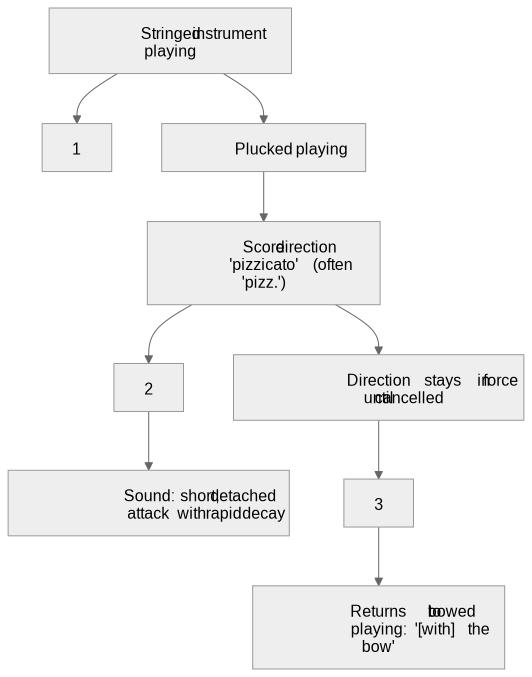
1Box 1
2Box 2
3Box 3
There is more to this lesson
The full lesson goes on to check your understanding and help you earn the marks. Create a free account to carry on, with your progress saved.
A week of Premium from your first lesson · Then the free plan continues · No card, no charge
Test your understanding of Appendix 3: Musical vocabulary - Dynamics and performance matters: Where the string(s) of a stringed instrument are plucked rather than bowed. The direction ‘pizzicato’ in the score is cancelled by ‘arco’, meaning ‘[with] the bow’
Active recall beats re-reading. Take an instant quiz now to test what you’ve learned and lock it into long-term memory.
A week of Premium from your first lesson · Then the free plan continues · No card, no charge