Pearson Edexcel · GCSE · Music
Course version: 1MU0 · Version from Sept 2016
Musical vocabulary - Dynamics and performance matters: The correct…
Full specification wording
Appendix 3: Musical vocabulary - Dynamics and performance matters: The correct observance of divisions between whole phrases and sometimes shorter groups of notes (often to accord with a composer’s phrase markings)
This vocabulary item concerns articulation at the level of phrasing.
- Point 17 of 25
- 4 key terms
Study notes
From the teaching notes for this specification point.
The idea
This vocabulary item concerns articulation at the level of phrasing. A performer must shape the music so that the boundary between one complete phrase and the next is clear, and sometimes also the smaller groupings of notes inside a phrase. The aim is a sense of breathing and structure rather than a continuous unbroken stream of sound. Composers often show these divisions with phrase marks, slurs or breath marks, and the performer follows them. In practice this means slight lifts, changes of bow or breath, or subtle shaping of dynamics and timing at the joins. When answering, connect the term to clear phrase boundaries, smaller note groups, and respect for the composer's markings.
What earns the marks
- Refers to the clear separation between whole phrases in performance.
- Recognises that shorter groups of notes within a phrase may also be divided.
- Links the observance to following a composer's phrase markings.
- Describes the effect as shaping and clarifying musical structure rather than playing continuously.
Common mistakes and how to put them right
Confusing phrasing with articulation of single notes.
Put it right by focusing on whole phrases and note groups, not individual note attacks.
Ignoring composer's markings: correct this by noting phrase marks and slurs guide where divisions fall.
Assuming divisions mean long pauses.
Put it right by explaining they are subtle shaping points that clarify structure.
Exam tips
- Check whether the question concerns whole phrases, smaller note groups, or both.
- Look for options that mention the composer's phrase markings as a guide.
- Reject answers that describe continuous unbroken playing, since the term is about clear divisions.
Try the lesson
The start of the Appendix 3: Musical vocabulary - Dynamics and performance matters: The correct observance of divisions between whole phrases and sometimes shorter groups of notes (often to accord with a composer’s phrase markings) lesson, made from teaching notes for this specification point.
Have a go first
In music, what is the main purpose of observing the divisions between phrases and smaller groups of notes?
Listen
This vocabulary item concerns articulation at the level of phrasing. A performer must shape the music so that the boundary between one complete phrase and the next is clear, and sometimes also the smaller groupings of notes inside a phrase. The aim is a sense of breathing and structure rather than a continuous unbroken stream of sound. Composers often show these divisions with phrase marks, slurs or breath marks, and the performer follows them. In practice this means slight lifts, changes of bow or breath, or subtle shaping of dynamics and timing at the joins. When answering, connect the term to clear phrase boundaries, smaller note groups, and respect for the composer's markings. A strong answer earns marks for these points. Refers to the clear separation between whole phrases in performance. Recognises that shorter groups of notes within a phrase may also be divided. Links the observance to following a composer's phrase markings. Describes the effect as shaping and clarifying musical structure rather than playing continuously. A common slip: Confusing phrasing with articulation of single notes. Instead, focusing on whole phrases and note groups, not individual note attacks. Exam tip: Check whether the question concerns whole phrases, smaller note groups, or both.
See it
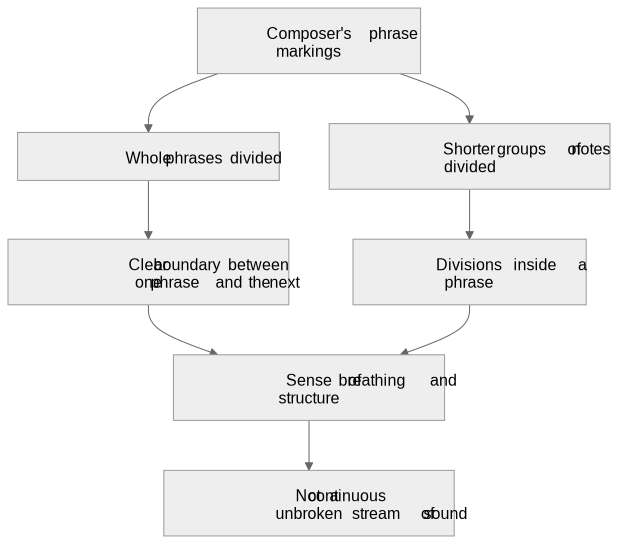
Key words
Say what each word means before you turn the card.
Phrasing and articulation
Try answering aloud or in your head before turning the card.
Musical structure in performance
Try answering aloud or in your head before turning the card.
Interpretation of composer's markings
Try answering aloud or in your head before turning the card.
Expressive shaping
Try answering aloud or in your head before turning the card.
See every definition
- Phrasing and articulation
- The correct observance of divisions between whole phrases and sometimes shorter groups of notes, often to accord with a composer's phrase markings.
- Musical structure in performance
- Shaping and clarifying musical structure rather than playing continuously, giving a sense of breathing and structure rather than a continuous unbroken stream of sound.
- Interpretation of composer's markings
- Following the divisions composers often show with phrase marks, slurs or breath marks.
- Expressive shaping
- Slight lifts, changes of bow or breath, or subtle shaping of dynamics and timing at the joins.
Label the diagram
Some boxes have lost their names. Pick the right name for each number.
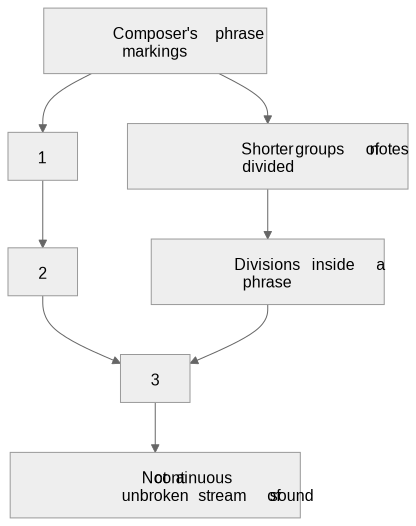
1Box 1
2Box 2
3Box 3
There is more to this lesson
The full lesson goes on to check your understanding and help you earn the marks. Create a free account to carry on, with your progress saved.
A week of Premium from your first lesson · Then the free plan continues · No card, no charge
Test your understanding of Appendix 3: Musical vocabulary - Dynamics and performance matters: The correct observance of divisions between whole phrases and sometimes shorter groups of notes (often to accord with a composer’s phrase markings)
Active recall beats re-reading. Take an instant quiz now to test what you’ve learned and lock it into long-term memory.
A week of Premium from your first lesson · Then the free plan continues · No card, no charge