Pearson Edexcel · GCSE · Music
Course version: 1MU0 · Version from Sept 2016
Musical vocabulary - Dynamics and performance matters: Where two (or more)…
Full specification wording
Appendix 3: Musical vocabulary - Dynamics and performance matters: Where two (or more) notes are played together on an orchestral string instrument (two or more strings being ‘stopped’ simultaneously).
This term describes multiple notes sounded together on an orchestral string instrument by stopping two or more strings at once.
- Point 7 of 25
- 4 key terms
Study notes
From the teaching notes for this specification point.
The idea
This term describes multiple notes sounded together on an orchestral string instrument by stopping two or more strings at once. On violin, viola, cello or double bass the player presses fingers on more than one string and draws the bow across them so the stopped strings sound simultaneously, producing a chord or double stop. The essential features are: an orchestral string instrument, two or more strings stopped at the same time, and the notes heard together. A single stopped string gives one pitch; stopping two or more strings lets the player sound a chord. To recognise it, listen for two or more sustained pitches from one string instrument and check that the player's fingers are holding more than one string. Distinguish this from separate notes played one after another on one string, and from several instruments each playing one note.
What earns the marks
- Identifies the technique as playing two or more notes together on an orchestral string instrument.
- Specifies that two or more strings are stopped simultaneously.
- Links the technique to producing a chord or double stop on violin, viola, cello or double bass.
- Distinguishes it from single-string playing or from several instruments each sounding one note.
Common mistakes and how to put them right
Describing a single note played on one string.
Put it right: The technique needs two or more strings stopped at once.
Confusing it with several instruments each playing one note.
Put it right: Here one instrument sounds the notes together.
Assuming any chord counts.
Put it right: The notes must come from stopped strings of one orchestral string instrument.
Thinking the strings are open rather than stopped.
Put it right: The player stops two or more strings with the fingers.
Exam tips
- Listen for two or more pitches sounding together from a single string instrument.
- Check that more than one string is being stopped at the same time.
- Contrast the sound with a single melodic line on one string.
Try the lesson
The start of the Appendix 3: Musical vocabulary - Dynamics and performance matters: Where two (or more) notes are played together on an orchestral string instrument (two or more strings being ‘stopped’ simultaneously). lesson, made from teaching notes for this specification point.
Listen
This term describes multiple notes sounded together on an orchestral string instrument by stopping two or more strings at once. On violin, viola, cello or double bass the player presses fingers on more than one string and draws the bow across them so the stopped strings sound simultaneously, producing a chord or double stop. The essential features are: an orchestral string instrument, two or more strings stopped at the same time, and the notes heard together. A single stopped string gives one pitch; stopping two or more strings lets the player sound a chord. To recognise it, listen for two or more sustained pitches from one string instrument and check that the player's fingers are holding more than one string. Distinguish this from separate notes played one after another on one string, and from several instruments each playing one note. A strong answer earns marks for these points. Identifies the technique as playing two or more notes together on an orchestral string instrument. Specifies that two or more strings are stopped simultaneously. Links the technique to producing a chord or double stop on violin, viola, cello or double bass. Distinguishes it from single-string playing or from several instruments each sounding one note. A common slip: Describing a single note played on one string. Instead, the technique needs two or more strings stopped at once. Exam tip: Listen for two or more pitches sounding together from a single string instrument.
See it
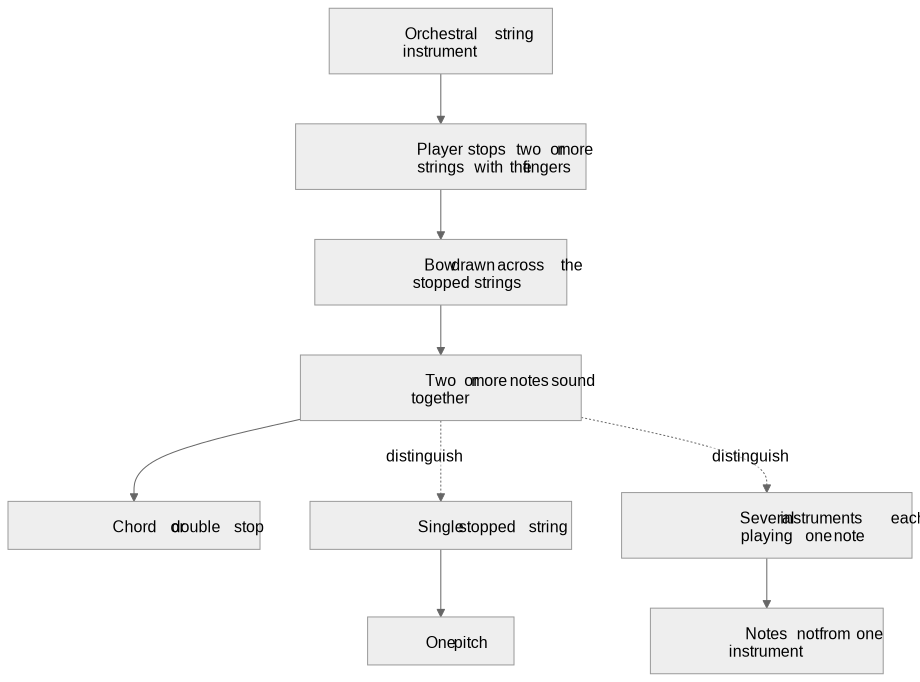
Key words
Say what each word means before you turn the card.
String playing techniques
Try answering aloud or in your head before turning the card.
Chords and double stops
Try answering aloud or in your head before turning the card.
Stopping strings simultaneously
Try answering aloud or in your head before turning the card.
Texture and performing forces
Try answering aloud or in your head before turning the card.
See every definition
- String playing techniques
- Playing two or more notes together on an orchestral string instrument, with two or more strings being stopped simultaneously.
- Chords and double stops
- A chord or double stop is produced when the player presses fingers on more than one string and draws the bow across them so the stopped strings sound simultaneously.
- Stopping strings simultaneously
- The player stops two or more strings with the fingers at the same time, letting the notes be heard together.
- Texture and performing forces
- One instrument sounds two or more sustained pitches together, rather than separate notes played one after another on one string or several instruments each playing one note.
Label the diagram
Some boxes have lost their names. Pick the right name for each number.
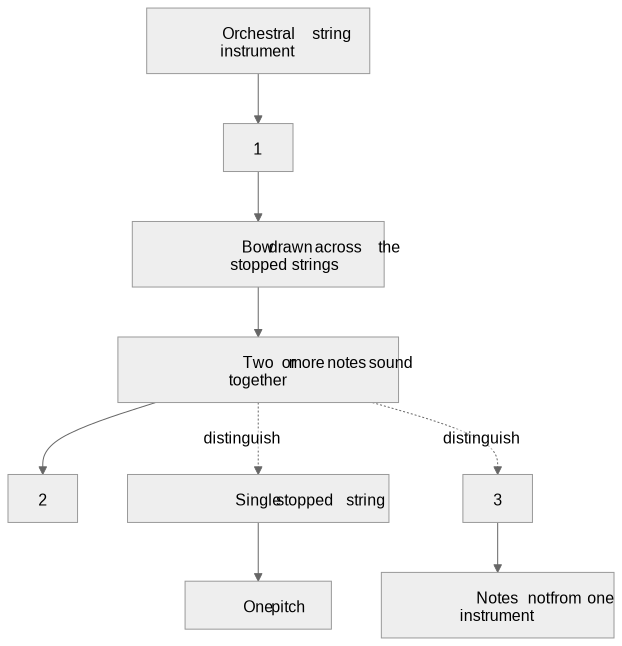
1Box 1
2Box 2
3Box 3
There is more to this lesson
The full lesson goes on to check your understanding and help you earn the marks. Create a free account to carry on, with your progress saved.
A week of Premium from your first lesson · Then the free plan continues · No card, no charge
Test your understanding of Appendix 3: Musical vocabulary - Dynamics and performance matters: Where two (or more) notes are played together on an orchestral string instrument (two or more strings being ‘stopped’ simultaneously).
Active recall beats re-reading. Take an instant quiz now to test what you’ve learned and lock it into long-term memory.
A week of Premium from your first lesson · Then the free plan continues · No card, no charge