Pearson Edexcel · GCSE · Music
Course version: 1MU0 · Version from Sept 2016
Musical vocabulary - Organisation of pitch: A series of chords, usually…
Full specification wording
Appendix 3: Musical vocabulary - Organisation of pitch: A series of chords, usually repeated (e.g. in a 12-bar blues)
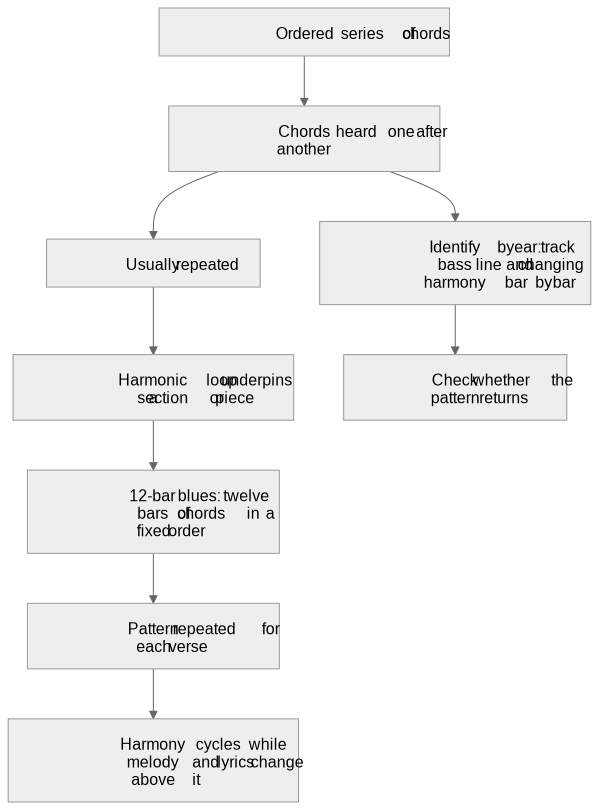
A chord sequence is an ordered series of chords heard one after another, and in many styles the same series is repeated as a loop that underpins a whole section or piece.
- Point 9 of 27
- 2 key terms
Study notes
From the teaching notes for this specification point.
The idea
A chord sequence is an ordered series of chords heard one after another, and in many styles the same series is repeated as a loop that underpins a whole section or piece. The 12-bar blues is the classic example: twelve bars of chords in a fixed order, repeated for each verse, so the harmony cycles while melody and lyrics change above it. To identify a chord sequence by ear, track the bass line and the changing harmony bar by bar, then check whether the pattern returns. Naming it means describing the chords in order and stating whether the series repeats, not just labelling one chord.
What earns the marks
- Identifies a chord sequence as an ordered series of chords, not a single chord or a melody.
- Recognises that the series is usually repeated, forming a harmonic loop.
- Cites the 12-bar blues as an example where a twelve-bar chord pattern repeats.
- Describes how the pattern can be heard by tracking bass movement and harmonic change bar by bar.
- Distinguishes a repeated chord sequence from a repeated melody or repeated rhythm.
Common mistakes and how to put them right
Confusing a chord sequence with a single chord.
Put it right by explaining that a sequence is several chords in order.
Assuming the sequence must always repeat.
Put it right by noting repetition is usual but not compulsory.
Treating the 12-bar blues as twelve different chords.
Put it right by explaining it is a repeating pattern of a small set of chords across twelve bars.
Exam tips
- Listen for the bass line first, since it usually outlines each chord's root.
- Count bars to check whether the harmonic pattern returns at the same point.
- When answering, name the chords in order and state whether the series repeats.
Try the lesson
The start of the Appendix 3: Musical vocabulary - Organisation of pitch: A series of chords, usually repeated (e.g. in a 12-bar blues) lesson, made from teaching notes for this specification point.
Have a go first
What term describes a series of chords, usually repeated, that forms the harmonic framework of a piece such as a 12-bar blues?
Listen
A chord sequence is an ordered series of chords heard one after another, and in many styles the same series is repeated as a loop that underpins a whole section or piece. The 12-bar blues is the classic example: twelve bars of chords in a fixed order, repeated for each verse, so the harmony cycles while melody and lyrics change above it. To identify a chord sequence by ear, track the bass line and the changing harmony bar by bar, then check whether the pattern returns. Naming it means describing the chords in order and stating whether the series repeats, not just labelling one chord. A strong answer earns marks for these points. Identifies a chord sequence as an ordered series of chords, not a single chord or a melody. Recognises that the series is usually repeated, forming a harmonic loop. Cites the 12-bar blues as an example where a twelve-bar chord pattern repeats. Describes how the pattern can be heard by tracking bass movement and harmonic change bar by bar. A common slip: Confusing a chord sequence with a single chord. Instead, explaining that a sequence is several chords in order. Exam tip: Listen for the bass line first, since it usually outlines each chord's root.
See it
Key words
Say what each word means before you turn the card.
Chord sequences
Try answering aloud or in your head before turning the card.
12-bar blues
Try answering aloud or in your head before turning the card.
See every definition
- Chord sequences
- An ordered series of chords heard one after another, which in many styles is repeated as a loop that underpins a whole section or piece.
- 12-bar blues
- Twelve bars of chords in a fixed order, repeated for each verse, so the harmony cycles while melody and lyrics change above it.
Label the diagram
Some boxes have lost their names. Pick the right name for each number.
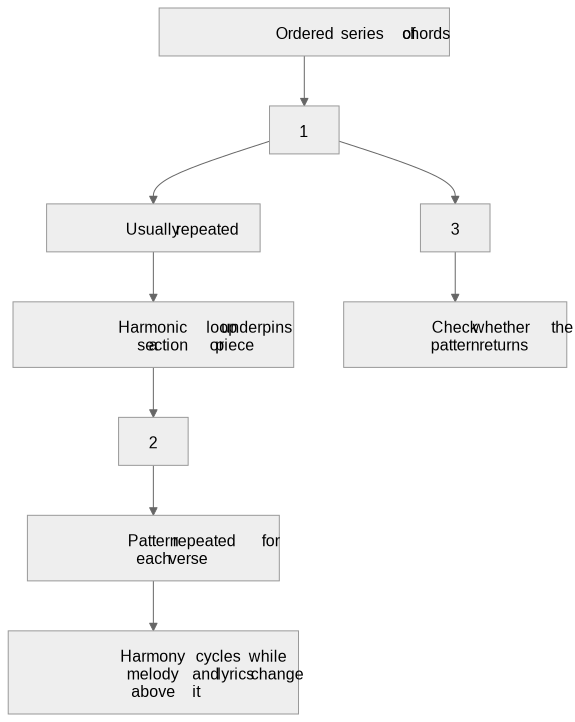
1Box 1
2Box 2
3Box 3
There is more to this lesson
The full lesson goes on to check your understanding and help you earn the marks. Create a free account to carry on, with your progress saved.
A week of Premium from your first lesson · Then the free plan continues · No card, no charge
Test your understanding of Appendix 3: Musical vocabulary - Organisation of pitch: A series of chords, usually repeated (e.g. in a 12-bar blues)
Active recall beats re-reading. Take an instant quiz now to test what you’ve learned and lock it into long-term memory.
A week of Premium from your first lesson · Then the free plan continues · No card, no charge