Pearson Edexcel · GCSE · Music
Course version: 1MU0 · Version from Sept 2016
Musical vocabulary - Organisation of pitch: In traditional harmony a…
Full specification wording
Appendix 3: Musical vocabulary - Organisation of pitch: In traditional harmony a dissonance is a note that does not belong to a common chord or triad – strict rules usually govern its approach and its resolution back to a non-dissonant note (i.e. a ‘consonance’)
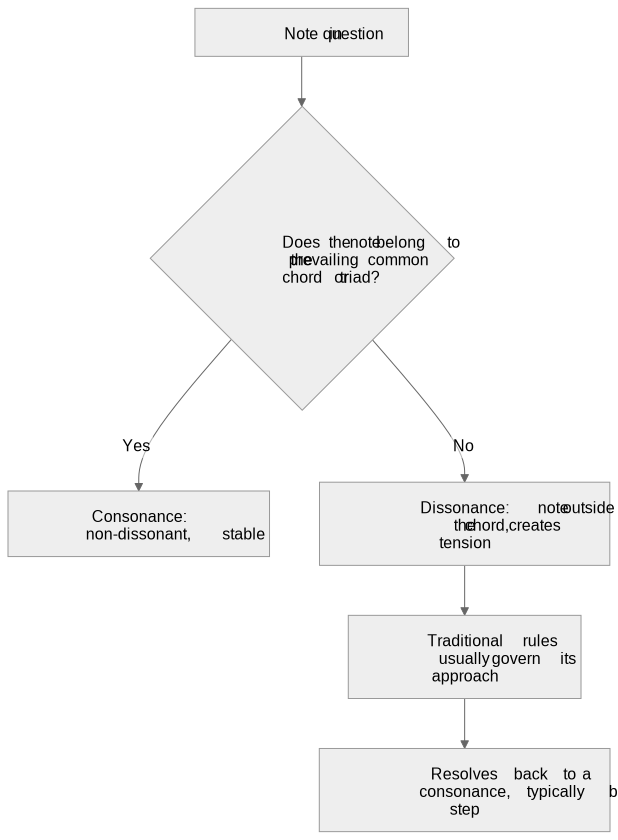
In traditional harmony, a consonance is a note that belongs to the prevailing common chord or triad and sounds stable; a dissonance is a note outside that chord, creating tension.
- Point 8 of 27
- 4 key terms
Study notes
From the teaching notes for this specification point.
The idea
In traditional harmony, a consonance is a note that belongs to the prevailing common chord or triad and sounds stable; a dissonance is a note outside that chord, creating tension. Traditional practice usually governs how a dissonance is approached (for example by step) and how it resolves, normally moving by step back to a consonance within the chord. For instance, in C major a held F over a C major triad clashes and typically resolves down to E. To answer, check whether the note belongs to the stated chord: if it does, it is consonant; if not, it is dissonant and will usually be resolved.
What earns the marks
- Defines a dissonance as a note that does not belong to the prevailing common chord or triad.
- Defines a consonance as a note that belongs to the chord and is non-dissonant.
- Explains that traditional harmony usually applies rules governing the approach of a dissonance.
- Explains that the dissonance is expected to resolve back to a consonance, typically by step.
- Applies the distinction to a short harmonic example by checking membership of the stated chord.
Common mistakes and how to put them right
Treating any loud or harsh-sounding chord as a dissonance.
Put it right: Dissonance is defined by a note not belonging to the prevailing chord, not by volume or timbre.
Assuming a dissonance can resolve to any note at random.
Put it right: Traditional practice usually governs its resolution back to a consonance, often by step.
Confusing dissonance with disjunct melody.
Put it right: Dissonance concerns harmonic membership of a chord, while disjunct concerns melodic leaps.
Exam tips
- Test membership: list the notes of the stated triad, then see whether the note in question is included.
- Remember the pairing of approach and resolution when describing a dissonance.
- Use the words consonance and dissonance precisely, linking each to chord membership.
Try the lesson
The start of the Appendix 3: Musical vocabulary - Organisation of pitch: In traditional harmony a dissonance is a note that does not belong to a common chord or triad – strict rules usually govern its approach and its resolution back to a non-dissonant note (i.e. a ‘consonance’) lesson, made from teaching notes for this specification point.
Have a go first
In traditional diatonic harmony, which statement accurately defines a dissonance?
Listen
In traditional harmony, a consonance is a note that belongs to the prevailing common chord or triad and sounds stable; a dissonance is a note outside that chord, creating tension. Traditional practice usually governs how a dissonance is approached (for example by step) and how it resolves, normally moving by step back to a consonance within the chord. For instance, in C major a held F over a C major triad clashes and typically resolves down to E. To answer, check whether the note belongs to the stated chord: if it does, it is consonant; if not, it is dissonant and will usually be resolved. A strong answer earns marks for these points. Defines a dissonance as a note that does not belong to the prevailing common chord or triad. Defines a consonance as a note that belongs to the chord and is non-dissonant. Explains that traditional harmony usually applies rules governing the approach of a dissonance. Explains that the dissonance is expected to resolve back to a consonance, typically by step. A common slip: Treating any loud or harsh-sounding chord as a dissonance. Instead, dissonance is defined by a note not belonging to the prevailing chord, not by volume or timbre. Exam tip: Test membership: list the notes of the stated triad, then see whether the note in question is included.
See it
Key words
Say what each word means before you turn the card.
Traditional harmony
Try answering aloud or in your head before turning the card.
Chord and triad membership
Try answering aloud or in your head before turning the card.
Consonance and dissonance
Try answering aloud or in your head before turning the card.
Approach and resolution of dissonance
Try answering aloud or in your head before turning the card.
See every definition
- Traditional harmony
- A style in which strict rules usually govern the approach and resolution of a dissonance back to a non-dissonant note.
- Chord and triad membership
- Whether a note belongs to a common chord or triad, which decides if it is a dissonance or a consonance.
- Consonance and dissonance
- A dissonance is a note that does not belong to a common chord or triad, while a consonance is a non-dissonant note.
- Approach and resolution of dissonance
- Strict rules usually govern how a dissonance is approached and its resolution back to a non-dissonant note.
There is more to this lesson
The full lesson goes on to check your understanding and help you earn the marks. Create a free account to carry on, with your progress saved.
A week of Premium from your first lesson · Then the free plan continues · No card, no charge
Test your understanding of Appendix 3: Musical vocabulary - Organisation of pitch: In traditional harmony a dissonance is a note that does not belong to a common chord or triad – strict rules usually govern its approach and its resolution back to a non-dissonant note (i.e. a ‘consonance’)
Active recall beats re-reading. Take an instant quiz now to test what you’ve learned and lock it into long-term memory.
A week of Premium from your first lesson · Then the free plan continues · No card, no charge