Pearson Edexcel · GCSE · Music
Course version: 1MU0 · Version from Sept 2016
Musical vocabulary - Organisation of pitch: A succession of pitches in…
Full specification wording
Appendix 3: Musical vocabulary - Organisation of pitch: A succession of pitches in stepwise order usually extending for an octave (e.g. C D E F G A B C is a (major) scale)
A scale is a succession of pitches moving mainly by step, and it usually spans an octave from a starting note back to the same letter name.
- Point 24 of 27
- 4 key terms
Study notes
From the teaching notes for this specification point.
The idea
A scale is a succession of pitches moving mainly by step, and it usually spans an octave from a starting note back to the same letter name. In the example, C D E F G A B C moves stepwise through seven different letter names and returns to C an octave higher, giving eight written notes that cover one octave. The pattern of whole and half steps between successive degrees gives each scale its character; the major scale follows the familiar arrangement of tones and semitones that produces its bright, stable sound. To recognise or write a scale, start on the named tonic, move up or down by step, keep each letter name in order without skipping, and finish on the octave. Check the interval pattern to confirm whether the scale is major or another type.
What earns the marks
- A scale is a succession of pitches arranged in stepwise order rather than by leaps.
- A scale usually extends across an octave, returning to the same letter name at the upper or lower octave.
- The example C D E F G A B C contains seven distinct letter names and completes one octave.
- The pattern of tones and semitones between the degrees determines the type of scale, such as major.
- To construct a scale, begin on the tonic, proceed by step through each letter name in order and finish on the octave.
Common mistakes and how to put them right
Treating a scale as any group of notes.
Put it right by requiring stepwise movement through successive letter names.
Skipping or repeating a letter name within one octave.
Put it right by keeping the letters in alphabetical order from tonic to octave.
Ignoring the tone and semitone pattern.
Put it right by checking the interval structure to confirm the scale type.
Exam tips
- Write out the letter names in order from tonic to octave before deciding on the scale type.
- Check the position of semitones, since they define the character of a major scale.
- When identifying a scale, confirm both the stepwise motion and the octave span.
Try the lesson
The start of the Appendix 3: Musical vocabulary - Organisation of pitch: A succession of pitches in stepwise order usually extending for an octave (e.g. C D E F G A B C is a (major) scale) lesson, made from teaching notes for this specification point.
Have a go first
Which of the following best defines a scale in music?
Listen
A scale is a succession of pitches moving mainly by step, and it usually spans an octave from a starting note back to the same letter name. In the example, C D E F G A B C moves stepwise through seven different letter names and returns to C an octave higher, giving eight written notes that cover one octave. The pattern of whole and half steps between successive degrees gives each scale its character; the major scale follows the familiar arrangement of tones and semitones that produces its bright, stable sound. To recognise or write a scale, start on the named tonic, move up or down by step, keep each letter name in order without skipping, and finish on the octave. Check the interval pattern to confirm whether the scale is major or another type. A strong answer earns marks for these points. A scale is a succession of pitches arranged in stepwise order rather than by leaps. A scale usually extends across an octave, returning to the same letter name at the upper or lower octave. The example C D E F G A B C contains seven distinct letter names and completes one octave. The pattern of tones and semitones between the degrees determines the type of scale, such as major. A common slip: Treating a scale as any group of notes. Instead, requiring stepwise movement through successive letter names. Exam tip: Write out the letter names in order from tonic to octave before deciding on the scale type.
See it
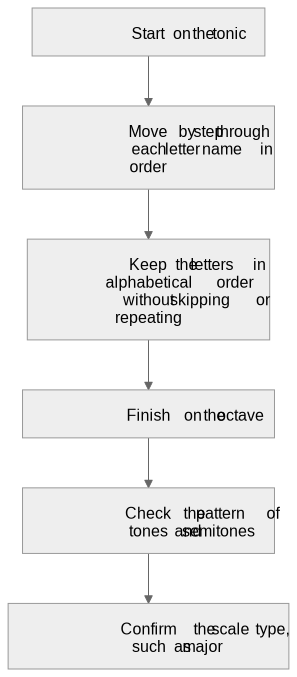
Put it in order
Put these steps in the order they happen.
- 1. Keep the letters in alphabetical order without skipping or repeating
- 2. Move by step through each letter name in order
- 3. Start on the tonic
- 4. Confirm the scale type, such as major
- 5. Check the pattern of tones and semitones
- 6. Finish on the octave
Key words
Say what each word means before you turn the card.
Stepwise pitch succession
Try answering aloud or in your head before turning the card.
Octave span and letter names
Try answering aloud or in your head before turning the card.
Tone and semitone patterns
Try answering aloud or in your head before turning the card.
Major scale structure
Try answering aloud or in your head before turning the card.
See every definition
- Stepwise pitch succession
- A succession of pitches arranged in stepwise order rather than by leaps, moving through successive letter names.
- Octave span and letter names
- A scale usually extends across an octave, returning to the same letter name at the upper or lower octave, with seven distinct letter names in the example.
- Tone and semitone patterns
- The pattern of whole and half steps between successive degrees determines the type of scale, such as major.
- Major scale structure
- The major scale follows the familiar arrangement of tones and semitones that produces its bright, stable sound.
Label the diagram
Some boxes have lost their names. Pick the right name for each number.
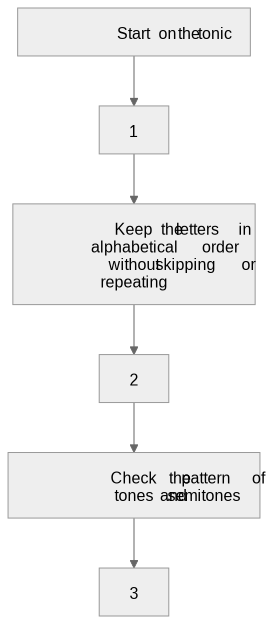
1Box 1
2Box 2
3Box 3
There is more to this lesson
The full lesson goes on to check your understanding and help you earn the marks. Create a free account to carry on, with your progress saved.
A week of Premium from your first lesson · Then the free plan continues · No card, no charge
Test your understanding of Appendix 3: Musical vocabulary - Organisation of pitch: A succession of pitches in stepwise order usually extending for an octave (e.g. C D E F G A B C is a (major) scale)
Active recall beats re-reading. Take an instant quiz now to test what you’ve learned and lock it into long-term memory.
A week of Premium from your first lesson · Then the free plan continues · No card, no charge