Pearson Edexcel · GCSE · Music
Course version: 1MU0 · Version from Sept 2016
Musical vocabulary - Organisation of pitch: Roman numerals (from I to VII)…
Full specification wording
Appendix 3: Musical vocabulary - Organisation of pitch: Roman numerals (from I to VII) are used to label chords in traditional harmony according to which degree of the scale is used as the root. Thus in C major, the chord D F A (with root D) is II
Roman numerals label triads in traditional harmony by the scale degree that forms the chord's root, not by the lowest sounding note.
- Point 23 of 27
- 4 key terms
Study notes
From the teaching notes for this specification point.
The idea
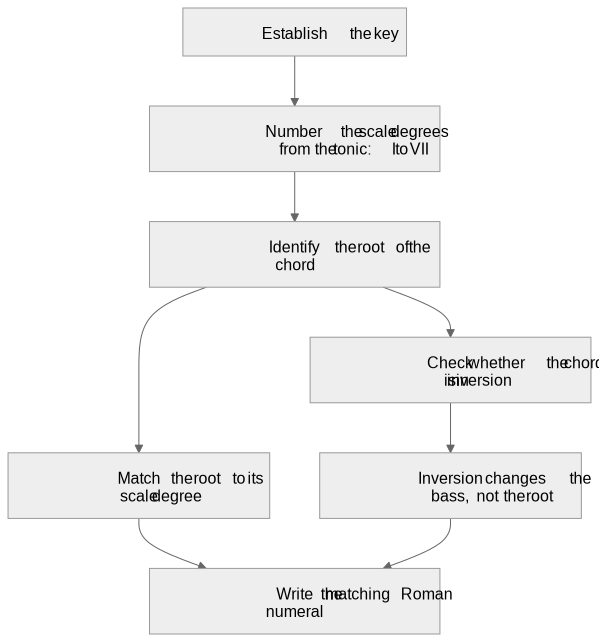
Roman numerals label triads in traditional harmony by the scale degree that forms the chord's root, not by the lowest sounding note. Number the degrees of the key from tonic upwards: in C major, C is 1, D is 2, E is 3, F is 4, G is 5, A is 6 and B is 7, written I to VII. Build the triad on the chosen degree using notes of that scale, then name it with the numeral of its root. The chord D–F–A has root D, the second degree of C major, so it is labelled II. If the same notes appeared with F in the bass, the root would still be D and the label would remain II, because inversion changes the bass, not the root. Work method: identify the key, find which scale degree matches the chord's root, then write the matching numeral.
What earns the marks
- Roman numerals run from I to VII and correspond to the seven degrees of the scale, with I on the tonic.
- The numeral is chosen by the root of the chord, that is, the scale degree on which the triad is built.
- In C major the second degree is D, so the triad D–F–A, rooted on D, is labelled II.
- The label is not decided by the lowest sounding note; an inversion keeps the same root and therefore the same numeral.
- To label a chord, first establish the key, then match the chord's root to its scale degree and write the corresponding numeral.
Common mistakes and how to put them right
Choosing the numeral from the bass note rather than the root.
Put it right by identifying the root of the triad first, then numbering that scale degree.
Counting scale degrees from the wrong tonic.
Put it right by naming the key and its tonic before numbering upwards to VII.
Assuming the numeral depends on the chord's quality or on the notes' vertical order.
Put it right by remembering the numeral records the root's scale degree only.
Exam tips
- Always state the key first, then count scale degrees from its tonic to locate the root.
- Check whether the given chord is in inversion; if so, keep the numeral of the root, not of the bass.
- Practise with several keys so that you can map any triad's root quickly onto I to VII.
Try the lesson
The start of the Appendix 3: Musical vocabulary - Organisation of pitch: Roman numerals (from I to VII) are used to label chords in traditional harmony according to which degree of the scale is used as the root. Thus in C major, the chord D F A (with root D) is II lesson, made from teaching notes for this specification point.
Have a go first
In the key of F major, what is the chord labelled 'vii°'?
Listen
Roman numerals label triads in traditional harmony by the scale degree that forms the chord's root, not by the lowest sounding note. Number the degrees of the key from tonic upwards: in C major, C is 1, D is 2, E is 3, F is 4, G is 5, A is 6 and B is 7, written I to VII. Build the triad on the chosen degree using notes of that scale, then name it with the numeral of its root. The chord D–F–A has root D, the second degree of C major, so it is labelled II. If the same notes appeared with F in the bass, the root would still be D and the label would remain II, because inversion changes the bass, not the root. Work method: identify the key, find which scale degree matches the chord's root, then write the matching numeral. A strong answer earns marks for these points. Roman numerals run from I to VII and correspond to the seven degrees of the scale, with I on the tonic. The numeral is chosen by the root of the chord, that is, the scale degree on which the triad is built. In C major the second degree is D, so the triad D–F–A, rooted on D, is labelled II. The label is not decided by the lowest sounding note; an inversion keeps the same root and therefore the same numeral. A common slip: Choosing the numeral from the bass note rather than the root. Instead, identifying the root of the triad first, then numbering that scale degree. Exam tip: Always state the key first, then count scale degrees from its tonic to locate the root.
See it
Key words
Say what each word means before you turn the card.
Roman numeral labelling of chords
Try answering aloud or in your head before turning the card.
Scale degrees and the tonic as reference point
Try answering aloud or in your head before turning the card.
Root versus bass note
Try answering aloud or in your head before turning the card.
Traditional harmony in a named key
Try answering aloud or in your head before turning the card.
See every definition
- Roman numeral labelling of chords
- Numerals from I to VII label chords in traditional harmony according to which degree of the scale is used as the root.
- Scale degrees and the tonic as reference point
- The degrees of the key are numbered from the tonic upwards, written I to VII, with I on the tonic.
- Root versus bass note
- The numeral is chosen by the root, the scale degree on which the triad is built, not by the lowest sounding note.
- Traditional harmony in a named key
- To label a chord, first establish the key, then match the chord's root to its scale degree and write the corresponding numeral.
Label the diagram
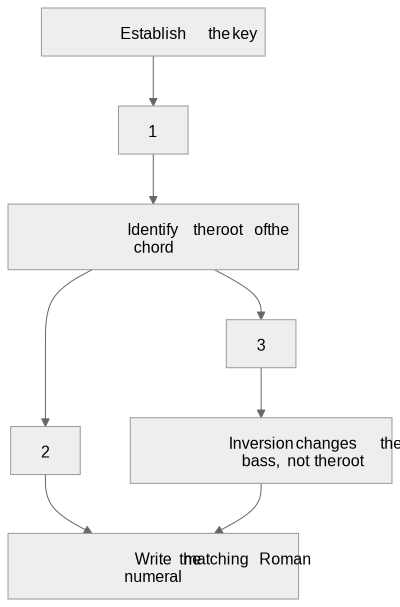
Some boxes have lost their names. Pick the right name for each number.
1Box 1
2Box 2
3Box 3
There is more to this lesson
The full lesson goes on to check your understanding and help you earn the marks. Create a free account to carry on, with your progress saved.
A week of Premium from your first lesson · Then the free plan continues · No card, no charge
Test your understanding of Appendix 3: Musical vocabulary - Organisation of pitch: Roman numerals (from I to VII) are used to label chords in traditional harmony according to which degree of the scale is used as the root. Thus in C major, the chord D F A (with root D) is II
Active recall beats re-reading. Take an instant quiz now to test what you’ve learned and lock it into long-term memory.
A week of Premium from your first lesson · Then the free plan continues · No card, no charge