Pearson Edexcel · GCSE · Music
Course version: 1MU0 · Version from Sept 2016
Musical vocabulary - Organisation of pitch: An arpeggio has the notes of a…
Full specification wording
Appendix 3: Musical vocabulary - Organisation of pitch: An arpeggio has the notes of a chord played in succession rather than together, strictly in continuously ascending or descending order. The term ‘broken chord’ is sometimes used as a synonym (the notes of the chord thus broken often occurring in any order)
A chord is a set of notes sounded together.
- Point 2 of 27
- 4 key terms
Study notes
From the teaching notes for this specification point.
The idea
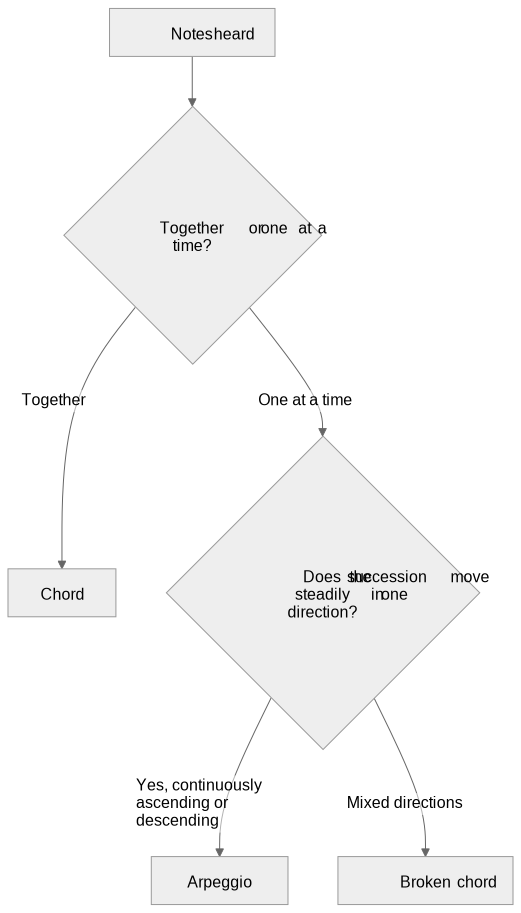
A chord is a set of notes sounded together. An arpeggio takes the same notes but plays them one after another, and strictly in continuously ascending or descending order, so the listener hears each note of the chord in turn rather than as a block. For example, a chord built on C, E and G played as C then E then G is an arpeggio going up; played G then E then C it is an arpeggio going down. The term ‘broken chord’ is sometimes used as a synonym, but with a looser meaning: the notes of the chord are broken apart and may occur in any order, not necessarily a continuous rise or fall. In listening questions, decide first whether the notes sound together (a chord) or one at a time (arpeggio or broken chord), then check whether the order moves steadily in one direction. If the notes leap about in mixed directions, ‘broken chord’ is the safer description.
What earns the marks
- A chord consists of notes sounded together; an arpeggio presents the same notes one after another.
- An arpeggio strictly moves in continuously ascending or descending order.
- ‘Broken chord’ is sometimes used as a synonym for arpeggio.
- In a broken chord the notes may occur in any order, not necessarily a continuous rise or fall.
- To identify one by ear, check whether notes sound together or in succession, then whether the succession moves steadily in one direction.
Common mistakes and how to put them right
Treating arpeggio and chord as the same thing.
Put it right: A chord sounds notes together; an arpeggio plays them in succession.
Believing an arpeggio may jump up and down freely.
Put it right: An arpeggio moves strictly in continuously ascending or descending order.
Assuming ‘broken chord’ must follow the same strict order as an arpeggio.
Put it right: Broken-chord notes may occur in any order.
Exam tips
- First decide whether the notes are heard together or one at a time before choosing a term.
- Check the direction of movement: a steady rise or fall supports ‘arpeggio’.
- If the notes of the chord appear in mixed order, choose ‘broken chord’ rather than ‘arpeggio’.
Try the lesson
The start of the Appendix 3: Musical vocabulary - Organisation of pitch: An arpeggio has the notes of a chord played in succession rather than together, strictly in continuously ascending or descending order. The term ‘broken chord’ is sometimes used as a synonym (the notes of the chord thus broken often occurring in any order) lesson, made from teaching notes for this specification point.
Have a go first
Which of the following best describes an arpeggio?
Listen
A chord is a set of notes sounded together. An arpeggio takes the same notes but plays them one after another, and strictly in continuously ascending or descending order, so the listener hears each note of the chord in turn rather than as a block. For example, a chord built on C, E and G played as C then E then G is an arpeggio going up; played G then E then C it is an arpeggio going down. The term ‘broken chord’ is sometimes used as a synonym, but with a looser meaning: the notes of the chord are broken apart and may occur in any order, not necessarily a continuous rise or fall. In listening questions, decide first whether the notes sound together (a chord) or one at a time (arpeggio or broken chord), then check whether the order moves steadily in one direction. If the notes leap about in mixed directions, ‘broken chord’ is the safer description. A strong answer earns marks for these points. A chord consists of notes sounded together; an arpeggio presents the same notes one after another. An arpeggio strictly moves in continuously ascending or descending order. Broken chord’ is sometimes used as a synonym for arpeggio. In a broken chord the notes may occur in any order, not necessarily a continuous rise or fall. A common slip: Treating arpeggio and chord as the same thing. Instead, a chord sounds notes together; an arpeggio plays them in succession. Exam tip: First decide whether the notes are heard together or one at a time before choosing a term.
See it
Key words
Say what each word means before you turn the card.
Arpeggio
Try answering aloud or in your head before turning the card.
Broken chord
Try answering aloud or in your head before turning the card.
Chord
Try answering aloud or in your head before turning the card.
Aural identification
Try answering aloud or in your head before turning the card.
See every definition
- Arpeggio
- The notes of a chord played in succession rather than together, strictly in continuously ascending or descending order.
- Broken chord
- Sometimes used as a synonym for arpeggio, but with a looser meaning: the notes of the chord are broken apart and may occur in any order.
- Chord
- A set of notes sounded together.
- Aural identification
- Deciding by ear whether notes sound together or one at a time, then whether the succession moves steadily in one direction.
There is more to this lesson
The full lesson goes on to check your understanding and help you earn the marks. Create a free account to carry on, with your progress saved.
A week of Premium from your first lesson · Then the free plan continues · No card, no charge
Test your understanding of Appendix 3: Musical vocabulary - Organisation of pitch: An arpeggio has the notes of a chord played in succession rather than together, strictly in continuously ascending or descending order. The term ‘broken chord’ is sometimes used as a synonym (the notes of the chord thus broken often occurring in any order)
Active recall beats re-reading. Take an instant quiz now to test what you’ve learned and lock it into long-term memory.
A week of Premium from your first lesson · Then the free plan continues · No card, no charge