Pearson Edexcel · GCSE · Music
Course version: 1MU0 · Version from Sept 2016
Musical vocabulary - Organisation of pitch: The lowest part in the musical…
Full specification wording
Appendix 3: Musical vocabulary - Organisation of pitch: The lowest part in the musical texture, which often determines or generates the harmony. A Baroque ‘figured bass’ has numerals underneath to indicate the chords to be ‘realised’ by the continuo keyboard player. A ‘murky’ bass has a pattern of broken octaves (as in parts of Beethoven’s Pathétique sonata)
The bass is the lowest part in a musical texture, and because it sits underneath the other parts it often determines or generates the harmony above it.
- Point 4 of 27
- 3 key terms
Study notes
From the teaching notes for this specification point.
The idea
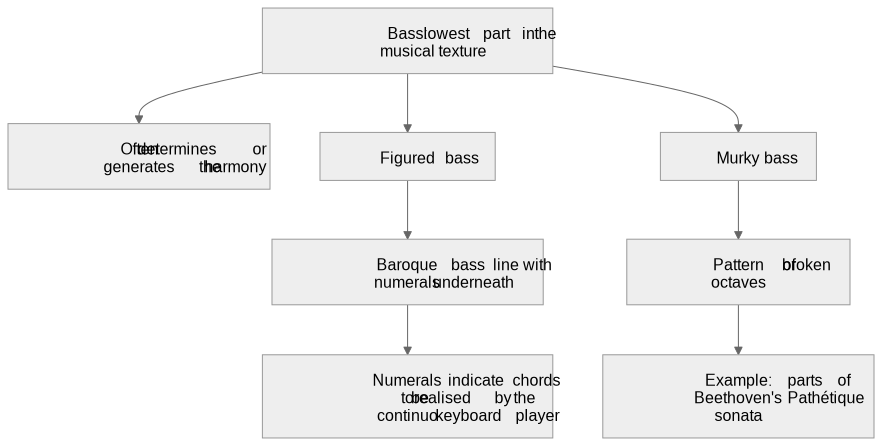
The bass is the lowest part in a musical texture, and because it sits underneath the other parts it often determines or generates the harmony above it. Two named types matter here. A Baroque figured bass is a bass line with numerals written underneath; these numerals tell the continuo keyboard player which chords to realise, that is, to fill in above the given bass. A murky bass is a bass that moves in a pattern of broken octaves, leaping between a note and its octave; the specification cites parts of Beethoven's Pathétique sonata as an example. To answer questions, decide whether the bass is a plain lowest line, a figured bass with numerals for realisation, or a broken-octave murky bass, and link each to its harmonic role.
What earns the marks
- The bass is the lowest part in the musical texture.
- The bass often determines or generates the harmony.
- A figured bass is a Baroque bass line with numerals underneath.
- The numerals indicate chords to be realised by the continuo keyboard player.
- A murky bass uses a pattern of broken octaves.
- Beethoven's Pathétique sonata is cited as containing murky bass passages.
Common mistakes and how to put them right
Describing the bass as the highest or melody part.
Put it right: It is the lowest part in the texture.
Thinking figured-bass numerals are melody notes.
Put it right: They indicate chords to be realised by the continuo player.
Confusing murky bass with any repeated bass note.
Put it right: It specifically uses a pattern of broken octaves.
Exam tips
- State the bass's position as the lowest part before explaining its harmonic role.
- For figured bass, mention both the numerals underneath and the continuo player realising chords.
- For murky bass, name the broken-octave pattern and, where relevant, the Pathétique sonata example.
Try the lesson
The start of the Appendix 3: Musical vocabulary - Organisation of pitch: The lowest part in the musical texture, which often determines or generates the harmony. A Baroque ‘figured bass’ has numerals underneath to indicate the chords to be ‘realised’ by the continuo keyboard player. A ‘murky’ bass has a pattern of broken octaves (as in parts of Beethoven’s Pathétique sonata) lesson, made from teaching notes for this specification point.
Have a go first
In Baroque music, what is the primary function of the figures (numerals) written under the bass line in a figured bass?
Listen
The bass is the lowest part in a musical texture, and because it sits underneath the other parts it often determines or generates the harmony above it. Two named types matter here. A Baroque figured bass is a bass line with numerals written underneath; these numerals tell the continuo keyboard player which chords to realise, that is, to fill in above the given bass. A murky bass is a bass that moves in a pattern of broken octaves, leaping between a note and its octave; the specification cites parts of Beethoven's Pathétique sonata as an example. To answer questions, decide whether the bass is a plain lowest line, a figured bass with numerals for realisation, or a broken-octave murky bass, and link each to its harmonic role. A strong answer earns marks for these points. The bass is the lowest part in the musical texture. The bass often determines or generates the harmony. A figured bass is a Baroque bass line with numerals underneath. The numerals indicate chords to be realised by the continuo keyboard player. A common slip: Describing the bass as the highest or melody part. Instead, it is the lowest part in the texture. Exam tip: State the bass's position as the lowest part before explaining its harmonic role.
See it
Key words
Say what each word means before you turn the card.
Bass
Try answering aloud or in your head before turning the card.
Figured bass
Try answering aloud or in your head before turning the card.
Murky bass
Try answering aloud or in your head before turning the card.
See every definition
- Bass
- The lowest part in the musical texture, which often determines or generates the harmony.
- Figured bass
- A Baroque bass line with numerals underneath to indicate the chords to be realised by the continuo keyboard player.
- Murky bass
- A bass with a pattern of broken octaves, as in parts of Beethoven's Pathétique sonata.
Label the diagram
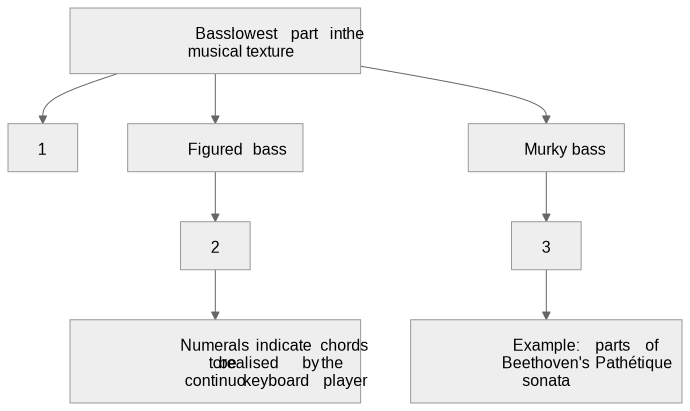
Some boxes have lost their names. Pick the right name for each number.
1Box 1
2Box 2
3Box 3
There is more to this lesson
The full lesson goes on to check your understanding and help you earn the marks. Create a free account to carry on, with your progress saved.
A week of Premium from your first lesson · Then the free plan continues · No card, no charge
Test your understanding of Appendix 3: Musical vocabulary - Organisation of pitch: The lowest part in the musical texture, which often determines or generates the harmony. A Baroque ‘figured bass’ has numerals underneath to indicate the chords to be ‘realised’ by the continuo keyboard player. A ‘murky’ bass has a pattern of broken octaves (as in parts of Beethoven’s Pathétique sonata)
Active recall beats re-reading. Take an instant quiz now to test what you’ve learned and lock it into long-term memory.
A week of Premium from your first lesson · Then the free plan continues · No card, no charge