Pearson Edexcel · GCSE · Music
Course version: 1MU0 · Version from Sept 2016
Composing - Brief 1: Instrumental Music 1700–1820: Students should study…
Full specification wording
Component 2: Composing - Brief 1: Instrumental Music 1700–1820: Students should study instrumental forms which facilitate the development and extension of an opening melody such as binary form, ternary, rondo, theme and variations and fantasia.
Within the 1700–1820 instrumental brief, learn how five forms take an opening melody and develop or extend it.
- Point 1 of 2
- 4 key terms
Study notes
From the teaching notes for this specification point.
The idea
Within the 1700–1820 instrumental brief, learn how five forms take an opening melody and develop or extend it. Binary form presents two related sections, often repeated, with contrast between them. Ternary form sets a first section, a contrasting middle, then a return of the first. Rondo keeps returning to a principal theme between contrasting episodes. Theme and variations states a melody then reshapes it through changes of rhythm, harmony, texture, ornamentation or mode. Fantasia is freer, using improvisatory gestures and looser structure to extend ideas. For each form, identify how the opening melodic idea is stated, altered and extended, and be ready to match a described structure to its form.
What earns the marks
- Binary form: two sections, typically with contrast and often repeated, extending an opening idea through a second related section.
- Ternary form: statement, contrasting middle section, then return of the opening material.
- Rondo: a recurring principal theme alternating with contrasting episodes.
- Theme and variations: an opening melody restated with changes in rhythm, harmony, texture, ornamentation or mode.
- Fantasia: a freer, improvisatory structure used to develop and extend melodic ideas.
Common mistakes and how to put them right
Confusing binary and ternary form.
Put it right: Binary has two sections, ternary has a statement, contrast and return.
Describing rondo as through-composed with no returns.
Put it right: Rondo is defined by its recurring principal theme.
Treating theme and variations as mere repetition.
Put it right: Each variation must alter the melody in a recognisable way.
Assuming fantasia follows a strict repeating pattern.
Put it right: Fantasia is comparatively free and improvisatory.
Exam tips
- When a question describes a structure, name the form first, then justify it by referring to the sections and any return of the opening melody.
- Learn one short example of each form so you can describe how the opening melody is developed or extended.
- Use precise vocabulary — statement, episode, return, variation — rather than vague words like 'part' or 'bit'.
Try the lesson
The start of the Component 2: Composing - Brief 1: Instrumental Music 1700–1820: Students should study instrumental forms which facilitate the development and extension of an opening melody such as binary form, ternary, rondo, theme and variations and fantasia. lesson, made from teaching notes for this specification point.
Have a go first
In which form does the opening melody undergo a series of transformations, each retaining some recognizable element of the original?
Listen
Within the 1700–1820 instrumental brief, learn how five forms take an opening melody and develop or extend it. Binary form presents two related sections, often repeated, with contrast between them. Ternary form sets a first section, a contrasting middle, then a return of the first. Rondo keeps returning to a principal theme between contrasting episodes. Theme and variations states a melody then reshapes it through changes of rhythm, harmony, texture, ornamentation or mode. Fantasia is freer, using improvisatory gestures and looser structure to extend ideas. For each form, identify how the opening melodic idea is stated, altered and extended, and be ready to match a described structure to its form. A strong answer earns marks for these points. Binary form: two sections, typically with contrast and often repeated, extending an opening idea through a second related section. Ternary form: statement, contrasting middle section, then return of the opening material. Rondo: a recurring principal theme alternating with contrasting episodes. Theme and variations: an opening melody restated with changes in rhythm, harmony, texture, ornamentation or mode. A common slip: Confusing binary and ternary form. Instead, binary has two sections, ternary has a statement, contrast and return. Exam tip: When a question describes a structure, name the form first, then justify it by referring to the sections and any return of the opening melody.
See it

Key words
Say what each word means before you turn the card.
Binary form
Try answering aloud or in your head before turning the card.
Ternary form
Try answering aloud or in your head before turning the card.
Rondo
Try answering aloud or in your head before turning the card.
Theme and variations
Try answering aloud or in your head before turning the card.
See every definition
- Binary form
- Presents two related sections, often repeated, with contrast between them, extending an opening idea through a second related section.
- Ternary form
- Sets a first section, a contrasting middle, then a return of the first.
- Rondo
- Keeps returning to a principal theme between contrasting episodes.
- Theme and variations
- States a melody then reshapes it through changes of rhythm, harmony, texture, ornamentation or mode.
Label the diagram
Some boxes have lost their names. Pick the right name for each number.
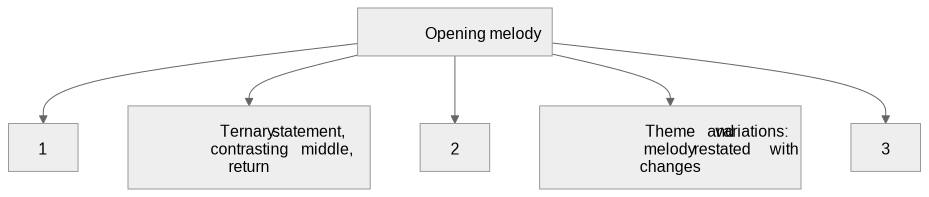
1Box 1
2Box 2
3Box 3
There is more to this lesson
The full lesson goes on to check your understanding and help you earn the marks. Create a free account to carry on, with your progress saved.
A week of Premium from your first lesson · Then the free plan continues · No card, no charge
Test your understanding of Component 2: Composing - Brief 1: Instrumental Music 1700–1820: Students should study instrumental forms which facilitate the development and extension of an opening melody such as binary form, ternary, rondo, theme and variations and fantasia.
Active recall beats re-reading. Take an instant quiz now to test what you’ve learned and lock it into long-term memory.
A week of Premium from your first lesson · Then the free plan continues · No card, no charge